


Introduction
Project management has always been about balancing scope, time, cost, quality, and stakeholder expectations. For decades, project managers relied on experience, spreadsheets, reports, and communication skills to guide projects toward successful outcomes. However, the landscape is evolving rapidly.
In 2026, Artificial Intelligence (AI) is no longer a futuristic concept. It has become a practical tool embedded within project management platforms, collaboration tools, analytics dashboards, and enterprise workflows. Solutions such as Microsoft Copilot, Azure DevOps Analytics, Jira AI, Power BI AI Insights, and other intelligent assistants are helping project teams make faster, data-driven decisions.
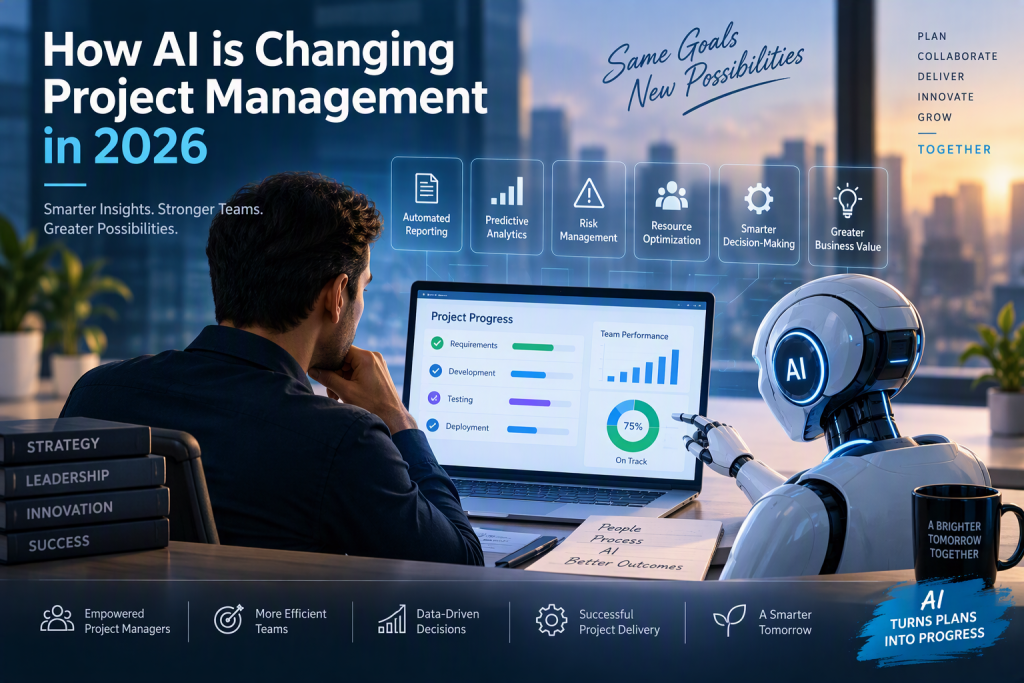
AI is not replacing project managers; rather, it is empowering them to spend less time on administrative work and more time on strategic leadership, stakeholder engagement, risk management, and value delivery.
This transformation marks one of the most significant shifts the profession has seen in decades.
The Evolution of Project Management
Traditional project management focused heavily on:
- Status reporting
- Resource tracking
- Scheduling
- Risk logs
- Meeting documentation
- Progress monitoring
While these activities remain important, many are repetitive and data-intensive.
Modern AI-driven project management introduces:
- Predictive forecasting
- Intelligent reporting
- Automated documentation
- Real-time risk identification
- Smart resource allocation
- Enhanced collaboration
Project managers are increasingly moving from “project administrators” to “strategic facilitators and decision-makers.”
Key Areas Where AI Is Transforming Project Management
1. Automated Project Reporting
One of the most time-consuming responsibilities for project managers is creating status reports.
AI-powered tools can now:
- Summarize project progress automatically
- Generate executive reports
- Highlight key risks and blockers
- Create dashboards from live project data
- Produce meeting summaries with action items
Instead of spending hours preparing reports, project managers can focus on interpreting insights and making informed decisions.
Business Impact:
- Faster reporting cycles
- Improved transparency
- Reduced manual effort
- More accurate communication
Popular AI tools:
- Microsoft Copilot for Microsoft 365
- Creates project status reports from Teams meetings, emails, and documents.Generates executive summaries automatically.
- Atlassian Intelligence (Jira AI)
- Summarizes Jira tickets and sprint progress.
- Generates release notes and project updates.
- ClickUp AI
- Produces task summaries and project reports.
- Creates automated progress updates.
- Monday AI
- Generates project health reports and updates.
2. Smarter Risk Management
Traditional risk identification depends largely on experience and manual observation.
AI can analyze:
- Historical project data
- Team velocity trends
- Defect patterns
- Requirement changes
- Resource availability
Based on these inputs, AI can predict potential risks before they become significant issues.
Example:
If a project experiences:
- Declining sprint velocity
- Increasing defect counts
- Growing backlog
AI may flag a potential delivery delay weeks before it becomes visible through traditional reporting.
This proactive approach allows teams to take corrective actions early.
Popular AI tools:
- Microsoft Copilot for Microsoft 365
- Detects declining velocity trends.
- Identifies bottlenecks impacting delivery.
- Planview
- Predictive portfolio risk analysis.
- Dependency and schedule risk detection.
- Oracle Primavera P6 Risk Analysis
- Forecasts schedule and cost risks.
- Microsoft Project for the Web
- Provides predictive project insights.
3. Intelligent Resource Planning
Finding the right person with the right skills at the right time is a constant challenge.
AI helps by:
- Matching skills to project requirements
- Identifying resource utilization patterns
- Highlighting capacity constraints
- Forecasting future staffing needs
This allows organizations to allocate resources more effectively while minimizing burnout and productivity loss.
Popular AI Tools:
- Microsoft Project
- Capacity planning and workload balancing.
- Resource forecasting.
- Resource Guru
- AI-assisted resource scheduling.
- Utilization monitoring.
- Float
- Resource forecasting and team planning.
- Runn
- Capacity planning and staffing optimization.
4. Enhanced Decision-Making Through Predictive Analytics
Project managers often need to make decisions with incomplete information.
AI-driven analytics provide:
- Schedule forecasts
- Budget projections
- Effort estimations
- Project health indicators
Instead of relying solely on intuition, project managers can leverage data-backed insights to improve accuracy and confidence.
Benefits:
- Better planning
- Reduced uncertainty
- Earlier intervention
- Improved delivery predictability
Popular AI tools:
- Power BI with AI Insights
- Predicts delivery timelines and performance trends.
- Creates intelligent forecasting dashboards.
- Tableau Pulse
- AI-driven business analytics and trend analysis.
- Azure Machine Learning
- Advanced predictive modeling.
- Jira Align
- Predictive delivery forecasting.
5. Meeting and Communication Optimization
Meetings remain essential, but project teams often lose valuable time documenting discussions and tracking action items.
AI tools can now:
- Transcribe meetings automatically
- Identify action items
- Assign responsibilities
- Generate summaries
- Track commitments across discussions
This ensures accountability and reduces the risk of missing important decisions.
Popular AI tools:
- Microsoft Teams Premium + Copilot
- Meeting transcription.
- Automatic action item extraction.
- Meeting recap generation.
- Otter.ai
- Live transcription and summaries.
- Fireflies.ai
- Records conversations.
- Identifies decisions and action items.
- Zoom AI Companion
- Creates meeting summaries.
- Tracks follow-up actions.
6. Faster Requirement Analysis
Understanding and analyzing requirements is a critical phase of any project.
AI can support teams by:
- Summarizing lengthy documents
- Identifying requirement gaps
- Detecting inconsistencies
- Suggesting user stories
- Highlighting dependencies
This improves requirement quality and reduces ambiguity before development begins.
Popular AI tools:
- Microsoft Copilot
- Summarizes Business Requirement Documents (BRDs).
- Identifies requirement gaps.
- Jama Connect AI
- Requirement traceability.
- Impact analysis.
- IBM Engineering Requirements Management DOORS Next
- Requirement validation.
- Dependency management.
- ChatGPT Enterprise / Copilot Chat
- Converts requirements into user stories.
- Generates acceptance criteria.
Advantages of AI in Project Management
1. Increased Productivity
Routine administrative tasks can be automated, allowing project managers to focus on higher-value work.
Examples
- Status reports
- Meeting summaries
- Risk reports
- Progress tracking
2. Improved Accuracy
AI reduces human error in:
- Estimation
- Scheduling
- Forecasting
- Reporting
Data-driven recommendations often lead to more reliable outcomes.
3. Better Risk Visibility
Organizations can identify risks earlier and respond proactively rather than reactively.
This leads to:
- Fewer surprises
- Better planning
- Reduced project disruption
4. Enhanced Stakeholder Communication
AI-generated insights allow stakeholders to receive:
- Real-time updates
- Clear project health indicators
- Actionable recommendations
As a result, decision-making becomes faster and more informed.
5. Greater Team Efficiency
AI helps teams spend less time on repetitive tasks and more time delivering business value.
This contributes to:
- Higher productivity
- Improved morale
- Faster project delivery
Disadvantages of AI in Project Management
While AI offers tremendous opportunities, it also presents several challenges.
1. Overdependence on Technology
Excessive reliance on AI may reduce critical thinking and decision-making capabilities.
Project managers must remember that AI provides recommendations, not final decisions.
Human judgment remains essential.
2. Data Quality Concerns
AI systems are only as reliable as the data they analyze.
Poor data quality can result in:
- Incorrect predictions
- Misleading recommendations
- Faulty decision-making
Organizations must maintain strong data governance practices.
3. Privacy and Security Risks
AI solutions often process large volumes of project and organizational data.
Key concerns include:
- Confidential information exposure
- Data privacy compliance
- Security vulnerabilities
Proper governance and security controls are essential.
4. Change Resistance
Not all teams readily adopt AI-driven processes.
Common concerns include:
- Fear of job replacement
- Lack of trust in AI recommendations
- Learning curve challenges
Successful adoption requires training, communication, and change management.
5. Initial Investment and Adoption Costs
Implementing AI technologies may require:
- New tools and licenses
- Process changes
- Employee training
- Integration efforts
Organizations should evaluate both short-term costs and long-term value.
Essential Skills for the AI-Empowered Project Manager
As AI becomes more integrated into project delivery, project managers must develop new competencies.
1. Data Literacy: Understanding project metrics and analytics.
2. Strategic Thinking: Focusing on business outcomes rather than task administration.
3. Change Management: Helping teams adapt to new technologies and processes.
4. Critical Decision-Making: Validating AI-generated recommendations with human judgment.
5. Stakeholder Management: Ensuring alignment between technology adoption and business goals.
The future project manager will combine leadership, business acumen, and technology awareness.
The Human Element: Why Project Managers Remain Essential
Despite rapid advances in AI, successful projects still depend on human capabilities that technology cannot fully replicate.
These include:
- Building stakeholder trust
- Negotiating conflicting priorities
- Managing organizational politics
- Leading teams through uncertainty
- Motivating people
- Exercising ethical judgment
Projects are ultimately delivered by people, and effective leadership remains irreplaceable.
AI can process vast amounts of data, but it cannot fully understand human emotions, organizational culture, or nuanced business relationships.
This is where project managers continue to create immense value.
Looking Ahead: The Future of Project Management
Over the next few years, we can expect AI to become even more deeply integrated into project delivery ecosystems.
Future capabilities may include:
- Autonomous project monitoring
- Predictive budget management
- Intelligent capacity planning
- AI-assisted project governance
- Advanced portfolio optimization
Organizations that embrace these innovations responsibly will gain a significant competitive advantage through improved efficiency, faster decision-making, and enhanced delivery outcomes.
Conclusion
Artificial Intelligence is redefining project management in 2026 by automating routine activities, improving forecasting accuracy, strengthening risk management capabilities, and enabling data-driven decision-making.
However, AI should not be viewed as a replacement for project managers. Instead, it serves as an intelligent assistant that augments human expertise and enhances productivity.
The most successful project managers of the future will be those who can effectively combine technological capabilities with leadership, communication, strategic thinking, and business understanding.
As AI continues to evolve, the profession itself is evolving with it, moving beyond task tracking and administrative oversight toward delivering meaningful business value. Those who embrace this transformation today will be best positioned to lead the projects, teams, and organizations of tomorrow.
If you want to learn about the automating-daily-status-reports-using-excel-power-automate-and-outlook, please click here.