


Introduction
ITIL (Information Technology Infrastructure Library) 4 is the latest version of the global best practice framework for IT Service Management (ITSM), released by Axelos in Feb 2019.
For over three decades, ITIL has provided direction, training, and certification programs that have set the standard for the ITSM industry, by adopting new methods of working such as Lean, Agile, and DevOps and reshaping many of the traditional ITSM practices in the broader context of value streams and customer experience.
History of ITIL

The benefits of ITIL 4
This framework is specifically designed to offer practical guidance organizations need to address new service management challenges and utilize the potential of modern technology, on how to adopt and adapt ITIL to deliver value and achieve business outcomes smoothly and cost-effectively in a digital world.
ITIL’s adaptable models and processes enable organizations to maintain high service standards while continuously improving end-to-end services. An organization can define its IT services, match those services to the particular needs of its clients, and create an explicit strategy for continuous success with the aid of the ITIL Framework. Because of ITIL’s modular design, improvements and implementation can proceed progressively.
The following qualities contribute to ITIL’s success:
- Vendor Neutrality: ITIL is owned by the U.K. government and has no associations to any commercial proprietary practices or solutions.
- Nonprescriptive: ITIL recommended the approach of “adopt and adapt” to the guidance it offers.
- Best Practices: ITIL accumulated knowledge and guidance from the best sources of service management practices across the world.
The key benefits of ITIL 4 include:
- A modular design that promotes continuous improvements.
- A Service Value Chain that incorporates the ITIL Framework across the entire organization.
- Innovative approaches to enhancing service effectiveness.
- Global quality standards for IT service delivery.
ITIL 4 key components
The Four dimensions models and the Service Value System (SVS) are the key components of ITIL framework.
Four dimensions model
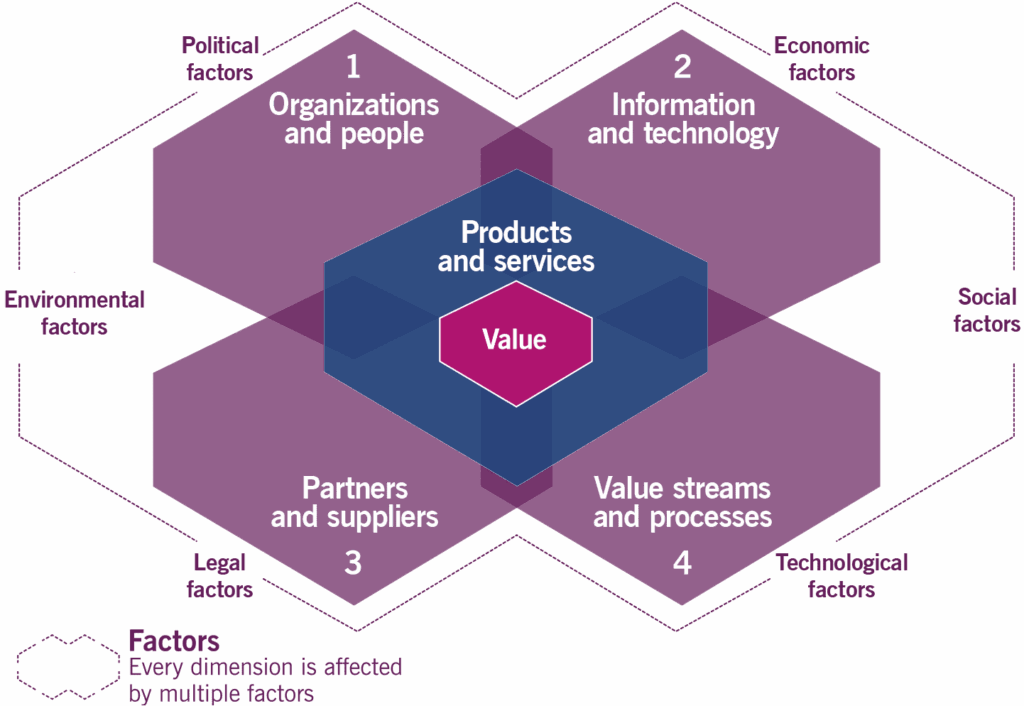
ITIL 4 defines four dimensions that should be considered to ensure a holistic approach to service management:
- Organizations and people.
- Information and technology.
- Partners and suppliers.
- Value streams and processes.
These dimensions are applicable to the Service Value System in general and to specific services.
Service Value System
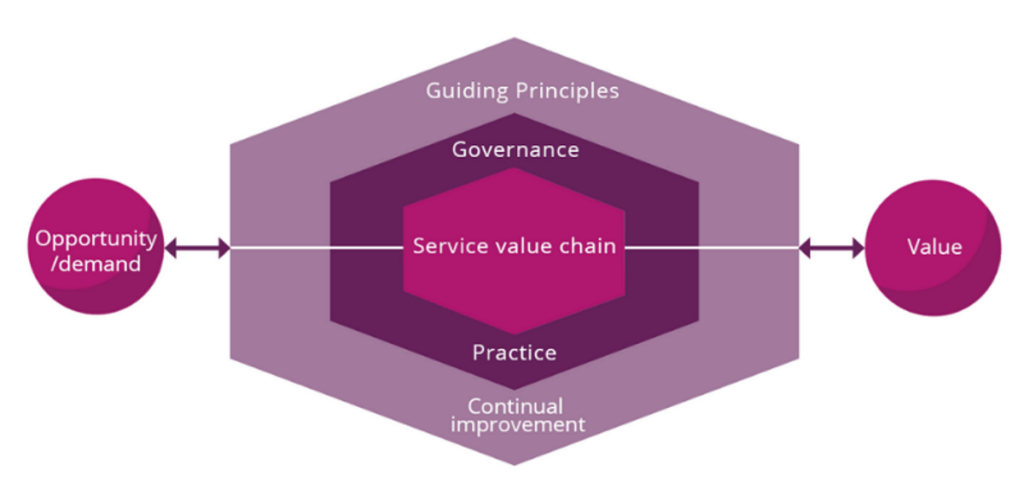
The Service Value System (SVS) represents how the various components and activities of the organization work together to facilitate value creation through IT-enabled services. The ITIL 4 SVS includes crucial elements:
- Guiding principles.
- Governance.
- Service value chain.
- 34 Practices.
- Continual improvement.
Conclusion
Businesses now operate in a digital environment that is changing quickly. The structure and operations of them are integrated with an abundance of IT solutions and services. In response to these changes, the ITIL 4 Framework has evolved and is now capable of offering best practices for all IT services to organizations to navigate the digital transformation and new methods of operation aimed at increasing service effectiveness.
Organizations can enhance the reliability, security, and cost-effectiveness of their IT services by complying to ITIL best practices. When putting in place the appropriate ITIL procedures and practices that address their unique requirements, organizations can achieve a competitive edge by offering quicker response times, and better higher-quality service.
In case you are interested in this topic, a number of blog posts that go into greater detail about ITIL’s concepts, essential elements, and particular guidelines will be released soon.