



Unleash Java’s Power: A Deep Dive into Version 21 Features (LTS!)

Ever felt like Java code held you back? Like building intricate structures with clunky wooden blocks? That frustration ends now. The arrival of Java 21, the new Long-Term Support (LTS) version, explodes onto the scene like a tech-fueled fireworks display, packed with features that ignite developer dreams and empower you to craft code like never before.
Extracting data with record patterns, weaving lightweight virtual threads into your applications, and enforcing airtight type safety with sealed classes – it’s a programmer’s paradise! But wait, there’s more! Java 21 is an LTS release, guaranteeing stability and support.
Java 21 has released many intersting featured including preview as well as closed/delivered versions.
- String Templates (Preview)
- Sequenced Collections
- Generational ZGC
- Record Patterns
- Pattern Matching for switch
- Foreign Function & Memory API (Third Preview)
- Unnamed Patterns and Variables (Preview)
- Virtual Threads
- Unnamed Classes and Instance Main Methods (Preview)
- Scoped Values (Preview)
- Vector API (Sixth Incubator)
- Deprecate the Windows -bit x Port for Removal
Prepare to Disallow the Dynamic Loading of Agents - Key Encapsulation Mechanism API
Structured Concurrency (Preview)
This article will delve into the latest closed/delivered features, unveil practical examples, and explore their impact.
Key features
1. Record patterns
Remember the days of wrestling with getters and setters, manually extracting data from complex objects? Java 21 introduces record patterns, a revolutionary tool that transforms data deconstruction with clarity and ease. They represent a paradigm shift in how you interact with data.
This simple concept unleashes a wave of advantages:
- Conciseness: Ditch the boilerplate code; record patterns express data extraction in a single, expressive line.
- Readability: The code becomes self-documenting, reflecting the structure of your data directly. No more deciphering method names or wondering where the information resides.
- Immutability: Record patterns seamlessly work with immutable records, promoting safer and more predictable code behavior.
- Declarative Style: Focus on the “what” data you need, leaving the “how” to the compiler, enhancing code cleanliness and maintainability.
- Destructure nested records: Imagine accessing data from deeply nested structures with the same ease as flat ones. No more chaining getter calls – record patterns handle the complexity transparently.
- Bind variables: Capture extracted data into named variables, further improving code readability and avoiding the clutter of temporary variables.
- Pattern matching: Combine record patterns with switch statements for powerful conditional logic based on record structure.
2. Virtual threads
Virtual threads revolutionize concurrent programming by offering a lightweight alternative to traditional (aka Platform) threads, paving the way for smoother performance and efficient resource utilisation. By embracing their lightweight nature and efficient management, you can unlock applications that scale effortlessly and respond with lightning speed.
Mechanics
- Virtual Thread Pool: Imagine a pool of lightweight carriers, ready to transport tasks. The virtual thread pool holds a limited number of platform threads (the “carriers”) that efficiently execute virtual threads (the “passengers”).
- Fork-Join Framework: Think of this as a traffic control system. It intelligently assigns tasks to available carriers in the pool, ensuring optimal utilisation and smooth flow.
- Blocking Transparency: When a virtual thread encounters a blocking operation, it doesn’t hold up a carrier. Instead, it parks itself, allowing the carrier to handle other tasks until the operation completes. This transparency prevents performance bottlenecks.
Benefits
- Scalability: Say goodbye to limitations! You can create millions of virtual threads without burdening your system, enabling applications to handle vast workloads seamlessly.
- Responsiveness: Forget about context switching bottlenecks. Virtual threads are lightweight, minimizing context switching overhead and leading to significantly improved responsiveness.
- Resource Efficiency: They require minimal memory compared to traditional threads, freeing up valuable resources for other tasks and improving overall system performance.
- Simplicity: Managing millions of virtual threads can be daunting. Java 21 takes care of that, handling scheduling and resource allocation transparently, freeing you to focus on your application logic.
3. Sealed classes
The inheritance hierarchy in Java can sometimes resemble a tangled jungle, leading to confusion and potential errors. Sealed classes are more than just a technical feature; they represent a shift in thinking about inheritance. By embracing them, you can cultivate cleaner, more maintainable, and type-safe code, ensuring your software thrives like a well-tended hierarchy.
Mechanism
- The
sealedKeyword: This keyword declares a class as sealed, essentially locking the gate, preventing unauthorized subclasses from entering. - Permitted Subclasses: You can explicitly list the classes allowed to extend the sealed class, ensuring only approved “seeds” are planted in your garden.
- Compiler Checks: The compiler diligently enforces the subclassing rules, catching any attempts to plant forbidden seeds, preventing potential errors and ensuring type safety.
Benefits
- Enhanced Type Safety: By explicitly defining permitted subclasses, you prevent accidental or unintended inheritance, leading to more robust and predictable code behavior. Imagine knowing exactly what kind of fruit (subclass) grows on each tree (class) in your garden – no more surprises!
- Improved Code Organization: Sealed classes help structure your code into well-defined hierarchies, making it easier to understand, maintain, and refactor. Think of neatly labeled sections in your garden, each section housing specific types of plants, making navigation and care much simpler.
- Pattern Matching: Combined with switch expressions, sealed classes enable powerful pattern matching within the inheritance hierarchy. You can write concise and expressive code that directly interacts with different subclasses based on their specific types. Imagine having a tool that instantly identifies each fruit by its unique characteristics, streamlining your harvesting process.
4. Pattern Matching for Switch
Traditional switch statements relied on comparing values to constants, often leading to verbose and repetitive code. Pattern matching breaks free from this limitation, allowing you to match against variables, data structures, and even combinations of conditions, resulting in concise and readable code.
Think of pattern matching as a key that unlocks hidden information within your data. With this key, you can:
- Match against complex data structures: Extract specific fields or elements from objects, records, arrays, and maps, eliminating the need for nested if-else statements.
- Combine patterns with conditions: Add conditional logic within patterns, creating richer and more nuanced matching behavior.
- Extract data while matching: Capture values during the matching process, further reducing code redundancy and improving clarity.
Mechanics
- Pattern Syntax: Define patterns using keywords like
instanceof,==, or custom predicates. You can combine them with wildcards (_) to match any value or use specific types and values for precise comparisons. - Matching Process: The switch statement evaluates the expression and tries to match it against each pattern defined in the cases. The first pattern that successfully matches wins, and its associated code block is executed.
- Data Extraction: During matching, you can extract elements from data structures using variables within the pattern, simplifying data access and manipulation.
5. Generational ZGC
Java 21 introduces Generational Z Garbage Collector (ZGC), a revolutionary low-latency solution that sweeps away the performance hurdles, ushering in a new era of smooth and responsive applications. But what exactly is it, and how does it work?
Breaking free from Pause times:
Traditional garbage collectors rely on “stop-the-world” pauses to reclaim unused memory, leading to noticeable freezes and performance hiccups. ZGC breaks free from this paradigm, adopting a concurrent approach that reclaims memory without pausing the entire application. Think of it like cleaning your room while still living in it, ensuring seamless performance even with ongoing garbage collection.
Two Generations, Efficient Allocation:
ZGC divides the heap into two generations: Young and Old. New objects are allocated in the Young generation, and as they survive garbage collection cycles, they are promoted to the Old generation. This approach leverages the “weak generational hypothesis,” which states that most objects die young, allowing ZGC to focus its efforts on the Young generation, where memory turnover is highest.
Concurrent Marking and Sweeping:
Unlike traditional collectors, ZGC performs marking (identifying unused objects) and sweeping (reclaiming memory) concurrently with application execution. This concurrent approach minimizes pauses, ensuring smooth and responsive applications even during garbage collection peaks. Imagine small cleaning robots constantly working in the background, keeping your room tidy without disrupting your activities.
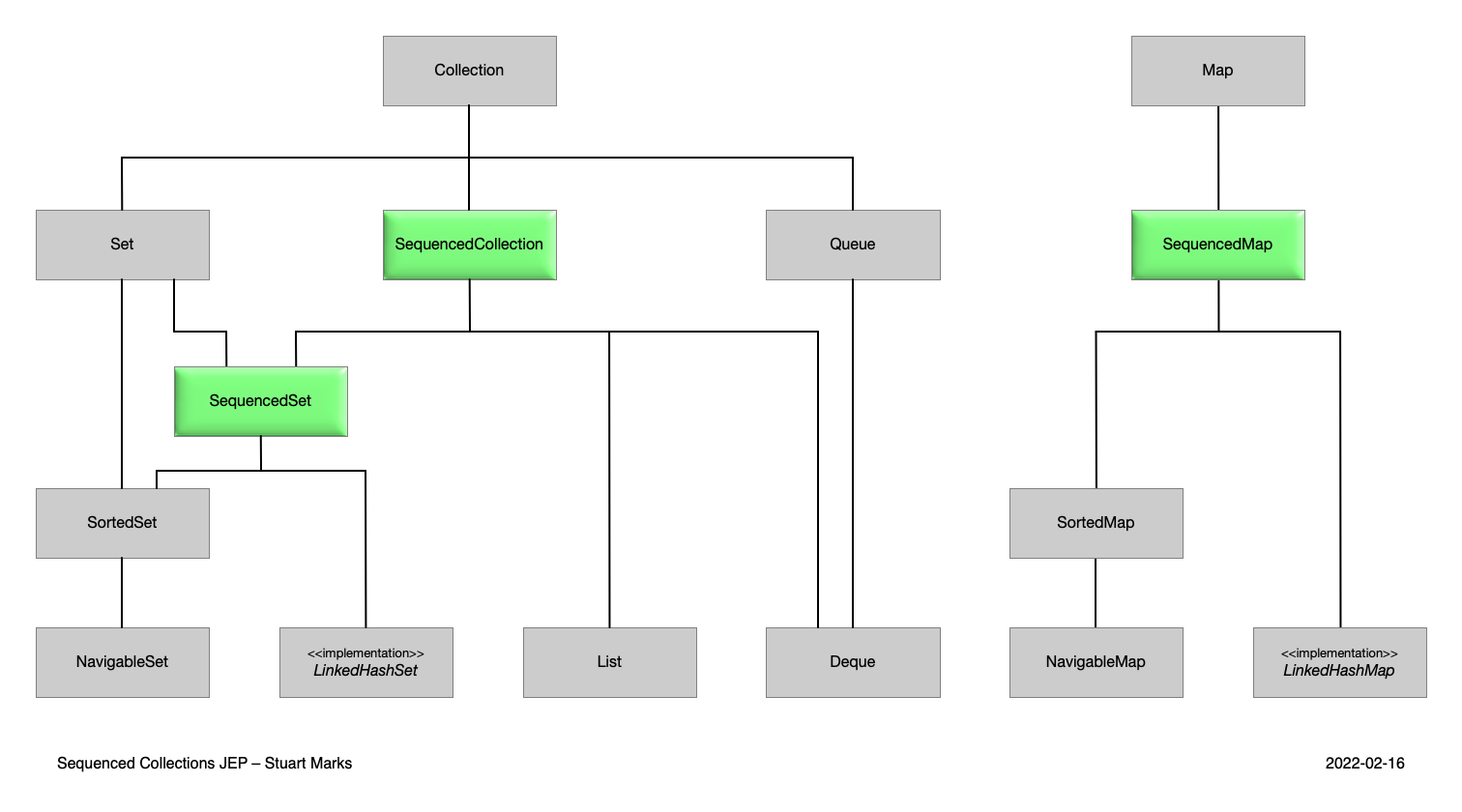
6. Sequenced Collections
Java 21 introduces a welcome change with Sequenced Collections. This isn’t a singular feature, but rather a unifying concept applied to existing interfaces like List, Deque, and SortedSet. By sharing a common API for first/last element access and forward/reverse iteration, Sequenced Collections streamline your interaction with these data structures, enhancing code clarity and consistency.
Previously, each collection type (List, Deque, SortedSet) had its own way of accessing the first and last elements, and navigating through its contents. This inconsistency could lead to confusion and boilerplate code. Sequenced Collections bridge this gap by introducing common methods:
first()andlast(): These methods provide direct access to the first and last elements of the collection, regardless of its specific type. Imagine having a universal key that unlocks any door (collection), allowing you to quickly retrieve the desired elements.forEach(Consumer<? super T> consumer): This method iterates through elements in the forward order, applying a provided consumer function to each element. Think of a universal paintbrush that works on any canvas (collection), applying the same action (consumer) to each item.descendingIterator(): This method returns an iterator that traverses the collection in reverse order, starting from the last element. Imagine having a universal telescope that allows you to explore any sky (collection) in the opposite direction.
Conclusion
Java 21 isn’t just another update; it’s a quantum leap forward, packing features that ignite developer creativity and empower you to craft applications that excel in performance, maintainability, and expressiveness.
We’ve explored record patterns, offering graceful data deconstruction and cleaner code. Virtual threads unlock lightning-fast concurrency, handling massive workloads with ease. Sealed classes bring order and type safety to your inheritance hierarchies, promoting robust and predictable code. Pattern matching for switch statements elevates your control flow to new heights, making it more expressive and intuitive. Generational ZGC frees you from pause-the-world garbage collection, ensuring smooth and responsive applications. Sequenced Collections unify your interaction with common data structures, streamlining code and enhancing readability.
Start your journey today:
- Dive deeper: Explore the features, experiment with code samples, and delve into the official documentation.
- Share your experiences: Join online communities, connect with fellow developers, and contribute to the growing Java ecosystem.
- Embrace the future: Build applications that leverage the power of Java 21, pushing the boundaries of what’s possible.