



In our previous Java 17 overview, we covered basic enhancements and optimizations. Now, let’s explore advanced features for experienced developers to build high-performance, scalable applications.
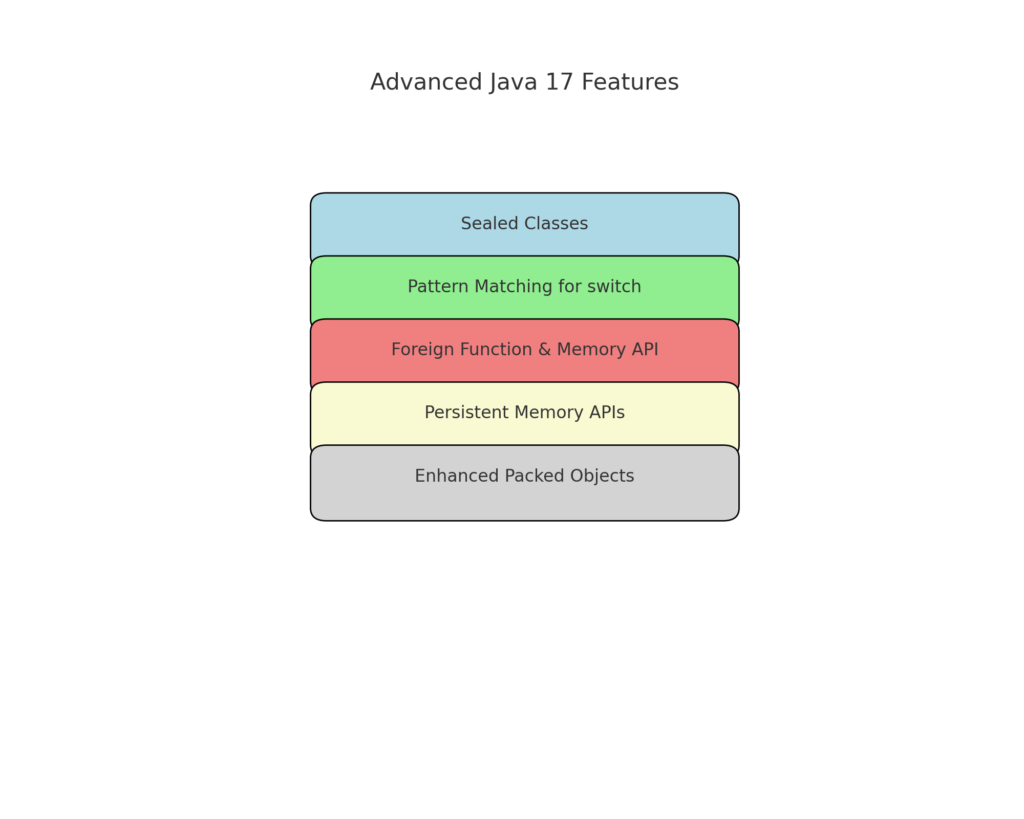
Advanced Sealed Classes
Sealed classes define controlled hierarchies, but their advanced use involves integrating them into larger projects and leveraging complex inheritance scenarios.
Example:
public abstract sealed class Shape permits Circle, Square, Rectangle {
    abstract double area();
}

public final class Circle extends Shape {
    private final double radius;

    public Circle(double radius) {
        this.radius = radius;
    }

    @Override
    double area() {
        return Math.PI * radius * radius;
    }
}

public final class Square extends Shape {
    private final double side;

    public Square(double side) {
        this.side = side;
    }

    @Override
    double area() {
        return side * side;
    }
}

public final class Rectangle extends Shape {
    private final double length;
    private final double width;

    public Rectangle(double length, double width) {
        this.length = length;
        this.width = width;
    }

    @Override
    double area() {
        return length * width;
    }
}
Enhanced Pattern Matching for switch
Advanced pattern matching allows for more sophisticated data handling within switch statements, particularly useful for processing complex data structures or performing multiple operations within a single case.
Example:
public String processData(Object obj) {
return switch (obj) {
case Integer i -> "Integer: " + (i * 2);
case String s && (s.length() > 5) -> "Long String: " + s.toUpperCase();
case null -> "Null value";
default -> "Unknown type";
};
}
Foreign Function & Memory API: Advanced Usage
The Foreign Function & Memory API opens up possibilities for high-performance computing and systems programming by facilitating direct memory access and native code interoperability. Advanced usage includes complex memory manipulations and efficient handling of large datasets.
Example:
import jdk.incubator.foreign.*;

public class AdvancedMemoryExample {
    public static void main(String[] args) {
        try (ResourceScope scope = ResourceScope.newConfinedScope()) {
            MemorySegment segment = MemorySegment.allocateNative(1024, scope);

            MemoryAddress addr = segment.baseAddress();
            MemoryAccess.setIntAtOffset(addr, 0, 42);
            int value = MemoryAccess.getIntAtOffset(addr, 0);

            System.out.println("Value: " + value);
        }
    }
}
Persistent Memory APIs: Advanced Integration
Advanced integration of persistent memory APIs can significantly enhance the performance of applications requiring high data durability and low-latency access to large datasets, such as databases and real-time analytics systems.
Example:
import jdk.incubator.pm.*;

public class AdvancedPersistentMemoryExample {
    public static void main(String[] args) {
        try (PersistentMemorySegment segment = PersistentMemorySegment.openFile("data.txt", PersistentMemorySegment.MapMode.READ_WRITE)) {
            segment.putByte(0, (byte) 42);
            byte value = segment.getByte(0);
            System.out.println("Persistent Value: " + value);
        } catch (Exception e) {
            e.printStackTrace();
        }
    }
}
Enhanced Packed Objects: Advanced Memory Optimization
For applications where memory efficiency is paramount, leveraging enhanced packed objects can lead to significant performance gains. This involves tightly packing data structures to minimize overhead and maximize cache performance.
Example:
public class AdvancedPackedObjectsExample {
    record Point(int x, int y) { }

    public static void main(String[] args) {
        Point[] points = new Point[1000];
        for (int i = 0; i < points.length; i++) {
            points[i] = new Point(i, i + 1);
        }

        // Optimized processing of packed points
        for (Point point : points) {
            System.out.println("Point: (" + point.x() + ", " + point.y() + ")");
        }
    }
}
Conclusion
Java 17 provides features and optimizations that can significantly boost application performance and scalability when used effectively. By mastering these advanced features, you can ensure your projects leverage the latest advancements in Java technology, staying ahead in the ever-evolving landscape of software development.
The new capabilities, from sealed classes and enhanced pattern matching to advanced memory management, equip developers with powerful tools to tackle complex challenges. Whether you are optimizing existing applications or developing new ones, these features facilitate cleaner, more efficient, and more maintainable code.
Embrace these advanced capabilities in Java 17 to push the boundaries of your development projects. Harness the power of modern Java to build robust, efficient, and future-proof applications that can adapt to the dynamic demands of today’s tech environment. Stay innovative, productive, and ahead of the curve with Java 17