


Introduction
In today’s fast-paced development world, Agile is more than a methodology – it’s a mindset. Agile Testing empowers QA teams to become core contributors to fast, high-quality releases. Whether you’re preparing for the ISTQB Agile Tester Extension certification or simply want to understand the tester’s role in Agile teams, this guide is here to help you get started.
Understanding Agile and the Evolving Role of Testers
Agile emphasizes iteration, rapid feedback, and close collaboration. Testers are involved from the very beginning, working closely with developers and product owners to ensure that quality is built into every stage. In Agile teams, testers do more than just execute test cases. They contribute to user story refinement, define acceptance criteria, and help the team understand quality expectations from the start.
Key Characteristics of Agile Testing
- Early Test Planning: Testers join sprint planning meetings to estimate testing effort and identify possible risks.
- Continuous Collaboration: Daily communication with developers and product owners via stand-ups and backlog grooming.
- Exploratory Testing: Encourages creativity and rapid bug detection beyond scripted test cases, especially in early builds.
- Test Automation: Essential for regression and smoke tests in fast delivery cycles.
- In-Sprint Testing: Testing happens during the sprint, reducing delays and feedback loops.
- Continuous Improvement: Testers participate in retrospectives to enhance practices and adapt to change.
Estimation and Risk in Agile Projects
Test Estimation Techniques:
- Planning Poker and T-shirt sizing help the team estimate complexity and effort.
- Testers contribute by estimating the effort required for writing test cases, automation, and exploratory testing.
- Estimation should be collaborative and revisited when story details change.
Risk-Based Testing:
- Identify quality risks during refinement or planning sessions (e.g., third-party dependencies, complex logic, tight deadlines).
- Prioritize testing efforts on high-risk areas to optimize limited testing time within sprints.
- Risks can also come from unclear requirements, lack of test data, or technical debt.
Common Techniques and Tools
- TDD (Test-Driven Development), BDD (Behavior-Driven Development): Ensure shared understanding between business and technical teams.
- ATDD (Acceptance Test Driven Development): Aligns development with customer expectations and acceptance criteria.
- Test Management Tools: JIRA, TestRail, Zephyr, and Xray.
- CI/CD Tools: Jenkins, GitLab CI, CircleCI for integrating automated tests.
What’s in the ISTQB Agile Tester Extension?
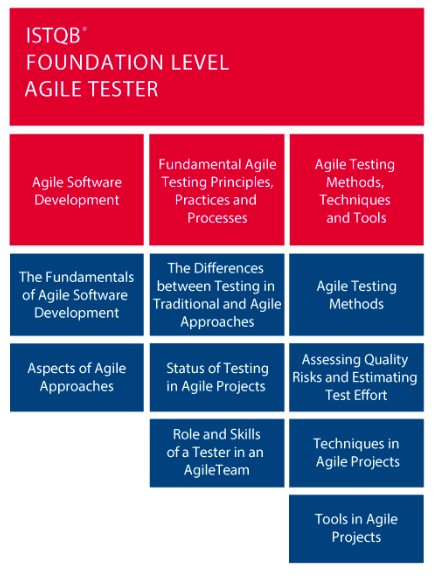
- Agile Principles and Mindset: Agile Manifesto, Scrum, Kanban, roles.
- Testing in Agile Projects: Planning, estimation, metrics, risk-based testing.
- Quality Risks and Test Levels: Unit, integration, system, acceptance.
- Techniques and Tools: Exploratory testing, automation, acceptance criteria writing.
📌 The exam includes 40 multiple-choice questions in 60 minutes. If English is not your native language, you get 75 minutes. You need 65% to pass. Available online or at test centers.
How to Prepare for the ISTQB Agile Tester Exam?
- Understand the Syllabus
Download and read the official ISTQB Agile Tester syllabus. - Familiarize with Key Terms
Use the ISTQB Glossary to understand testing vocabulary in an Agile context. - Practice with Mock Tests
Use apps like ISTQB Q‑Boost, or official sample questions to get familiar with question formats.
Start by doing practice questions by chapter to reinforce your understanding of each topic.
Then, take full mock exams with time limits (60 or 75 minutes) to simulate the real test experience and build time management skills. - Focus Areas for Study:
- Agile principles & tester mindset
- Agile ceremonies and the tester’s role
- Differences in test planning and documentation in Agile
- Risk-based testing and estimation
- BDD, TDD, ATDD – understand differences and examples
- Role of automation in Agile
- Metrics: burndown charts, velocity, test progress
- Take Notes & Revise Often
Create flashcards for key concepts or use spaced repetition tools to retain knowledge longer.
Why Should You Take This Certification?
- Proves your adaptability to Agile environments.
- Opens doors to roles like Agile Test Lead or QA Coach.
- Helps bridge communication between dev and business teams.
Conclusion
Agile Testing isn’t just about adapting to change – it’s about thriving in it. Testers need to evolve into quality advocates. Mastering Agile Testing can help you grow into roles like QA Coach or even Product Owner.
References
- Agile Testing: https://www.istqb.org/certifications/certified-tester-foundation-level-agile-tester-ctfl-at/
- ISTQB Glossary: https://glossary.istqb.org/