


In the world of cybersecurity, passwords are the first line of defense. From email accounts to banking systems, everything depends on them. But what happens if someone tries every password combination until they find the correct one?
That method is called Brute Force Password Cracking.
It may sound dramatic, but the concept is surprisingly simple. Let’s break it down in clear, practical language.
Introduction
Imagine you have a 3-digit lock.
you forget the code.
What do you do?
You start trying:
000
001
002
003
. . .
999
eventually, one combination will open the lock.
That’s exactly how brute force works – it systematically tries every possible combination until the correct password is found.
No shortcuts.
No intelligence.
Just raw computational power.
What is Brute Force Password Cracking?
Brute force password cracking is a technique where an attacker attempts all possible password combinations until the correct one is discovered.
It relies on:
- Compting power
- Time
- Automation
The method guarantees success if given enough time, but the time required depends heavily on password complexity.
How it works
Let’s say a password is: abc
if only lower letters are allowed :
- 26 possibilities per character
- Total combination = 26^3 = 17576
A computer can test thousands or millions of combinations per second.
Now imagine the password is: ab9$
If we allow:
- Uppercase (26)
- Lowercase(26)
- Numbers(10)
- Symbols(~32)
That’s 94 possible characters per position.
Total combinations: 74^4 =7,80,74,896
And if the password length increases to 10 characters?
The combination explodes exponentially.
Thats the Key idea: Every extra character makes brute force exponentially harder.
Why is it Dangerous?
Brute force attacks are dangerous because:
- They require no knowledge about the target
- They don’t rely on tricking users
- They eventually succeed if defenses are weak
Weak passwords like:
123456
password
admin
can be cracked almost instantly.
Types of Brute Force Attacks
1 Simple Brute force
Tries every possible combination.
2 Dictionary Attack
Uses a predefined list of common passwords.
3 Hybrid Attack
Combines dictionary words with variations(e.g., Password123).
4 Credential Stuffing
Uses leaked username-password combinations from other breaches.
Time complexity behind the scenes
if:
n = password length
c = number of possible characters
total combinations
c^n
This is exponential growth.
That’s why strong password policies focus on:
* Increasing length
* Increasing character variety
Real-World Example
Let’s compare:
Password Estimated Strength
1234 Cracked instantly
admin123 Cracked in seconds
P@ssw0rd! Cracked in minutes
T7#kLPp!xQ23 Could take years
Modern GPUs can attempt billions of guesses per second, especially against poorly hashed passwords.
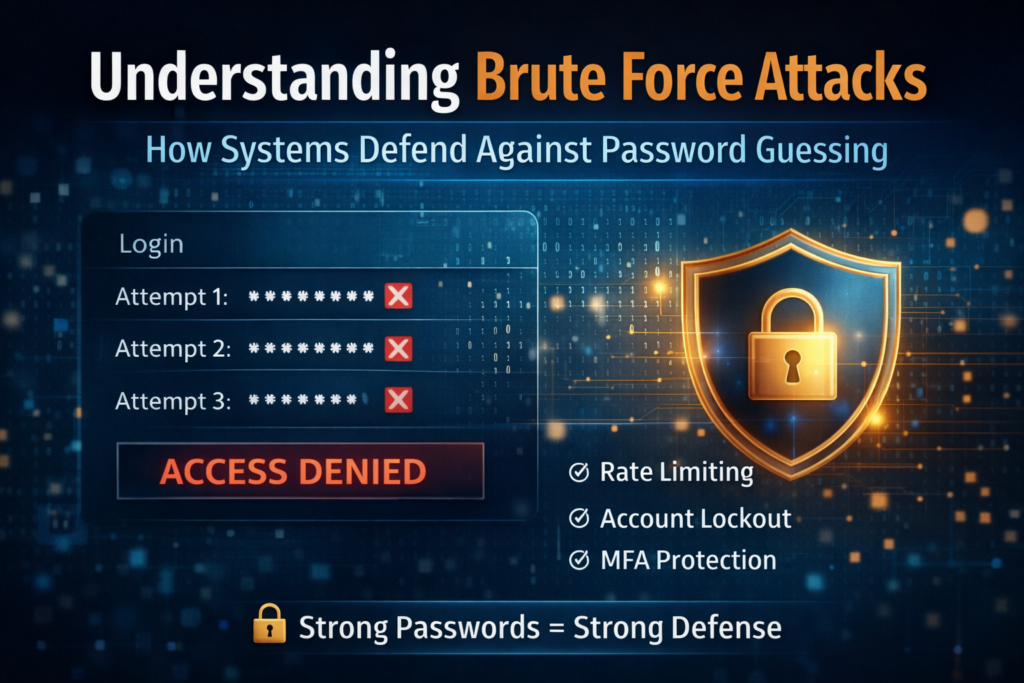
How Systems Defend Against Brute Force
Modern security systems implement protections like:
1 Account Lockout
After 3-5 failed attempts, the account locks.
2 Captcha
prevents automated bots.
3 Rate Limiting
Slows down login attempts.
4 Multi-Factor Authentication (MFA)
Even if the password is cracked, the attacker needs a second verification.
5 Password Hashing
Instead of storing passwords directly, systems store hashed versions using secure algorithms like:
* bcrypt
* Argon2
* PBKDF2
These algorithms intentionally slow down password verification, making brute force expensive.
Ethical Perspective
It’s important to understand:
Brute force techniques are studied in :
- Cybersecurity research
- Penetration testing
- Ethical hacking
Security professionals use controlled brute force testing to identify weak systems and improve defenses.
However, unauthorized password cracking is illegal and unethical.
Key Takeways
- Brute force tries every possible password combination.
- It always works in theory – but may take centuries with strong passwords.
- Passwords lenght and complexity dramatically increase security.
- Modern defenses make brute force impractical against well-designed systems.
Conclusion
Brute Force Password Cracking is one of the oldest and simplest attack methods in cybersecurity. It doesn’t rely on intelligence – just patience and computing power.
But the good news?
Strong passwords, proper hashing, and modern security mechanisms make brute force attacks extremely difficult and time-consuming.
In cybersecurity, strength doesn’t come from hiding secrets – it comes from designing systems that remain secure even when attackers try everything.
And when it comes to passwords:
Longer. More complex. Always better.