


Introduction
The rapid growth of Artificial Intelligence (AI) tools has changed how software teams work. From generating code to summarizing requirements, AI is now involved in many parts of the software development lifecycle.
In software testing, tools such as ChatGPT and GitHub Copilot can already help testers generate test cases, create automation scripts, analyze logs, and even suggest edge cases within seconds.
Because of this, one question is becoming increasingly common:
“Will AI replace software testers in the future?”
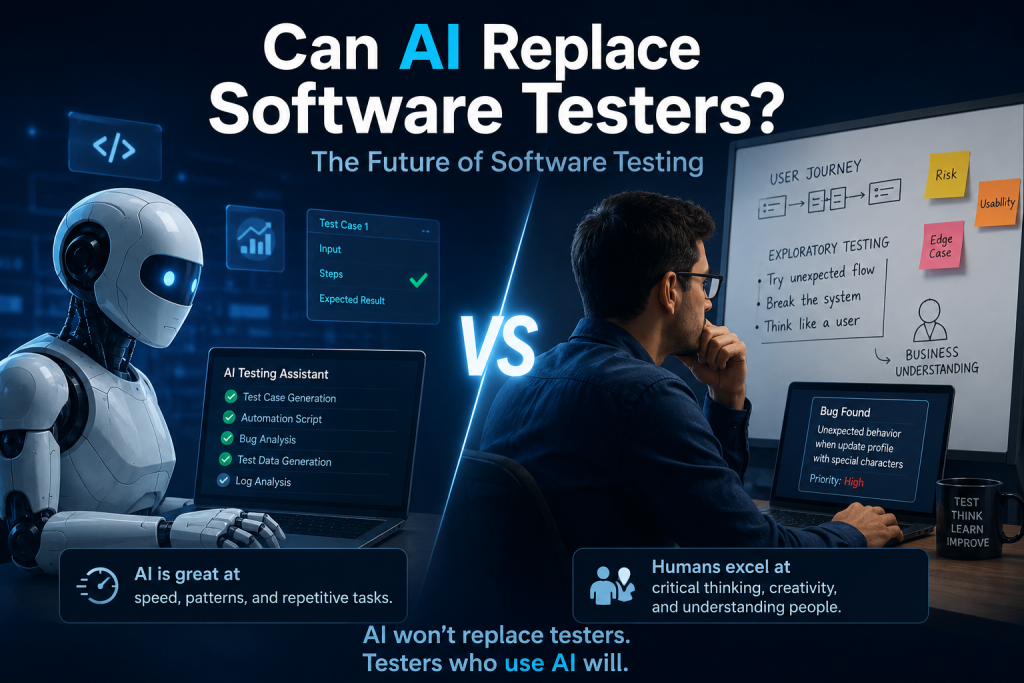
The short answer is: not completely.
AI is transforming software testing significantly, but testing is not only about executing predefined steps. A large part of testing still depends on human judgment, business understanding, communication, and critical thinking.
This article explores what AI can already do, where its limitations remain, and how the tester role is evolving in the AI era.
Why Are Testers Concerned About AI?
In recent years, AI-powered tools have become much more accessible and practical for daily work.
Today, AI can help teams:
- Generate test cases from requirements
- Produce sample automation scripts
- Suggest API requests and validations
- Create test data
- Summarize bug reports
- Analyze logs and stack traces
- Support performance and regression testing
Many companies are also introducing “AI Testing” solutions into their QA processes. Tools like Applitools promote AI-driven visual validation and automated testing capabilities.
As a result, repetitive testing activities that once required significant manual effort can now be completed much faster.
For some testers, especially those focused mainly on repetitive manual execution, this creates uncertainty about the future of the role.
However, the reality is more nuanced.
What AI Can Already Do Well in Software Testing
AI is highly effective at accelerating repetitive and pattern-based activities.
1. Generating Basic Test Cases
Given a requirement or user story, AI can quickly generate:
- Positive test cases
- Negative test cases
- Boundary-value scenarios
- Validation checks
This helps testers save time during the initial drafting phase.
2. Assisting Automation Script Creation
AI tools can generate automation code templates for frameworks such as:
- Selenium
- Playwright
- Cypress
- Postman collections
Instead of writing scripts entirely from scratch, testers can focus more on refining logic and improving coverage.
3. Supporting API Testing
AI can:
- Generate sample request payloads
- Suggest status code validations
- Create JSON schemas
- Explain API responses
This is especially useful for testers transitioning from manual testing into API testing.
4. Analyzing Logs and Errors Faster
When a failed execution produces large logs, AI can help summarize:
- Possible root causes
- Error patterns
- Common fixes
- Related dependencies
This reduces investigation time significantly.
5. Improving Productivity
AI helps reduce repetitive work and allows testers to spend more time on higher-value activities.
Instead of manually writing dozens of similar test cases, testers can focus on:
- Risk analysis
- Exploratory testing
- Test strategy
- Business validation
This shift improves overall testing efficiency.
What AI Still Cannot Replace
Although AI is powerful, software testing is not only about generating outputs from prompts.
There are several important areas where human testers still provide critical value.
1. Business Understanding
AI can process information quickly, but it does not truly understand business goals the same way humans do.
Experienced testers often identify risks based on:
- Customer behavior
- Business priorities
- User expectations
- Product context
For example:
A feature may technically work correctly, but the workflow could still confuse users or negatively affect business operations.
Recognizing these problems requires domain understanding and contextual thinking.
2. Exploratory Testing
Exploratory testing involves creativity, curiosity, and intuition.
Human testers often discover defects by:
- Trying unexpected flows
- Combining unusual actions
- Challenging assumptions
- Thinking like real users
AI performs well with known patterns, but exploratory testing frequently depends on unpredictable human behavior.
Subtle usability issues such as:
- confusing UI behavior
- inconsistent navigation
- poor user experience
- misleading messaging
are still much easier for humans to detect.
3. Communication and Collaboration
Testing in real projects is not an isolated activity.
Testers regularly work with:
- Developers
- Business Analysts
- Product Owners
- Clients
- Support teams
A tester may need to:
- Clarify unclear requirements
- Discuss release risks
- Negotiate priorities
- Explain defects clearly
- Support UAT activities
These communication and collaboration responsibilities remain difficult for AI to fully replace.
4. Critical Thinking and Decision Making
Testing often requires making judgment calls.
Examples include:
- Which areas are highest risk?
- What should be tested first?
- Is the release stable enough?
- Is this issue critical or acceptable?
AI can assist with recommendations, but final decisions still depend heavily on human evaluation and project context.
How the Tester Role Is Changing
AI is not eliminating testing roles, but it is changing what companies expect from testers.
Traditional repetitive activities will likely decrease over time, including:
- repetitive manual execution
- simple test case writing
- repetitive regression validation
At the same time, demand is increasing for testers who can:
- understand business workflows
- design test strategies
- perform exploratory testing
- work with automation frameworks
- use AI tools effectively
- analyze risks and quality metrics
The role is gradually shifting from:
“person who executes tests”
to:
“quality-focused problem solver”
This evolution is similar to how automation changed testing years ago. Automation did not eliminate testers; instead, it changed the required skill set.
Practical Ways Testers Can Work with AI
Instead of viewing AI as competition, testers can treat it as a productivity tool.
Some practical examples include:
Use AI to Draft Test Cases
Generate an initial list quickly, then review and refine based on business context.
Use AI to Learn Automation Faster
AI can explain frameworks, generate examples, and help debug scripts.
This is especially useful for testers learning automation for the first time.
Use AI for Documentation
AI can help summarize:
- meeting notes
- test reports
- release summaries
- defect trends
This reduces manual documentation effort.
Use AI During Investigation
When analyzing defects, AI can help interpret:
- stack traces
- logs
- API responses
- SQL queries
This accelerates troubleshooting.
Common Misconceptions About AI in Testing
“AI will completely replace testers.”
Unlikely in the near future.
AI is strongest when assisting repetitive and structured tasks, but software quality still requires human reasoning and business understanding.
“Manual testing will disappear.”
Manual execution may reduce, but exploratory testing and business validation remain highly valuable.
“Only automation testers will survive.”
Automation skills are increasingly important, but communication, domain knowledge, analytical thinking, and quality ownership are equally critical.
Conclusion
AI is already transforming software testing and improving productivity across many testing activities. It can generate test cases, assist automation, analyze logs, and reduce repetitive work much faster than before.
However, software testing is not only about executing predefined steps.
Human testers still play a critical role in:
- understanding business context
- evaluating user experience
- performing exploratory testing
- assessing risks
- collaborating with teams
- making quality decisions
Rather than replacing testers completely, AI is changing how testers work.
The testers who adapt, learn new tools, and combine AI assistance with strong testing skills will likely become even more valuable in the future.