



Cloud Readiness Assessment is a necessary business strategy, especially in the rapid evolution of cloud computing. Following the rapid evolution of cloud computing, business operations have significantly changed. In particular, cloud computing helps businesses achieve unparalleled scalability, flexibility, and cost-efficiency. However, transitioning to the cloud is not merely a technological upgrade but a strategic shift that requires careful planning and analysis. So, organizations must evaluate their preparedness with the Cloud Readiness Assessment. Finally, organizations ensure that migration is efficient, cost-effective, and aligned with business goals.
In this blog, we will explain why organizations need to know and how NashTech can help to conduct the assessment.
Why is a Cloud Readiness Assessment essential?
Before starting anything, we must understand our current state and prepare a plan. Organizations must also understand their current IT landscape and readiness to embrace cloud technologies to prepare to move to the cloud. A Cloud Readiness Assessment is an indispensable step in this process.
It offers a detailed evaluation of potential challenges and aligns the migration strategy with organizational goals. By thoroughly assessing technical, operational, and security factors, this assessment minimizes risks, ensures cost efficiency, and establishes a strong foundation for unlocking the full potential of cloud computing.
- Minimizing Risks: Cloud migration can lead to unexpected downtime, security vulnerabilities, or data loss without proper planning. A Cloud Readiness Assessment identifies potential risks and develops strategies to mitigate them.
- Cost Optimization: Cloud services offer diverse pricing models. Understanding current workloads and usage patterns allows businesses to choose the most cost-efficient solutions.
- Aligning with Business Objectives: The assessment ensures that cloud adoption aligns with organizational objectives, such as enhancing customer experience, improving operational agility, or reducing infrastructure costs.
- Addressing Compliance and Security: Different industries have specific compliance and security requirements. The assessment evaluates whether the cloud solution meets these regulations and identifies areas needing additional controls.
- Scalable Architecture: A readiness assessment ensures that the chosen cloud solution can handle growth, new workloads, or shifting market demands without compromising performance.
The Cloud Readiness Assessment Process
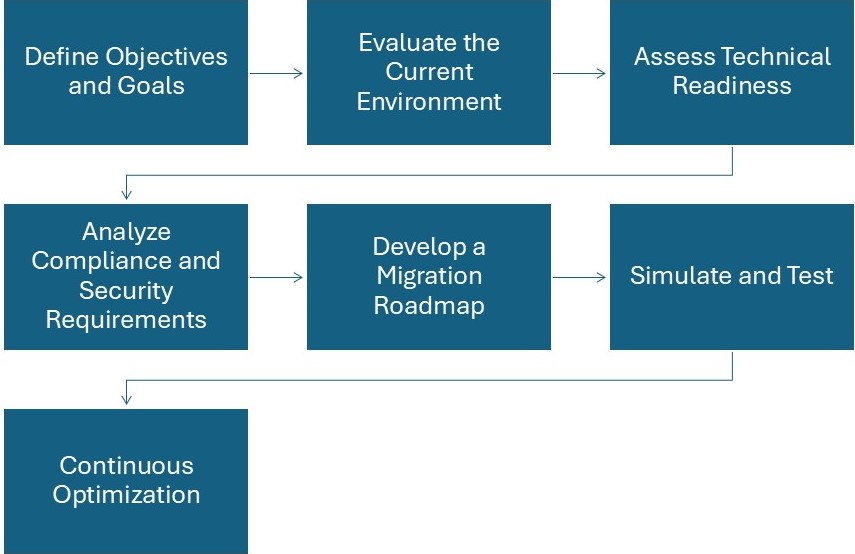
A Cloud Readiness Assessment Process evaluates an organization’s preparedness for cloud adoption by systematically analyzing the existing environment’s technical, operational, and strategic aspects. It ensures that the transition to the cloud aligns with the organization’s goals and capabilities. This process is closely aligned with the AWS Cloud Adoption Framework (AWS CAF), which provides a structured approach to cloud adoption through six perspectives: Business, People, Governance, Platform, Security, and Operations.
Each step in the assessment serves a distinct purpose and maps to specific sections of the AWS Cloud Adoption Framework.
1. Define Objectives and Goals
Establishing clear objectives ensures that cloud adoption aligns with business goals, such as cost optimization, enhanced scalability, operational resilience, or improved customer experience.
AWS CAF Mapping:
- Business Perspective: Aligns cloud strategy with business outcomes such as ROI and agility.
- People Perspective: Identifies stakeholder roles and responsibilities for achieving these goals.
2. Evaluate the Current Environment
Understanding the existing infrastructure, workloads, and dependencies helps identify compatibility with cloud technologies and areas needing transformation.
AWS CAF Mapping:
- Platform Perspective: Analyzes infrastructure, networks, and application readiness.
- Operations Perspective: Evaluates current operational models and identifies gaps for cloud alignment.
3. Assess Technical Readiness
A deep dive into application architectures, legacy systems, and integration points ensures that workloads can perform optimally in the cloud.
AWS CAF Mapping:
- Platform Perspective: Reviews technical architectures for cloud readiness.
- Security Perspective: Ensures data, identity, and compliance requirements are met.
4. Analyze Compliance and Security Requirements
Ensures the cloud environment meets regulatory standards and internal security protocols, mitigating data breaches or non-compliance risks.
AWS CAF Mapping:
- Security Perspective: Focuses on compliance, identity management, and data protection strategies.
5. Develop a Migration Roadmap
Prioritizing workloads and defining timelines ensures an efficient and cost-effective migration process.
AWS CAF Mapping:
- Governance Perspective: Provides cost management and organizational alignment.
- Operations Perspective: Outlines transition plans for operational continuity.
6. Simulate and Test
Running a pilot migration validates technical compatibility, identifies performance bottlenecks, and builds confidence for full-scale migration.
AWS CAF Mapping:
- Platform Perspective: Ensures technical feasibility through testing.
- Operations Perspective: Verifies that operational workflows can handle the transition.
7. Continuous Optimization (Post-Migration Planning)
Incorporating optimization practices into the assessment ensures long-term efficiency, scalability, and alignment with evolving business needs.
AWS CAF Mapping:
- Operations Perspective: Establishes a feedback loop for continuous improvement.
- Business Perspective: Ensures ongoing alignment with business objectives.
Take the First Step Toward Cloud Adoption with NashTech
At NashTech, we offer a powerful Cloud Readiness Assessment Tool designed to help businesses evaluate their readiness for cloud adoption. This tool provides a comprehensive overview of your organization’s current IT landscape and identifies the steps needed to prepare for a successful transition to the cloud.
With NashTech’s assessment tool, your business can gain:
- A holistic view of your current capabilities.
- Actionable insights into areas requiring improvement or optimization.
- A clear roadmap to align your cloud adoption strategy with your goals.
To make the most of this tool, it’s essential to have a clear understanding of your organization’s current state and future aspirations. This foundational knowledge will ensure the assessment delivers meaningful results, setting the stage for an efficient and effective cloud migration.
If you’re ready to embark on your cloud transformation journey, contact NashTech today. Our team of experts will guide you through the assessment process and provide the support you need to evaluate your organization’s cloud readiness. Let’s build a future-ready IT strategy together!
Conclusion
Cloud Readiness Assessment is essential for businesses, clarifying your current state and ensuring a successful cloud migration. If you want to learn more about AWS Cloud, visit our recommended pages below:
- AWS Well-Architected Framework – Cost Optimization Pillar
- AWS Cost Explorer User Guide
- AWS Trusted Advisor
- AWS Savings Plans
- AWS Compute Optimizer
- AWS Pricing Calculator
- Right-Sizing Your EC2 Instances for Cost Optimization
- AWS Cost and Usage Report
- AWS Budgets
- AWS Cost Anomaly Detection
- Cloud Optimization – Overall – NashTech Insights (nashtechglobal.com)
- Cost Management in Cloud Optimization – NashTech Insights (nashtechglobal.com)