


Centralized data platforms consolidate all data management into a single, unified system controlled by a central IT team. This setup ensures standardized access methods, uniform governance, and concentrated expertise. However, it may face challenges in scaling operations efficiently and adapting quickly to evolving business needs and technological advancements.
Conversely, decentralized data platforms distribute data management responsibilities across multiple locations or domains, allowing individual teams or departments to manage their data independently. This approach provides greater flexibility, domain-specific innovation, and scalability.
Overview Of Data Mesh and Data Fabric
The concept of a data mesh proposes that each business domain takes charge of hosting, preparing, and delivering its own data to both its internal team and broader stakeholders. This decentralized approach empowers autonomous data teams to take full ownership and accountability for their data products and management processes.
Data fabric is a system designed to help a company manage and use its data from various storage types, like databases, tagged files, or document stores. It supports different tools and applications to easily access this data, working with technologies like Apache Kafka for real-time data streaming, ODBC for database connections, HDFS for big data storage and REST APIs for web services. It focuses on creating a unified data environment that acts as a reliable, centralized source for all organizational data. This setup ensures data is accurate, consistent, and secure, making it easy for different teams to access and manage data efficiently.
Key Benefits of Data Mesh and Data Fabric
Benefits of Data Mesh:
1. Domain Ownership: In a data mesh architecture, individual domain teams assume responsibility for managing and owning their respective data products. This approach ensures alignment with specific domain requirements and enables quicker adaptation to evolving needs and challenges.
2. Organizational scalability: The decentralized design of data mesh empowers organizations to expand their data management capabilities efficiently. By decentralizing responsibilities across domain teams, it prevents bottlenecks and single points of failure, ensuring robust and adaptable data operations.
3. Enhanced data accessibility: It enables a self-service data culture across diverse domains within organizations. By creating accessible data products, it promotes broader utilization of data and enhances the management of complexity in large and diverse organizational settings.
Benefits of Data Fabric:
1. Unified data access: Provides a seamless, integrated layer for accessing data from various sources, formats, and locations, simplifying data retrieval and analysis across the entire organization.
2. Centralized governance and automation: Enables consistent application of data policies, security measures, and compliance standards, while leveraging AI/ML for automated data integration and management.
3. Comprehensive visibility and analytics: Data fabric enhances data transparency by providing clear visibility into the origin and evolution of data. This build trust in data integrity and supports more informed decision-making processes.
Analysis
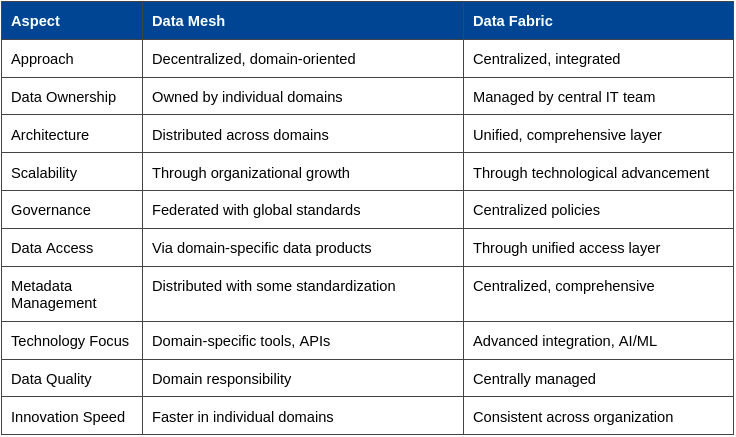
Below is a comparison table outlining the differences between Data Mesh and Data Fabric architecture
Conclusion
The choice between Data Mesh and Data Fabric ultimately depends on an organization’s specific needs, structure, and goals. Data Fabric provides centralized data management with strong governance, automated integration, and unified access. It suits organizations with robust central IT capabilities, strict compliance requirements, and a focus on comprehensive analytics across the enterprise. Conversely, Data Mesh represents a decentralized approach tailored for large organizations with diverse domains, promoting innovation, agility, and scalability through domain-oriented data management and a data-as-a-product mindset. Its flexibility caters well to varied business needs across complex environments.
References
https://www.datamesh-architecture.com
https://www.datanami.com/2021/10/25/data-mesh-vs-data-fabric-understanding-the-differences/