



Introduction
In the vast landscape of software engineering, design patterns serve as guiding principles, offering time-tested solutions to recurring problems encountered during the development lifecycle. They encapsulate industry best practices, architectural blueprints, and proven methodologies that empower developers to create robust, scalable, and maintainable software solutions. In this definitive guide, we’ll embark on a journey through the intricate world of design patterns, unravelling their essence, exploring their categories, delving into real-world applications, and mastering their implementation techniques.
Unveiling Design Patterns
At their core, design patterns are elegant solutions to common design problems in software development. They embody tried-and-tested approaches, distilled from years of collective experience and wisdom within the developer community. By leveraging design patterns, developers can abstract away complexity, promote code reuse, enhance maintainability, and foster a deeper understanding of software architecture.
Exploring Design Pattern Categories
Design patterns are typically classified into three main categories, each addressing specific aspects of software design and development:
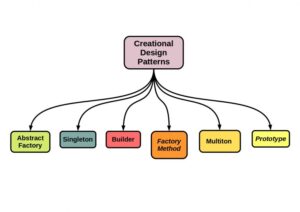
- Creational Patterns: Creational patterns focus on object creation mechanisms, providing flexible ways to instantiate objects while decoupling the client code from the details of object creation. Examples of creational patterns include Singleton, Factory Method, Abstract Factory, Builder, and Prototype.
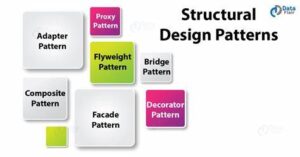
- Structural Patterns: Structural patterns concentrate on object composition and relationships, enabling developers to create large, complex structures from simpler components. These patterns facilitate flexibility, extensibility, and the management of relationships between objects. Examples include Adapter, Bridge, Composite, Decorator, Facade, Flyweight, and Proxy.
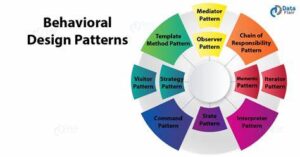
- Behavioural Patterns: Behavioural patterns revolve around communication and interaction between objects, defining how objects collaborate to achieve specific behaviours and responsibilities. These patterns promote flexibility, encapsulation, and separation of concerns. Examples include Observer, Strategy, Chain of Responsibility, Command, Interpreter, Iterator, Mediator, Memento, State, Template Method, and Visitor.
Real-World Applications of Design Patterns
Design patterns find application across various domains and industries, offering solutions to diverse challenges encountered in software development:
- Enterprise Applications: In enterprise software development, patterns like Repository, Unit of Work, Service Locator, and Dependency Injection promote modularity, maintainability, and testability, while facilitating the integration of disparate systems and components.
- Web Development: In web applications, patterns like Model-View-Controller (MVC), Front Controller, and Dependency Injection enhance separation of concerns, code organization, and scalability, enabling the development of robust and maintainable web solutions.
- Game Development: In the realm of game development, patterns like Entity-Component-System (ECS), State, Command, and Observer streamline game logic, facilitate code reuse, and support the creation of dynamic and interactive gaming experiences.
- Concurrency and Parallelism: In concurrent and parallel programming, patterns like Thread Pool, Producer-Consumer, and Read-Write Lock provide strategies for managing resources, coordinating tasks, and ensuring thread safety, enabling the development of efficient and scalable concurrent systems.
Mastering Design Pattern Implementation
Implementing design patterns requires a deep understanding of their structure, principles, and usage, as well as the ability to apply them effectively to solve specific problems or address particular requirements. Key steps for mastering design pattern implementation include:
- Problem Identification: Identify the recurring problem or challenge in your codebase that can be addressed by a design pattern. Analyse the context, requirements, and constraints to determine the most suitable pattern.
- Pattern Selection: Choose the appropriate design pattern based on the identified problem and the desired outcome. Consider factors such as scalability, maintainability, performance, and flexibility when selecting a pattern.
- Pattern Application: Apply the chosen design pattern by following its guidelines, principles, and structure. Implement the necessary classes, interfaces, and relationships to realize the pattern’s intent and achieve the desired functionality.
- Testing and Refactoring: Test the implementation of the design pattern to ensure correctness, reliability, and adherence to requirements. Refactor the code as needed to improve clarity, modularity, and extensibility while maintaining the integrity of the pattern.
Conclusion
Design patterns serve as invaluable tools in a developer’s arsenal, providing reusable solutions to common design problems and guiding the development of high-quality, maintainable software. By mastering the essence, categories, real-world applications, and implementation techniques of design patterns, developers can elevate their coding skills, enhance their problem-solving abilities, and deliver elegant and efficient software solutions that stand the test of time.