


In this blog, we will explore the difference between the ref and out keywords in C#. These two keywords are often confusing for beginners, but they serve distinct purposes in passing parameters to methods. Let’s break it down step-by-step in simple language.
Table of Contents
- Introduction
- Passing Parameters by Reference in C#
- What is
refin C#? - Key Points About
ref - What is
outin C#? - Key Points About
out - Bonus: Method Overloading with
refandout - Similarities Between
refandout - Differences Between
refandout - Conclusion
1. Introduction
In C#, both ref and out keywords allow you to pass arguments by reference instead of by value. This means any changes made to the argument inside the method will reflect in the calling method. However, they differ in how the argument is handled during the method call.
2. Passing Parameters by Reference in C#
According to Microsoft:
ref: The argument must be initialized before calling the method. The method may or may not modify the value.out: The argument does not need to be initialized before calling the method, but the method must assign a value before it returns.
3. What is ref in C#?
The ref keyword allows a method to modify the value of a parameter passed to it. You must initialize the variable before passing it to the method using ref.
Example of ref
namespace RefExample
{
    class Program
    {
        static void Main()
        {
            int number = 10;
            Console.WriteLine("Before calling the method: " + number);

            DoubleValue(ref number);

            Console.WriteLine("After calling the method: " + number);
        }

        static void DoubleValue(ref int value)
        {
            value *= 2; // Modify the value
        }
    }
}
Output:
Before calling the method: 10
After calling the method: 20
4. Key Points About ref
- The variable must be initialized before being passed with
ref. - Changes made inside the method will affect the original variable.
- It allows two-way communication (data can flow in and out of the method).
- Properties cannot be passed as
refparameters.
5. What is out in C#?
The out keyword is useful when you want to return multiple values from a method. Unlike ref, the variable does not need to be initialized before being passed, but the method must assign a value to it before it returns.
Example of out
namespace OutExample
{
    class Program
    {
        static void Main()
        {
            int area, perimeter;

            CalculateRectangle(10, 5, out area, out perimeter);

            Console.WriteLine("Area: " + area);
            Console.WriteLine("Perimeter: " + perimeter);
        }

        static void CalculateRectangle(int length, int width, out int area, out int perimeter)
        {
            area = length * width;
            perimeter = 2 * (length + width);
        }
    }
}
Output:
Area: 50
Perimeter: 30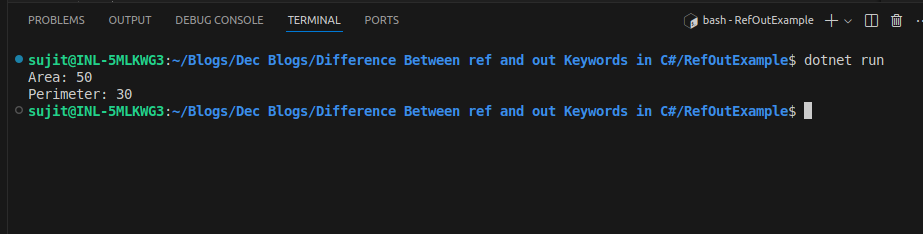
6. Key Points About out
- The variable does not need to be initialized before being passed.
- The method must assign a value to the
outparameter. - It allows one-way communication (data flows only out of the method).
- Properties cannot be passed as
outparameters.
7. Bonus: Method Overloading with ref and out
C# allows method overloading, where multiple methods share the same name but differ in parameters. However, ref and out are treated the same during compilation, so you cannot overload methods solely based on ref or out.
Example
namespace OverloadingExample
{
    class Program
    {
        static void Main()
        {
            int number;

            SetValue(ref number);  // Calls the ref method
            SetValue(out number); // Calls the out method
        }

        static void SetValue(ref int value)
        {
            value = 10;
        }

        static void SetValue(out int value)
        {
            value = 20;
        }
    }
}
8. Similarities Between ref and out
- Both pass parameters by reference.
- Both must be explicitly specified in the method signature and the calling method.
- Neither can be used with properties.
- Both are treated the same at compile time but differently at runtime.
9. Differences Between ref and out
| Key Points | ref | out |
|---|---|---|
| Direction | Allows data to flow both into and out of the method. | Data flows only out of the method. |
| Initialization | Must be initialized before being passed. | Does not need to be initialized. |
| Usage | Useful when the method needs to modify the value. | Useful for returning multiple values. |
Combined Example: ref and out Together
namespace RefAndOutTogether
{
    class Program
    {
        static void Main()
        {
            int refValue = 5;
            int outValue;

            Console.WriteLine("Before: refValue = " + refValue);

            ModifyValues(ref refValue, out outValue);

            Console.WriteLine("After: refValue = " + refValue);
            Console.WriteLine("After: outValue = " + outValue);
        }

        static void ModifyValues(ref int refParam, out int outParam)
        {
            refParam += 10; // Modify the ref parameter
            outParam = 15;  // Assign value to the out parameter
        }
    }
}
Output:
Before: refValue = 5
After: refValue = 15
After: outValue = 15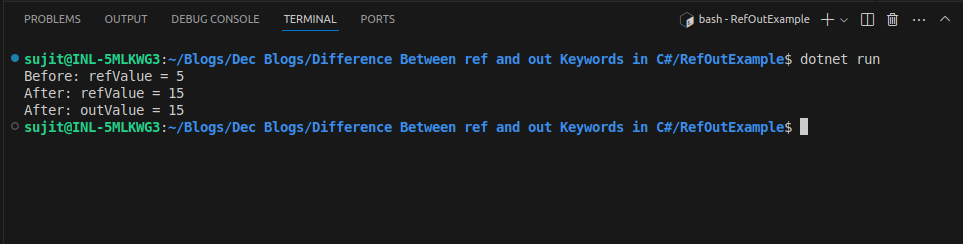
10. Conclusion
The ref and out keywords in C# are powerful tools for parameter passing. Use ref when you want to modify the passed value and require it to be initialized before the method call. Use out when you need to return multiple values and don’t require initialization beforehand. While they may seem similar at first glance, their use cases are distinct and essential in different scenarios.