


Functional programming is a paradigm that views computation as the evaluation of mathematical functions while emphasizing immutability and statelessness. Functions in this technique are pure, which means they rely solely on their input arguments and have no side effects, resulting in more predictable and manageable code. Functional programming also encourages immutable data structures, which prevent data from being changed after it has been produced. This immutability helps to minimize unforeseen consequences and makes programs easier to understand and debug. The advantages of functional programming include increased modularity, clearer reasoning about code behavior, and better support for concurrent programming.
Despite being a multi-paradigm language, Kotlin provides strong support for the ideas of functional programming. Its features—such as lambda expressions, which enable succinct function representations—higher-order functions, which let functions return or accept other functions as parameters, and an extensive standard library with functions for functionally working with collections—all demonstrate this. Developers can easily combine functional programming approaches with other paradigms, such as object-oriented programming, thanks to Kotlin’s design. Because of its versatility, Kotlin is a great option for developers who want to use functional programming in their projects without being limited to using only functional languages. We will examine these Kotlin functional programming concepts in this blog post, along with samples that show how to use them in practical ways.
Functional Programming Concepts in Kotlin
Immutability
When a data structure is immutable, it cannot be altered once it has been constructed. Since the data is constant throughout the lifecycle of the data, this approach helps prevent side effects and makes your code easier to reason about. Kotlin allows for immutability by offering immutable collections like listOf and mapOf and the ability to declare read-only variables using val. You cannot add or remove elements from a list created using listOf(1, 2, 3), for instance. In a similar vein, val declares a read-only variable that cannot have its value changed.
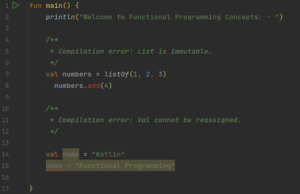
In these cases, numbers are an immutable list, and any effort to change it will result in a compilation error. Similarly, the name is a read-only variable that cannot be reassigned, therefore the value remains constant. This immutability makes programming more predictable and reliable.
Pure Functions
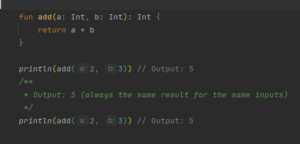
Pure functions have no observable side effects and their return value is defined solely by their input values. This property makes them predictable and easier to evaluate because they continually generate the same output for the same input and do not change the external state. A function that adds two numbers, for instance, is pure since it depends only on its input arguments and doesn’t change or rely on any outside variables.
First-Class Functions
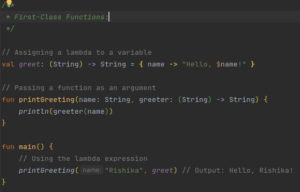
Functions are treated like first-class citizens in Kotlin, which allows them to be returned from other functions, assigned to variables, and supplied as arguments. This makes it possible for a code structure to be flexible and modular, which in turn helps developers write more abstract and reusable code. A lambda expression, for instance, can be assigned to a variable and used just like any other object.
Lambda Expressions
Lambda expressions in Kotlin are anonymous functions that you can assign to variables or pass directly as arguments. They provide a concise way to represent function literals, which makes your code more readable and expressive.
For single-parameter lambdas, Kotlin allows using the it keyword to represent the parameter.
// Lambda assigned to a variable
val double: (Int) -> Int = { it * 2 }
println(double(4)) // Output: 8// Lambda passed directly as an argument
val numbers = listOf(1, 2, 3, 4, 5)
val doubled = numbers.map { it * 2 }
println(doubled) // Output: [2, 4, 6, 8, 10]
Higher-Order Functions
Functions that return or accept other functions as parameters are known as higher-order functions. They allow functions to be supplied and returned like variables, enabling strong abstractions and code reuse.
// Higher-order function taking a function as a parameter
fun <T, R> transform(value: T, transformer: (T) -> R): R {
return transformer(value)
}val result = transform(5) { it * 2 }
println(result) // Output: 10
Kotlin also supports function references, allowing you to pass functions by their name.
fun multiply(a: Int, b: Int): Int = a * b
val result = transform(5) { multiply(it, 2) }
println(result) // Output: 10
Inline Functions
Inline functions minimize the overhead of higher-order functions by placing the function body at the call point. This can enhance efficiency by removing the overhead associated with function calls.
inline fun <T, R> inlineTransform(value: T, transformer: (T) -> R): R {
return transformer(value)
}val inlineResult = inlineTransform(5) { it * 2 }
println(inlineResult) // Output: 10
Using Kotlin’s Standard Library for Functional Programming
Kotlin’s standard library provides many functions that facilitate functional programming, such as map, filter, reduce, and fold. These functions operate on collections and return new collections or single values based on the provided lambda expressions.
map
Transforms each element in a collection and returns a list of the transformed elements. It’s useful for applying a function to each element of a collection.
val numbers = listOf(1, 2, 3, 4, 5)
val squared = numbers.map { it * it }
println(squared) // Output: [1, 4, 9, 16, 25]
filter
Filters elements in a collection based on a predicate and returns a list of the elements that satisfy the predicate. This is useful for extracting elements that meet certain criteria.
val evenNumbers = numbers.filter { it % 2 == 0 }
println(evenNumbers) // Output: [2, 4]
reduce
Reduces a collection to a single value by iteratively combining elements using a specified function. It’s often used for summing or concatenating elements.
val sum = numbers.reduce { acc, number -> acc + number }
println(sum) // Output: 15
fold
Similar to reduce, but takes an initial value and accumulates the result starting with that initial value. It’s more flexible reduce as it allows you to specify an initial accumulator value.
val sumWithInitial = numbers.fold(10) { acc, number -> acc + number }
println(sumWithInitial) // Output: 25
Conclusion
Kotlin’s support for functional programming empowers developers to write clean, concise, and immutable code. By incorporating functional programming principles, developers can ensure that their code is more predictable and easier to maintain. Lambda expressions provide a concise way to define functions on the fly, enabling more readable and expressive code. Higher-order functions, which accept other functions as parameters or return them, allow for greater abstraction and code reuse. Inline functions help to reduce the overhead associated with higher-order functions, making them more efficient. The extensive standard library in Kotlin offers numerous functions for working with collections in a functional style, such as `map`, `filter`, `reduce`, and `fold`, facilitating the creation of robust and efficient algorithms.
These functional programming features in Kotlin not only enhance code readability and maintainability but also contribute to more robust and less error-prone software. Immutability, a core concept in functional programming, ensures that data structures remain unchanged, preventing side effects and making it easier to reason about code behavior. This leads to fewer bugs and more reliable applications. Additionally, the modularity and composability of functional programming make it easier to build and test individual components, further improving software quality. By leveraging Kotlin’s functional programming capabilities, developers can create applications that are not only efficient and performant but also easier to understand, maintain, and extend over time.