


Introduction
Angular is a development platform it is built on TypeScript. As a platform, it includes:
- Component-based framework to build scalable web applications
- Collection of libraries that cover a wide variety of features forms management including routing, client-server communication etc
- A suite of developer tools to help you test, develop, build, and update your code
If we build applications with Angular, we should take advantage of a platform that can scale from single-developer projects to enterprise-level applications. It is designed to make updating as easy as possible also you can take advantage of the latest developments with a minimum effort. Best of all, the Angular ecosystem consists of a diverse group of over 1.7 million developers, library authors, and content creators.
Before we start exploring the platform, we should be familiar about the Angular CLI. This CLI is the, easiest, fastest, and recommended way to develop applications and Angular CLI makes a number of tasks easy. Here are some examples:
ng build | It compiles an Angular app into an output directory. |
ng serve | It builds and serves your application, rebuilding on file changes. |
ng generate | It modifies and generates files based on a schematic. |
ng test | It runs unit tests on a given project. |
ng e2e | It serves and builds an application, then runs end-to-end tests. |
Distinction from AngularJS
Before we start with Angular in detail, we should understand the difference between Angular and AngularJS. Angular was written from scratch as a successor to AngularJS and differs in many ways. In AngularJS, applications are subdivided into modules such as controllers, templates, scopes, and providers, only parts of which can be found in an Angular application also Angular still has something like templates and providers.
Angular recommends the use of TypeScript while applications in AngularJS were still implemented in JavaScript. Angular relies entirely on the RxJS library, which implements the Observable pattern, whereas Handling asynchronous tasks was mostly based on Promises in AngularJS.
In summary, it’s simply wrong to say that AngularJS and Angular are actually the same framework and that an AngularJS application could be easily migrated to Angular.
Why prefer Angular?
We know that JavaScript is the most frequently used client-side scripting language. Developers write JavaScript into HTML files to enable interactions with internet pages in many special ways.
But JavaScript is not the best for growing single-page applications that require testability, modularity, and developer productivity.
Nowadays, we have a lot of frameworks and libraries designed to supply choice solutions. With admiration for front-end internet development.
Architecture
Modules
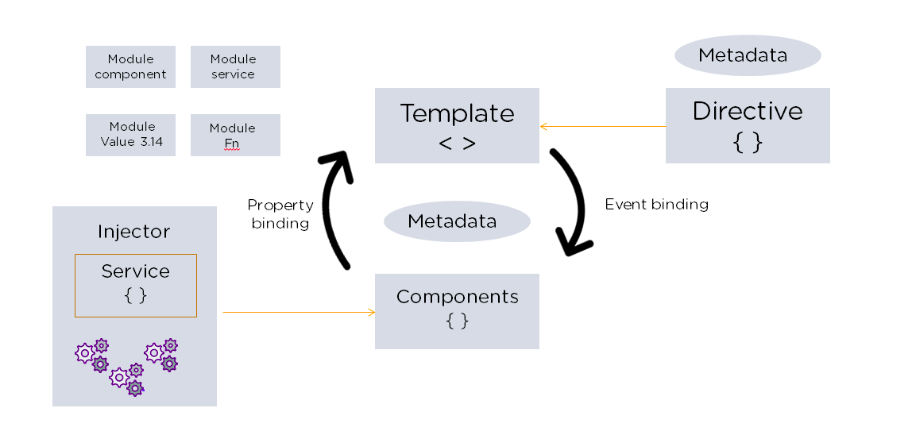
Module is a service or component. Within an Module context is bunch together into a single component or service. An animation-related functionality can be split into different modules. It already provides a module to support for that type of functionality i.e. Browser Animation Module.
We can deploy any number of modules in an Angular application, but only one core module – That will bootstrap the application and it will be calling other modules whenever necessary. The Components from different modules may also access services and components from other modules.
Angular Component
Angular application consist of several Components, is built from Components. The Components are simple Typescript /JavaScript classes with HTML names and templates.
A component’s HTML template can also access data from its corresponding JavaScript or Typescript class or component if it has a selector’s value (name). Angular components may have CSS styles integrated with them and also the HTML template have access to them.
Templates
The template is an HTML super set. It contains all the features of HTML and additional functionality that hold together component data into the HTML and generates HTML DOM elements dynamically.
- The function of event list is to modernize your app’s data in response to stoner input in the target terrain.
- However you can use interpolation values from your operation data and enable the property list when necessary.
Metadata
Metadata is used to inform the framework on how to handle a class.
Services
A veritably specific functionality is handed by a service. Service composition is useful to reduce reiteration. Rather of developing a mileage function inside a element, separating it into a service will be useful in other factors as well.
Angular Features
Document Object Model
DOM (Document Object Model) use an XML or HTML file as a tree shape in which every node constitutes a phase of the document. It makes use of everyday DOM. Assuming that the same HTML page has undergone ten updates. Rather than updating the ones that have been already updated. It will replace the whole tree shape of HTML tags.
TypeScript
TypeScript describe a set of kinds of JavaScript, which helps users write JavaScript code that is less complicated to understand. All the TypeScript code compiles with JavaScript, and it can run easily on any platform. TypeScript is now not mandatory for growing an application. However, it recommend using higher syntactic structure to make the codebase easier to understand and maintain.
Data Binding
Data binding allows customers to operate net web page factors via an internet browser. It does not require complicated scripting or programming. Data binding is use in net pages. Interactive components, such as tutorials, forums, games, and calculators make up it.
Testing
It uses the Jasmine trying-out framework. This framework offers a couple of utility to write distinct sorts of check cases.
Support for TypeScript 4.4
Angular v13 now Support TypeScript 4.4. High quality for apps is that it no longer implements setters and getters to get a comparable type.
Angular CLI Enhancements
The Angular CLI is one of the vital parts of the Angular Puzzle. Several builders can take care of the complicacy of the modern-day internet upgrade ecosystem in the world, and the CLI safeguards them from most of it.
After the launch of v13, this framework now supports power construct cache by way of default. It’s a feature that caches construct consequences on a disk. It aims up to 68% enhancement in improvement speed. We can enable or disable this characteristic in cutting-edge apps.
Changes to the Angular Package Format (APF)
The Angular Package Format (APF) explains the structure of the Angular Framework modules. It’s a first-rate method for packaging all the third-party library in the net improvement ecosystem.
Advantages of Angular
- Custom Components
- Data Binding
- Dependency Injection
- Testing
- Comprehensive
- Browser Compatibility
Conclusion
In the above blog, we have explained the key features, architecture, advantages of using the Angular Framework.
Reference Link:- https://en.wikipedia.org/wiki/Angular_(web_framework)