


Why user experience (UX) defines success in modern e-commerce
In today’s digital retail world, user experience has shifted from being just a design issue to becoming a data challenge. Shoppers now want smooth journeys, personalized deals, and quick support. Old rule-based user experience (UX) design simply can’t keep up with the countless small decisions that lead to customer satisfaction.
More than just a fancy industry term, UX refers to a customer’s entire journey on an online platform. This includes:
– Interface design
– Interaction
– User reactions
– Overall impression that lingers long after the session ends
According to the latest study for user experience which is conducted by Baymard Institute and eMarketer, e-commerce websites lose as much as $1.420 trillion yearly because of bad user experience. The same study shows that 88% of online consumers are prone to leaving an ecommerce website when the user experice are not met their expectations.
That’s where Artificial Intelligence (AI) steps in with analyzing customer behaviors, forecasting needs, and continuously optimizing the experience at every touchpoint. For a business analyst, this means bridging customer-centric design with data-driven software solutions. For a developer, it means architecting systems that can learn, adapt, and scale without breaking under peak traffic.
How AI Enhances E-Commerce UX
Personalized Product Discovery
AI doesn’t just wait for you to search, it actually guesses what you might want next. By looking at your browsing habits, past purchases, and real-time preferences, it can suggest products that fit your taste perfectly.
If one day, after looking at one pair of sneakers, your home page suddenly fills up with similar styles, colors, and accessories then that’s AI studying your clicks and predicting what you might like next.
Behind the scenes, developers set up real-time data pipelines that track your actions: what you viewed, added to cart, or ignored. Machine-learning models process this data and feed it back to the website through APIs that refresh product lists instantly and return a list of suitable products which make you feels like the site “knows” your taste.
This makes shopping feel smoother and more personal, and often leads to bigger carts. This results in more people engaging with your store, happier customers and stronger loyalty to your brand.
Conversational Shopping Assistants
Instead of waiting for a human agent, many websites now have AI chatbots that help you answering all your questions without having to wait in line, from picking products, checking delivery times, or even applying discount codes.
For example, Sephora’s chatbot can suggest makeup shades based on your skin type or occasion. On the tech side, that involves natural language processing (NLP), APIs that pull your historical data including your personal info, historical product details, and connections to CRM systems so the bot can greet you by name, remember past orders, know your skin shade and skin type to return a set of suitable products. It’s like having a sales assistant who never sleeps and never forgets with lower salary.
Visual & Voice Commerce
Today’s shoppers want everything to be quick and easy. With AI, you can just upload a photo and instantly see products that look similar without the need to type a single word. And with voice search powered by machine learning, you can simply say what you’re looking for, which is super handy when you’re on your phone.
Upload a photo of an outfit and find something similar online, that’s computer vision in action. Platforms like Shopee or Lazada analyze image patterns and recommend look-alike products from the catalogue.
Some people even shop by voice: “Hey Alexa, reorder my favorite ice-cream.” That’s voice recognition AI talking directly to e-commerce APIs. Together, these tools turn browsing into a more natural, intuitive experience.
Intelligent Search and Recommendation
Old-style keyword searches don’t always get what you really mean. AI changes that by using Natural Language Processing (NLP) to understand what you’re actually looking for. So whether you type “Wrist-friendly mouse” or “ergonomic computer mouse”, it knows you’re after the same thing.
Tools like Algolia or Elastic Search with AI embeddings can tell that mouse which is “wrist-friendly” implies a hand-held pointing device, not an actual animal.
Developers use machine learning to constantly re-rank search results based on how users actually click. The system learns over time: if everyone searching “ergonomic computer mouse” ends up buying a specific brand, that item moves to the top.
The result is you find what you need faster and the whole shopping experience just feels easier and more natural.
Real Use-Case Analysis: Amazon’s AI-Driven Personalization
Amazon is the poster child for AI in e-commerce. Every product suggestion, banner, and “Frequently Bought Together” section comes from powerful machine-learning models.
The system tracks your clicks, wish lists, and even how long you hover over a product. It uses this behavior to predict what you’ll want next. When millions of people interact daily, Amazon’s algorithms constantly learn and adjust in real time.
Industry data shows that 35–40% of Amazon’s sales come directly from AI-powered recommendations. That’s billions of dollars earned by making customers feel seen and understood.
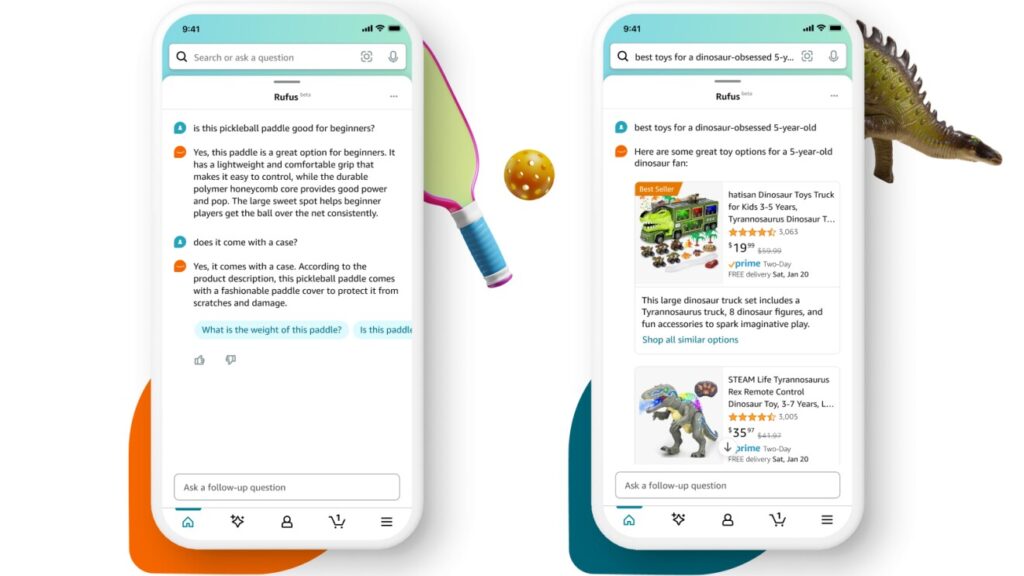
In February 2024, Amazon launched Rufus, an AI shopping assistant built directly into the Amazon app. It’s like having a helpful chat companion while you shop. Trained on Amazon’s massive product catalog, customer reviews, and Q&A content, Rufus can handle open-ended questions like “What’s a good gift for a 2-year-old girl who loves dinosaurs?”. It can also compare products, refine your choices as you chat, and help you find exactly what you want without having to scroll endlessly.
Behind the scenes, Rufus runs on a custom-built language model that’s fine-tuned for shopping and product reasoning. It combines real-time catalog data such as product specs, prices, and customer reviews with your shopping context. This allows Rufus to remember what you’ve already asked or what’s in your cart, so its answers feel more personal and relevant.
Rufus helps shoppers in several ways:
- Learn while you shop: You can ask broad questions like “what should I look for when buying headphones?” or “what are clean beauty products?” and get quick, useful tips to guide your choices.
- Shop by purpose: Looking for gear for a hobby or event? Just ask things like “what do I need for playing pickleball in winter?” or “how do I start an indoor garden?” Rufus will suggest the right product categories and related ideas to explore.
- Compare options: Unsure about differences between products? Ask Rufus to explain, like “serum vs essence” or “ceremonial vs culinary-grade matcha” and it’ll help you decide what fits you best.
- Get personalized picks: You can ask for tailored suggestions, such as “trendy gift for Woman’s Day” or “dinosaur toys for a 3-year-old,” and Rufus will instantly narrow down the best matches based on what you’ve already asked, what’s in your cart and your purchase history.
- Ask about specific products: While viewing an item, you can ask things like “is this good for beginners?” or “is it machine washable?” Rufus gives instant answers based on product info, reviews, and customer Q&As.
You can access Rufus anywhere in the mobile app, from the search bar to the product page, and it can link straight to checkout or your wish list.
For customers, AI makes shopping faster and easier. It reduces decision fatigue, shortens the time spent searching, and builds confidence by showing clear comparisons. Early trials showed that people added more items to their carts and stayed longer in the app, especially on mobile devices.
For Amazon, AI helps drive more engagement and conversions, which means higher sales and ad revenue. It also provides valuable insights into shopper intent, helping improve ad targeting and inventory planning. Rufus meaningfully improves how easy it is for customers to find and discover the best products to meet their needs, integrated seamlessly into the same Amazon shopping experience they use regularly.
Of course, there are challenges too. Ensuring accuracy and protecting privacy are top priorities. Amazon uses fact-checking systems, secure data handling, and gives users control over their data. Looking ahead, Rufus is expected to expand with voice features through Alexa, photo-based search, and support for more local languages to serve customers worldwide.
Downsides of AI implementation in E-commerce UX
AI brings a lot of benefits to online shopping, but it’s not all smooth sailing. Here are a few downsides businesses need to watch out for:
- Cost: Setting up AI isn’t cheap. It takes money for software, hardware, and skilled people to keep it running. For small businesses, that can be a real hurdle, and the return on investment isn’t always guaranteed. It’s smart to carefully check whether the cost actually makes sense before jumping in.
- Privacy issues: AI runs on data — a lot of it. That means collecting and analyzing customer information, which can make some people uneasy. Online stores need to be upfront about what they collect and make sure that data stays safe.
- Less human touch: Even though AI can personalize your shopping, it can’t replace the warmth of a real conversation. Chatbots can sound robotic and miss the human empathy that customers sometimes need. The best approach is mixing AI efficiency with real human support.
- Bias: If AI is trained on limited or unbalanced data, it can unintentionally favor certain groups over others. This can hurt a brand’s image, so businesses need to regularly check their systems and fix any unfair patterns.
- Security risks: Like any tech system, AI can be a target for hackers. Protecting customer data means constant security updates and monitoring — it’s not a one-time job.
Proposed Solutions for New E-Commerce Platforms
If you’re building or improving an online store, here are some practical ways to bring AI into the experience:
Start Modular
Don’t try to build a giant “AI system” all at once. Instead, pick one area that matters most, maybe product recommendations, a chatbot, or smart search and start there.
Connect each new AI feature through simple APIs so you can upgrade later without breaking everything else.
Think of it like building Lego blocks instead of pouring concrete.
Use Data Feedback Loops
AI gets smarter only when it learns from real behavior.
Make sure your system logs user actions and compares them with AI predictions. If users ignore certain recommendations, retrain the model with that insight.
Dashboards can track metrics like add-to-cart rate, time spent on page, or interaction after chatbot use.
Test and Explain
People trust AI more when it’s transparent.
Use tools that explain why an item was recommended (“because you viewed similar styles”) and run A/B tests to see if AI suggestions really improve results.
Gradual rollouts help you measure success and avoid surprises.
Respect Privacy
Personalization should never feel creepy.
Follow privacy-by-design principles: anonymize data, encrypt sensitive info, and let users manage what data they share.
From a developer’s side, build secure APIs and access controls; from a business side, be honest about how data improves customer experience.
Conclusion
For business to decide whether to bring AI into their e-commerce business isn’t always simple. Despite the fact that the technology has a lot to offer, it also comes with a few challenges. Costs, data privacy, the lack of human touch, possible bias, and security risks are all things worth thinking about before diving in.
That said, the upsides can be huge. AI can personalize shopping experiences, make searches smarter, speed up operations, detect fraud, and even help manage stock more efficiently. Used the right way, it can give your business a real edge and make customers happier.
In the end, it’s all about balance. Every business should take time to look at its goals, weigh the pros and cons, and figure out how AI can truly add value. When done thoughtfully, AI isn’t just another tech trend but a powerful tool to help your business grow and stand out among competitors.