


In this fast-developing world of software development, CI/CD (Continuous Integration and Continuous Deployment) pipelines have become essential to automate the build, test, and deploy phases in the life cycle of a software product. As applications are increasingly using Kubernetes for orchestration, the ability to ensure the integrity and recoverability of Kubernetes resources and data is also becoming crucially important. This is where Velero, a powerful tool for backup and restore of Kubernetes resources and persistent volumes, comes into action. Integrating Velero with CI/CD pipelines enhances automation and enables a smooth backup and restore operation as part of the deployment workflow. In this article we will see how to integrate Velero within CI/CD pipelines and details the process to automate Kubernetes backup and restore workflows.
Understanding Velero and CI/CD
Before we move to the integration, let us quickly review Velero and CI/CD pipelines.
Velero is an open-source tool to safely back up, recover, and migrate Kubernetes cluster resources and persistent volumes. It supports various back-end storage and integrates with Restic for file system backups, providing a complete data protection solution for Kubernetes environments.
CI/CD Pipelines automate the stages of delivering software, starting from changes in the codebase to deployment. It is the process of Continuous Integration and ensures that after the build, code commits are tested; after the tests, it is packaged, deployed, and readied for production. Continuous Deployment extends this by deploying tested changes to production environments automatically.
Why Integrate Velero with CI/CD Pipelines?
There are several reasons for integrating Velero with CI/CD pipelines. The most important ones are:
Automated Backup and Restore: Backup processes are automated before deployment, and a restoration process is set while performing rollbacks, which keeps data safe and enhances application stability.
Maintain Consistent Environments: Ensure the production environment is the same as what passed through staging by restoring configurations and data.
Faster Recovery: Since the process of restoration is automated, the recovery process post-disaster is faster.
Audit Trails: Maintain an audit trail of backups and restores, which helps in compliance and in the process of troubleshooting.
Steps to Integrate Velero with CI/CD Pipelines
1. Install and Configure Velero
First, you should get Velero installed and set up in your Kubernetes cluster. This includes setting up Velero with access to your backup storage location (e.g., AWS S3, Google Cloud Storage) and configuring any necessary encryption settings.
2. Define Backup and Restore Commands
Define the commands for creating backups and restoring from backups. These commands will be integrated into your CI/CD pipeline scripts. For an instance, this can be your backup command:
velero backup create my-ci-cd-backup –include-namespaces=my-namespace
And just like that, your restore command can be something like this:
velero restore create –from-backup my-ci-cd-backup
3. Integrate with CI/CD Pipeline
Depending on your CI/CD tool (Jenkins, GitLab CI, GitHub Actions, etc.), you can integrate the Velero commands into your pipeline configuration. Here’s a generic example using YAML syntax for GitHub actions, which might be adapted for your specific CI/CD tool:
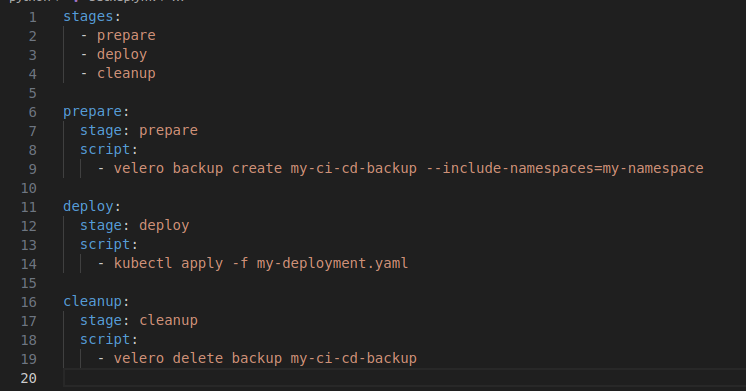
Let’s see what we have in the above example. We are using the “velero backup” command to create a complete backup of resources inside my-namespace before applying the new manifest. So that if anything goes wrong and we are unable to rollback the changes immediately we can restore the newly created backup to tackle this challenge. There can be multiple usecase for this backup as well based on your requirements.
Moreover, if you want to customise the backups, have a look at how we can customise the Velero backups.
Conclusion
Velero helps automate backup and restore, enhancing the level of reliability and efficiency in the workflow of deploying software. Organizations can follow the outlined steps to ensure their Kubernetes environments are resilient, recoverable, and aligned with DevOps principles. As the adoption of Kubernetes continues to grow, so does the importance of robust data protection strategies. That makes Velero an invaluable tool in the modern developer’s toolkit.