


This article covers the basics and theory of gRPC and in upcoming parts I will tell you the implementation of the all gRPC communication patterns (server-streaming, client-streaming, bidirectional-streaming, and unary RPC)
Introduction to gRPC
gRPC, which stands for Google Remote Procedure Call, is a high-performance, open-source framework designed by Google. Built on top of the HTTP/2 protocol, gRPC leverages Protocol Buffers (protobufs) for efficient data serialization, making it a powerful tool for developing distributed systems and microservices. Protocol Buffers are a language-neutral, platform-neutral, and extensible mechanism for serializing structured data, enabling easy communication between services written in different languages. This article will delve into the fundamentals of gRPC, covering its various communication patterns and how to implement a simple client-server communication in an ASP.NET Core Web API application.
gRPC Communication Patterns
gRPC supports four primary types of communication patterns:
- Server-Streaming RPC
- Client-Streaming RPC
- Bidirectional-Streaming RPC
- Unary RPC
Server-Streaming RPC
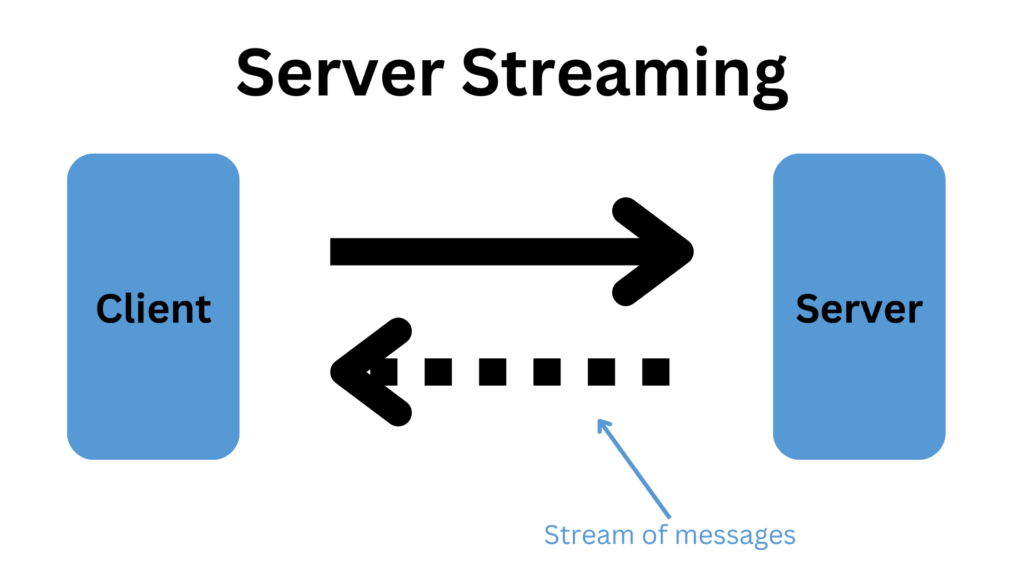
In a server-streaming RPC, the client sends a single request to the server and receives a stream of messages in response. The server sends multiple messages back to the client over a single connection, which the client reads sequentially. This pattern is useful for scenarios where the server needs to provide multiple pieces of data in response to a single request, such as retrieving a list of records from a database.
Client-Streaming RPC
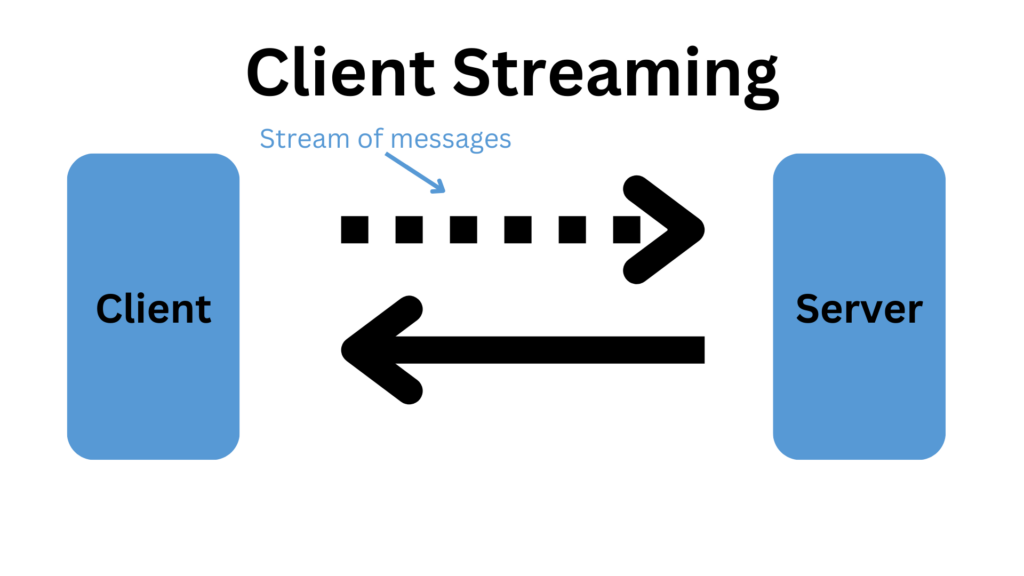
Client-streaming RPC allows the client to send a stream of messages to the server instead of a single message. The server processes the stream and typically sends back a single response after it has received all the client’s messages. This pattern is beneficial for operations that involve uploading a large amount of data, such as file uploads or streaming sensor data.
Bidirectional-Streaming RPC
Bidirectional streaming in gRPC enables both the client and the server to send a stream of messages to each other over a single connection. This pattern supports real-time, asynchronous, and continuous communication, allowing both parties to read and write messages in an ongoing interaction. Bidirectional streaming is ideal for chat applications, live data feeds, or any scenario where real-time bidirectional communication is required.

Unary RPC
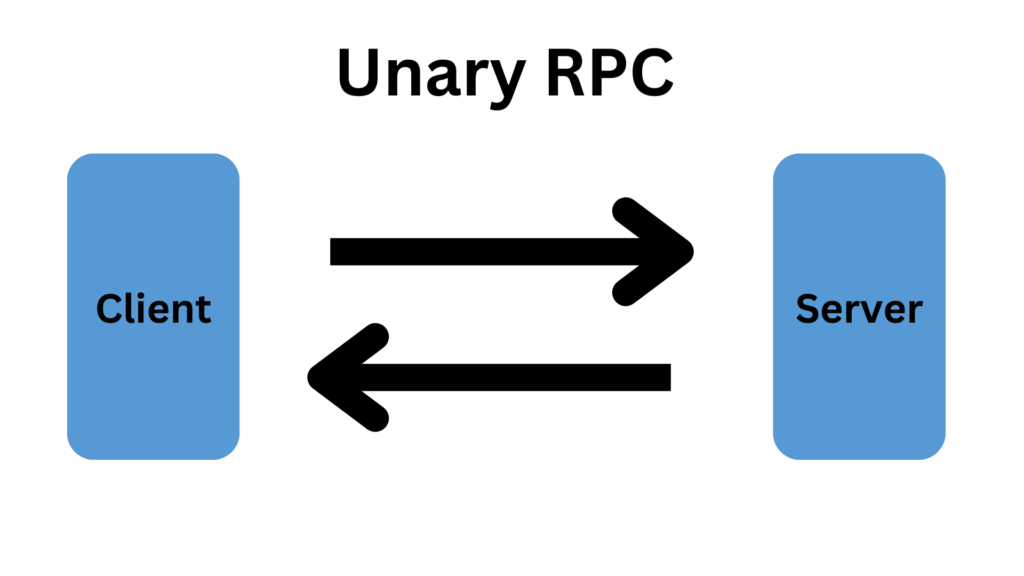
A unary RPC is the simplest type of gRPC communication. In this pattern, the client sends a single request to the server and receives a single response. This is akin to traditional HTTP request-response mechanisms. Unary RPC is suitable for operations where the client needs to send one request and expect one response, such as querying data from a database or performing a single calculation.
Serialization Formats in gRPC
Serialization is a critical aspect of gRPC, as it determines how data is encoded and decoded during communication. gRPC supports multiple serialization formats, with Protocol Buffers being the default and most recommended.
Types of Serialization
- Protocol Buffers (Language-neutral, efficient way to define data structures)
- JSON (Human-readable, easy to use)
Protocol Buffers
Protocol Buffers (protobufs) are the default serialization format for gRPC. Developed by Google, protobufs are a language-agnostic, binary serialization format that is both efficient and extensible. In gRPC, you define your data structures using .proto files, which specify the messages and their fields. The Protocol Buffers compiler then generates strongly-typed code for serialization and deserialization in your target language (e.g., C# for .NET Core applications). Protobufs are highly efficient in terms of both size and speed, making them ideal for high-performance applications.
JSON
While Protocol Buffers are recommended, gRPC also supports JSON serialization. JSON (JavaScript Object Notation) is a human-readable, text-based format that is widely used for data interchange. JSON is easy to use and understand, making it a good choice for applications that require human readability or need to interoperate with systems that do not support protobufs. However, JSON is generally less efficient than protobufs in terms of serialization size and speed.
Advantages of gRPC
- High Performance:
- gRPC uses HTTP/2, which allows for multiplexing multiple requests over a single connection, reducing latency and improving performance.
- The protocol buffers (protobuf) used by gRPC are more efficient in terms of serialization and deserialization compared to JSON.
- Language Agnostic:
- gRPC supports multiple programming languages (e.g., Java, C#, Go, Python, etc.), making it suitable for polyglot environments.
- It provides language-specific libraries that simplify implementation.
- Streaming Support:
- gRPC natively supports various types of streaming (unary, server streaming, client streaming, and bidirectional streaming), facilitating real-time communication between services.
- gRPC natively supports various types of streaming (unary, server streaming, client streaming, and bidirectional streaming), facilitating real-time communication between services.
- Strongly Typed Contracts:
- gRPC uses protocol buffers to define service contracts, ensuring type safety and consistency between client and server.
- This leads to fewer runtime errors and more reliable communication.
- Efficient Communication:
- Protocol buffers are compact and efficient, resulting in lower network bandwidth usage and faster transmission times.
- gRPC also supports advanced features like load balancing, authentication, and service discovery.
- Code Generation:
- gRPC automatically generates client and server code from service definitions, speeding up development and reducing boilerplate code.
- gRPC automatically generates client and server code from service definitions, speeding up development and reducing boilerplate code.
- Error Handling:
- gRPC has a robust mechanism for handling errors, with well-defined status codes and rich error details.
- gRPC has a robust mechanism for handling errors, with well-defined status codes and rich error details.
Use Cases for gRPC
- Microservices Communication:
- gRPC is ideal for internal microservices communication due to its high performance and efficient serialization.
- gRPC is ideal for internal microservices communication due to its high performance and efficient serialization.
- Real-time Communication:
- Applications requiring real-time data exchange, such as chat applications, live sports updates, or stock trading platforms, benefit from gRPC’s streaming capabilities.
- Applications requiring real-time data exchange, such as chat applications, live sports updates, or stock trading platforms, benefit from gRPC’s streaming capabilities.
- Polyglot Environments:
- Environments with multiple programming languages benefit from gRPC’s language agnostic design and automatic code generation.
- Environments with multiple programming languages benefit from gRPC’s language agnostic design and automatic code generation.
- Low-latency Applications:
- Applications where performance and low latency are critical, such as gaming or high-frequency trading platforms, can leverage gRPC’s efficiency.
- Applications where performance and low latency are critical, such as gaming or high-frequency trading platforms, can leverage gRPC’s efficiency.
- IoT and Mobile Applications:
- gRPC’s compact message format and efficient communication make it suitable for IoT devices and mobile applications with limited bandwidth.
- gRPC’s compact message format and efficient communication make it suitable for IoT devices and mobile applications with limited bandwidth.
- Cloud-Native Applications:
- Modern cloud-native applications that utilize container orchestration platforms like Kubernetes can take advantage of gRPC’s features like load balancing and service discovery.
- Modern cloud-native applications that utilize container orchestration platforms like Kubernetes can take advantage of gRPC’s features like load balancing and service discovery.
Next Steps
This concludes Part 1 of our exploration of gRPC. In the next upcoming parts, we will see into the implementation of gRPC in .NET 8, covering the different types of gRPC methods: unary, client streaming, server streaming, and bidirectional streaming.