



Introduction
The rapid evolution of cross-platform development frameworks has introduced a plethora of choices, each with its strengths and considerations. Notably, Flutter, React Native, and the emerging Kotlin Multiplatform (KMP) are state-of-the-art (SOTA) technologies that support creating multi-platform apps.
Flutter: Flutter, developed by Google, is known for its expressive UI and hot reload feature, enabling rapid development and real-time updates. Its Dart programming language offers a modern and reactive approach to building cross-platform applications.
React Native: Backed by Facebook, React Native has gained popularity for its extensive community support and the ability to leverage existing web development skills. It uses JavaScript and React to build native-like mobile applications for both iOS and Android.
Kotlin Multiplatform (KMP): developed by JetBrains, is a rising star in the cross-platform arena. Leveraging Kotlin, it emphasizes code sharing between platforms while allowing seamless integration of platform-specific code when necessary. Its interoperability with existing Java and Swift codebases is a notable advantage.
In this article, we will delve into an in-depth exploration of Kotlin Multiplatform (KMP) and discovering what kind of project suitable for it
What is KMP?
Before delving into the Kotlin Multiplatform (KMP), let me introduce Kotlin Multiplatform Mobile (KMM) first.
Kotlin Multiplatform Mobile (KMM) emerges as an essential Software Development Kit (SDK) tailored for iOS and Android app development. Essentially, KMM encapsulates the core capabilities of Kotlin Multiplatform while seamlessly incorporating mobile-specific elements, making it a comprehensive solution for cross-platform mobile application development.
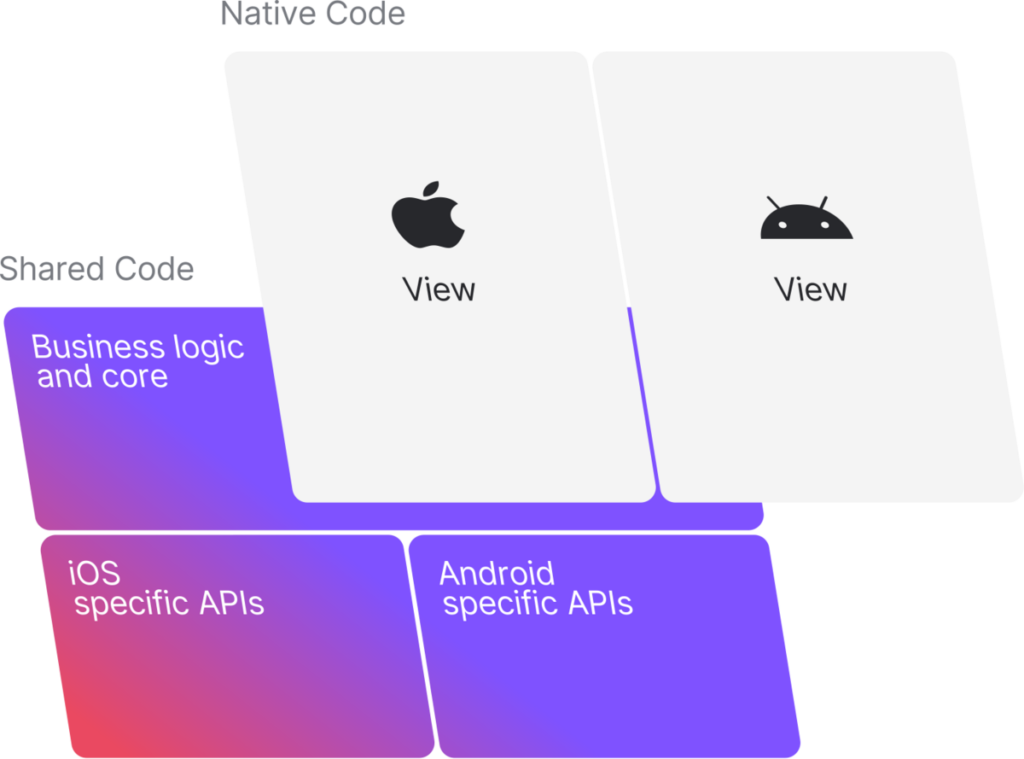
Figure: Kotlin Multiplatform Mobile (Source: https://kotlinlang.org/lp/mobile )
Kotlin Multiplatform (KMP) empowers developers to craft applications for diverse platforms, facilitating efficient code reuse while preserving the advantages of native programming. This approach ensures that your multiplatform applications seamlessly operate across various operating systems, including but not limited to iOS, Android, macOS, Windows, Linux, and more.

Figure: Kotlin Multiplatform (Source: https://kotlinlang.org/docs/multiplatform.html)
Kotlin Multiplatform (KMP) stands as a powerful tool, offering developers the flexibility to share code with variable intensity across diverse systems. This innovative technology empowers developers to leverage code reuse to their desired extent, incorporate native code when needed, and effortlessly integrate shared Kotlin code into diverse projects.
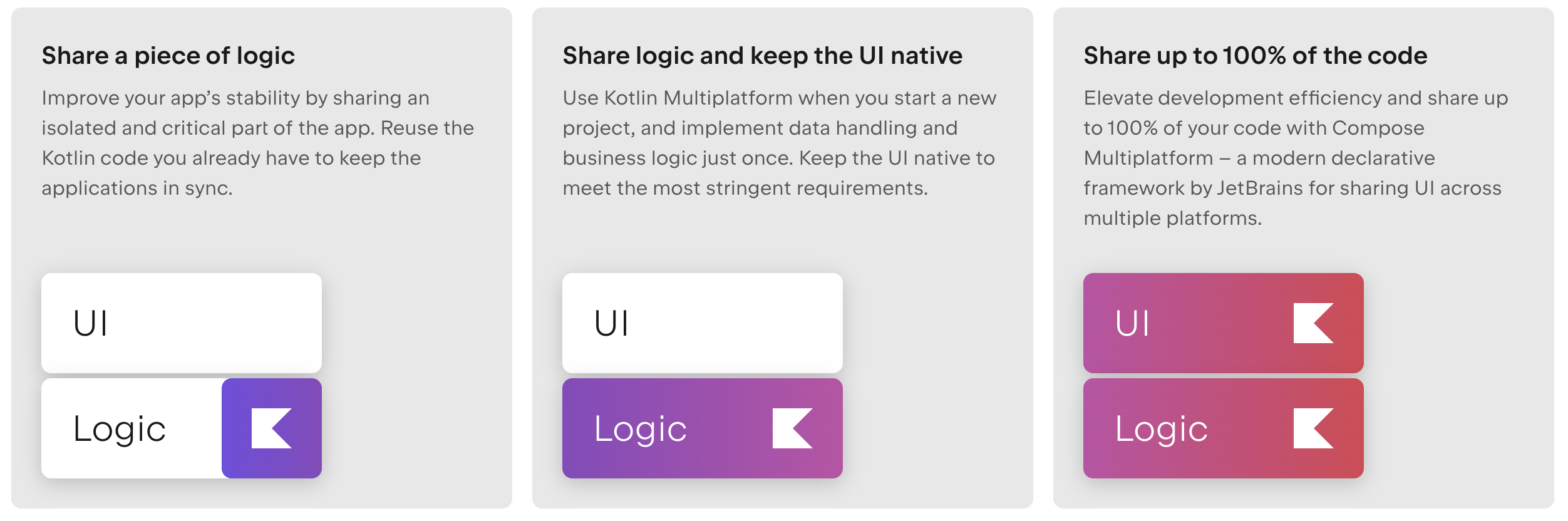
Kotlin Multiplatform use cases:
– Android and iOS applications: Kotlin Multiplatform makes it easy to share code between Android and iOS in cross-platform mobile apps. This means you can use the same code for tasks like networking, data storage, validation, analytics, computations, and other application logic, streamlining the development process for both platforms.
– Multiplatform libraries: Kotlin Multiplatform is beneficial for library creators. With it, you can build a library with shared code and platform-specific versions for JVM, web, and native platforms. After publishing, this library can be easily used as a dependency in other cross-platform projects.
– Desktop applications: Compose Multiplatform helps share UIs across desktop platforms like Windows, macOS, and Linux. You can try it Compose Multiplatform desktop application template to create your own project with UIs shared among desktop platforms.
When to choose Kotlin Multiplatform
Kotlin Multiplatform (KMP) emerges as the quintessential solution for crafting new applications, especially those demanding a substantial amount of platform-specific code. Its versatility becomes even more evident when considering the migration of existing, natively developed apps, owing to the scalability it affords in code sharing.
Seamless Migration and Iterative Development: KMP offers a seamless migration path for existing apps, allowing developers to iteratively transition towards a shared codebase. This scalability proves invaluable, ensuring a smooth evolution from native development to a more unified and efficient approach.
Scalability for Performance Excellence: The scalability of Kotlin Multiplatform doesn’t just facilitate migration; it also guarantees excellent performance, even when dealing with complex features. This scalability makes KMP an ideal choice for larger projects where performance is paramount and the demand for platform-specific code is substantial.
Effective Handling of Natively Implemented Features: Kotlin Multiplatform excels not only in shared code scenarios but also in creating applications requiring natively implemented features. This effectiveness stems from its ability to seamlessly integrate natively implemented elements within a shared codebase, striking a harmonious balance between platform-specific functionalities and shared code efficiency.
In essence, Kotlin Multiplatform stands as a powerful ally for app development . Whether you are embarking on new projects demanding a blend of shared and platform-specific code or navigating the iterative migration of existing native apps. Its scalability and performance prowess make it a strategic choice, particularly for larger projects where code efficiency and platform-specific functionalities are crucial.
Kotlin Multiplatform ecosystem and case studies
The evolution of Kotlin Multiplatform transcends its technological prowess, extending its influence into a thriving ecosystem nurtured by thousands of Kotlin developers worldwide. Since its Beta release, the KMP library count has multiplied, offering a diverse array of tools for networking, data storage, arithmetic operations, analytics, and more. This abundance empowers developers to build applications swiftly and confidently.

Google’s Ongoing Support: The Android team at Google continues to bolster KMP users by providing cross-platform experimental versions of Jetpack libraries. Notably, they have crafted Kotlin Multiplatform-compatible versions of libraries such as Collection, DataStore, Annotation, and Paging, reinforcing the seamless integration of KMP into Android development.
Expanding iOS Developer Experience: The KMP ecosystem extends its reach to enhance the iOS developer experience, prominently featuring Touchlab’s SKIE. This innovative tool generates Swift code, furnishing a Swift-friendly API layer. It seamlessly connects essential Kotlin types and leverages the interactive capabilities of Coroutines, ensuring a harmonious cross-platform development experience.
Collaborative Tools and Libraries: The collaborative spirit within the KMP ecosystem is evident through the creation of various tools and libraries. These offerings not only simplify the development process but also foster a sense of community-driven progress within the global Kotlin developer community.
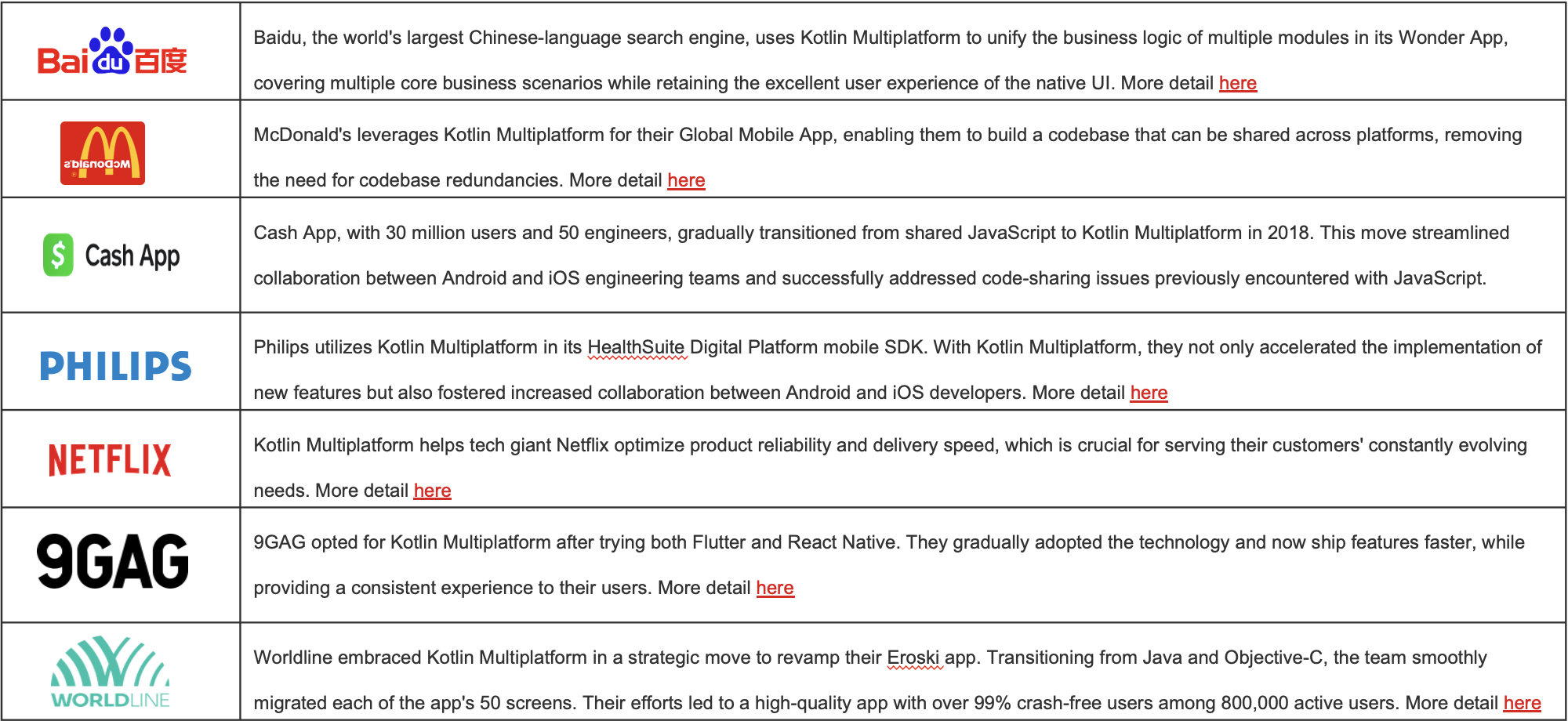
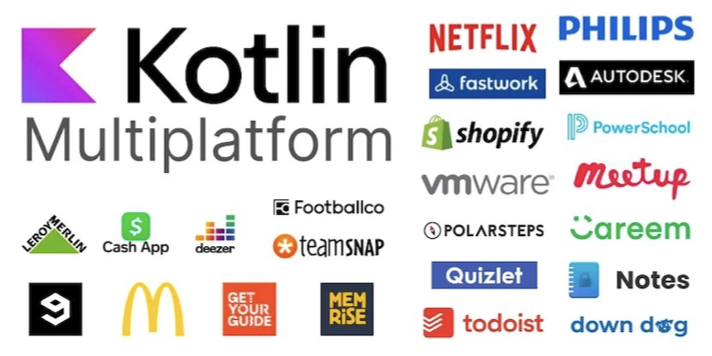
Discover how major companies leverage Kotlin Multiplatform for cross-platform development. They apply different code-sharing strategies. From integrating into existing apps and sharing a portion of app logic to building new applications based on Kotlin Multiplatform and Compose Multiplatform.
And more……
Kotlin Multiplatform Development Roadmap for 2024
Compose Multiplatform
- Improve rendering performance on iOS.
- Implement a common API for sharing all types of resources.
- Integrate with iOS and Desktop accessibility APIs.
Tooling
- Migrating Kotlin IDE plugin to K2 compiler frontend, but also providing a single tool (Fleet)
- Enhanced support for Compose Multiplatform, including live preview for common code and visual debugging tools
Multiplatform core
- The main initiative in this area is a direct Kotlin-to-Swift export
- Enhancing CocoaPods integration, and introducing support for exporting your framework with SwiftPM.
Library ecosystem
- Make it possible to build and publish a KMP library without having a Mac machine.
Conlusion
Kotlin Multiplatform (KMP) is more than just a tech solution. It’s a driving force behind a thriving ecosystem that’s making waves across platforms. The substantial increase in KMP libraries since its Beta release signals widespread adoption and the active involvement of a global community of Kotlin developers. The consistent backing from the Android team at Google, exemplified by Kotlin Multiplatform-compatible versions of essential Jetpack libraries. Beyond Android, the ecosystem’s extension into iOS development, exemplified by tools like SKIE. This reflects a commitment to delivering a seamless cross-platform experience.
In next part, we will start to create a new project with KMM (Android/IOS) and apply some libraries are commonly used in day-to-day life while working with KMM (Kotlin Multiplatform Mobile) like: Ktor, SQLDelight, Kotlin-DateTime, Kotlin-Serialization, Kotlin coroutines