


Introduction to DSLs:
A DSL (Domain Specific Language) is a specialized programming language or syntax designed to meet the needs and challenges within a specific domain or problem area. Unlike general programming languages such as Kotlin, Java, or Python, which are intended to be versatile and applicable in different domains, DSLs are narrowly focused and optimized for tasks in a specific area.
In software development, optimizing applications requires adjusting settings like database connections and API endpoints. Orchestrating these configurations clearly presents a significant challenge.
Overview of Kotlin’s DSL Capabilities:
In the context of Kotlin, features such as extension functions, lambda expressions, and operator overloading provide developers with powerful tools for building domain-specific languages (DSLs).
These features allow developers to manipulate the syntax and semantics of the language to adapt it to the problem domain. Now let’s consider a real-world problem: When developers are tasked with defining custom validation rules for user input in a web application. This involves ensuring that the data entered by users meets certain criteria, such as a certain length, a certain format, or meeting specific business needs.
Traditionally, without the use of DSLs, developers could implement validation logic using conditional statements or complex function calls. This approach can result in verbose code that is difficult to understand and maintain, especially as validation requirements become more complex.
However, Kotlin’s DSL features allow developers to create a special language for defining, validation rules that reads more like natural language and is easier to understand.
Benefits of Kotlin DSLs:
Kotlin DSLs for UI layout definition offer significant benefits in terms of improved readability and maintenance, enabling developers to create UI code that is clearer, more concise, and easier to maintain, ultimately leading to a more efficient development process and a better user experience.
Improved Readability:
Developing complex user interfaces (UIs) for applications can present difficulties for developers when attempting to represent the layout structure in code. Conventional methods, like the use of declarative or imperative syntax, can result in verbose, confusing, and hard-to-read code.
To define UI layouts, Kotlin DSLs provide a more natural and expressive method. Through the utilization of Kotlin’s syntactic features, like lambdas and extension functions, developers craft DSLs that mimic the UI’s visual representation.
Problems:
Designing user interfaces with nested layouts and complex view hierarchies can quickly become overwhelming, especially as the complexity of the user interface increases. Without a clear and intuitive way to express the layout structure in code, developers may find it difficult to understand and modify the UI codebase, leading to maintenance issues and potential bugs.
Using a DSL like the one shown above allows developers to overcome these challenges by creating code that accurately reflects the visual layout of the user interface. This improves readability by making the code more descriptive and easier to understand, even for developers who are not intimately familiar with the codebase. Additionally, the use of DSLs can streamline the process of changing and extending user interfaces, improving maintainability and reducing the risk of introducing bugs.
Internal DSLs:
Internal DSLs, also called embedded DSLs, are DSLs that are implemented within the syntax and semantics of an existing programming language, in this case, Kotlin itself. They use the features and constructs of the language to provide a more expressive and intuitive way to solve problems within a specific domain. In Kotlin, internal DSLs are usually created using techniques such as function literals with receiver (also known as lambda with receiver). , extension functions, and builder patterns.
When to Use?
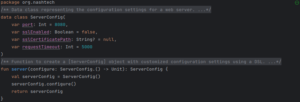
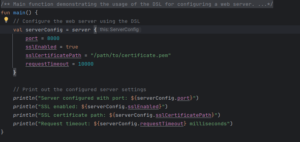
Internal DSLs are often used in scenarios where the problem domain is closely related to the host language and simplicity and ease of use are desired. Examples include validation libraries, testing frameworks, and configuration APIs.
External DSLs:
External DSLs are, as the name suggests, DSLs that have their own syntax and semantics different from the host language (Kotlin). These DSLs are typically defined using a custom syntax and parsed by specialized parsers to translate them into executable code.
When to Use?
Practical Applications of Kotlin DSLs:
Best Practices and Tips:
-
Use Meaningful Names:
- Choose descriptive names for functions, properties, and parameters within your DSL to clearly convey their purpose.
- When naming elements of the DSL, use domain-specific terminology to adapt to the problem domain.
-
Provide Clear Documentation:
- Document each function, feature, and concept within the DSL using comments or KDocs to explain their purpose, behavior, and use.
- Include examples and use cases to illustrate how the DSL should be used in practice.
-
Follow Consistent Conventions:
- Establish consistent naming, syntax, and usage pattern conventions across the DSL to promote predictability and understandability.
- Adhere to Kotlin language conventions and idioms to maintain consistency with the rest of the codebase.
-
Optimize for Readability:
- When designing your DSL, focus on readability and clarity so that developers can easily understand and use it effectively.
- Avoid overly complex or complicated syntax that could confuse or overwhelm users of the DSL.
-
Provide Error Handling Mechanisms:
- Implement error handling mechanisms within the DSL to detect and report invalid configurations or misuse of DSL elements.
- Communicate error messages clearly and provide instructions for resolving common problems.
-
Support IDE Features:
- Leverage Kotlin’s language features to improve IDE support for the DSL, such as Code completion, syntax highlighting, and refactoring functions.
- Design the DSL to be compatible with IDE features to improve developer productivity and usability.
-
Offer Extensibility and Customization:
- Design the DSL to be extensible and customizable so developers can easily add new features or change existing behavior.
- Provide extension points or hooks within the DSL to allow users to customize the DSL to their specific needs.
-
Encourage Testability:
- Design the DSL to make it easier to test DSL code and configurations, allowing developers to effectively write unit tests and integration tests.
- Provide utilities or frameworks for testing DSL configurations to ensure correctness and reliability.
-
Solicit Feedback and Iterate:
- Encourage users of the DSL to provide feedback on usability, clarity, and functionality.
- Revise the design of the DSL based on user feedback and evolving needs to continually improve its effectiveness and usability.
-
Document Design Decisions:
- Document the reasons for design decisions, such as the selection of syntax, structure, and functions to provide context for future maintainers and users of the DSL.
- Explain trade-offs and considerations that influenced the design of the DSL to facilitate understanding and decision-making. Manufacturing.
Conclusions: