


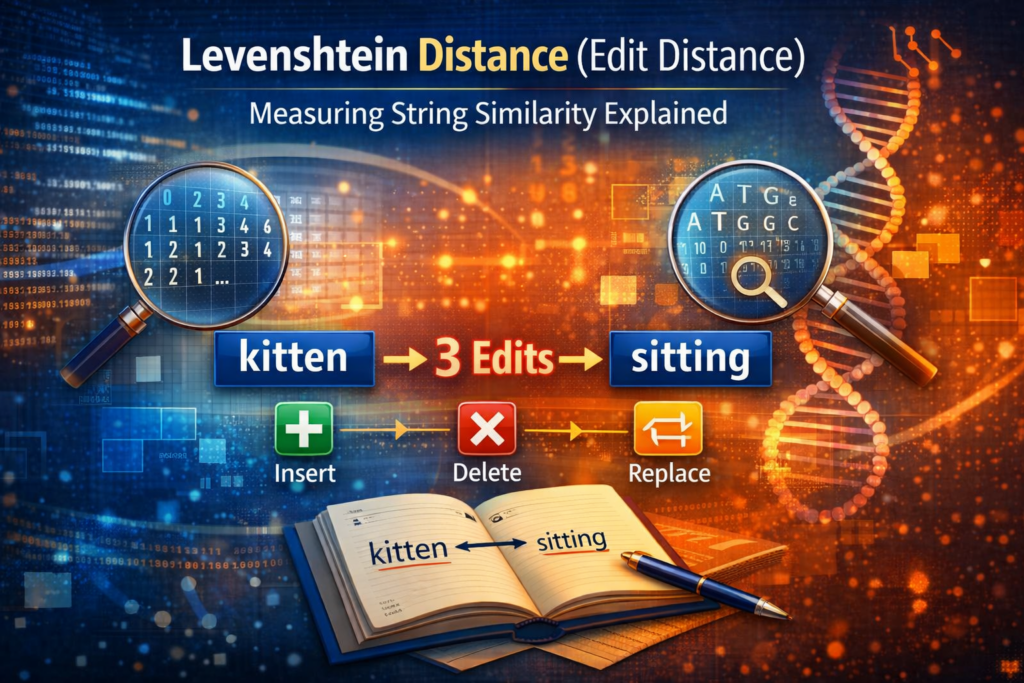
In the world of software development, we often deal with text – usernames, search queries, passwords, DNA sequences, log messages, and much more. But what happens when the text isn’t exactly the same? How do we measure how similar two strings are?
That’s where Levenshtein Distance, also known as Edit Distance, comes into play.
Introduction
Imagine you type “javva” instead of “java” in a search bar. Even though the spelling is slightly wrong, you still expect the system to understand what you meant.
But how does the system know that “jaava” is close to “java”?
The answer lies in Levenshtein Distance – a mathematical way to calculate how many small changes are needed to convert one string into another.
It was introduced by the Russian scientist Vladimir Levenshtein in 1965, and today it is widely used in search engines, spell checkers, plagiarism detection tools, and even bioinformatics.
What is Levenshtein Distance?
Levenshtein Distance measures the minimum number of single-character edits required to transform one string into another.
There are only three allowed separations:
- Insertion -> Add a character
- Deletion -> Remove a character
- Substitution -> Replace one character with another
Each operation costs 1 step.
Example
Let’s Compare:
kitten
sitting
To convert kitten -> sitting, we need:
- Replace k with s -> sitten
- Replace e with i -> sittin
- Insert g at the eng -> sitting
Total edits = 3
So, the Levenshtein Distance between “kitten” and “sitting” is 3.
The smaller the number, the more similar the strings are.
Why is it important?
Levenshtein Distance is extremely useful in real-world systems.
1 Spell Checkers
when you type:
recieve
The system compares it with dictionary words and suggests:
receive
because the edit distance is small.
1 Search Engines
search engines tolerate typos:
microsofft
still shows:
microsoft
3 Plagiarism Detection
If two texts are slightly modified but mostly similar, edit distance can detect similarity.
4 DNA sequence matching
In bioinformatics, small mutations in DNA sequences are measured using edit distance.
How does it work internally?
Levenshtein Distance is usually implemented using Dynamic Programming.
We create a 2D matrix:
- Rows represent characters of string A
- Columns represent characters of string B
- Each cell stores the minimum edits needed up to that point
The algorithm:
- Initialize the first row and column
- compare characters
- if same -> copy diagonal value
- if different -> take minimum of : 1 + min ( insert, delete, replace)
Time complexity
O(m * n)
where m = length of first string
n = length of second string
optimized versions reduce space to O(min(m,n))
Intuition Behind the Algorithm
Think of it like this:
At every character comparison, we ask:
“What is the cheapest way to reach here?”
And we store that result so we don’t recompute it again.
When should you use it?
Use Levenshtein Distance when:
- You expect typos
- You want fuzzy matching
- You need similarity scoring
- Exact matching is too strict
Avoid it when:
- You need extremely high performance on very large strings
- Real-time performance with huge datasets (without optimization)
Conclusion
Levenshtein Distance is a simple yet powerful concept that helps computers understand similarity between strings – even when they’re not exactly the same.
By counting the minimum number of insertions, deletions, and substitutions, we can quantify “closeness” between words.
From spell checkers to search engines to DNA analysis, this small mathematical idea has a massive real-world impact.
If you’re preparing for interviews, working on search features, or building intelligent systems, understanding Levenshtein Distance is a must.
Because in real life – and in software – things are rarely perfect.