


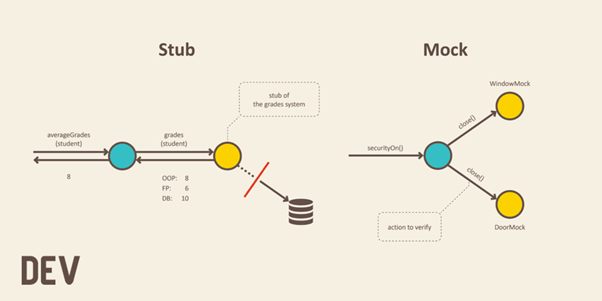
Testing in JavaScript can be difficult, especially for big applications with lots of dependencies and complex logic. Mocking and stubbing come to the rescue by simplifying complex test cases and improving test reliability. In this comprehensive guide, we’ll dive deep into mocking and stubbing in JavaScript, breaking down concepts, showcasing real-world examples, and helping you write better tests for your applications.
What is Mocking in Javascript?
Mocking is the process of creating a simulated version of a function, object, or module to control how it behaves during testing. It allows developers to test components in isolation without relying on external factors like databases, APIs, or third-party services.
For example, when testing an API call, you can “mock” the response to simulate different scenarios without actually making a network request.
Key benefits of Mocking:
- Removes reliance on external systems.
- Increases test reliability.
- Accelerates testing by avoiding slow dependencies.
- Enables simulation of edge cases easily.
Popular tools like Jest, Sinon.js, and Mocha are commonly used in JavaScript for mocking.
What is Stubbing in Javascript?
Stubbing, often confused with mocking, involves replacing a function or behavior with a custom implementation for the scope of your tests. While mocks are focused on expectations and verification, stubs are used to define predetermined behavior.
For instance, when testing a function that depends on a database call, you can replace the database function with a “stub” that returns a fixed value.
Key Characteristics of Stubbing:
- Used to control method behavior.
- Does not verify behavior, unlike mocks.
- Simplifies tests by isolating components.
Stubbing is especially useful when you need to return fixed data in tests without actually executing the real implementation.
Difference between Mocking & Stubbing in Javascript
Although mocking and stubbing are closely related, they serve distinct purposes in test cases.
| Aspect | Mocking in Testing | Stubbing in Testing |
| Purpose in Testing | Used to simulate and verify interactions between the code under test and its dependencies. | Used to control the output or behavior of dependencies to test the code in isolation. |
| Focus on Tests | Focuses on testing how code interacts with external systems, e.g., “Was this API called? How many times?” | Focuses on testing what the code produces by replacing actual implementations with predefined responses. |
| Validation | Verifies interactions such as calls, arguments, and invocation frequency (e.g., expect(mockFn).toHaveBeenCalledTimes(1)) | Does not validate interactions, only provides a controlled response for testing behavior. |
| Testing Goals | Used when testing dynamic behaviors or processes involving external components like APIs, databases, or other modules. | Used when returning predictable data is more important than verifying behavior. |
| Real-World Testing Example | Mock an HTTP client (like axios) to check whether it was called with specific headers or payloads. | Stub a database query to always return a specific user object for testing business logic. |
| Complexity in Testing | Supports complex scenarios such as chaining calls, verifying parameters, or simulating errors. | Simpler, as it focuses only on replacing the original dependency with predefined values or outputs. |
| Common Libraries for Testing | Mocking Tools: Jest (jest.mock), Sinon (sinon.mock), Mocha with Chai (chai-spies). | Stubbing Tools: Sinon (sinon.stub), Jest (can also stub via jest.fn()), and manual implementations. |
Mocking and Stubbing in Testing Scenarios
To further clarify their role in testing, here are common scenarios where mocking and stubbing are applied:
| Testing Scenario | When to Use Mocking | When to Use Stubbing |
| API Testing | Mock an HTTP client to verify the correct request structure (e.g., headers, body, and endpoint). | Stub an API response to test how your code behaves with different server responses. |
| Database Testing | Mock a database client to verify query execution or how many times it was called. | Stub a database method to return specific data (e.g., a predefined user object). |
| Error Handling | Mock a function to simulate exceptions and test how your code handles them. | Stub a method to always throw an error for error scenario testing. |
| Component/Frontend Testing | Mock child components in React to verify if they’re rendered or called with the correct props. | Stub API calls in the component to test rendering logic without relying on real backend data. |
How Mocking and Stubbing Simplify Complex Test Cases in Test Automation
1. Isolating Code for Targeted Testing
One of the biggest challenges in testing is isolating the code under test from its dependencies. Real-world dependencies like databases, APIs, or file systems often make tests slower, less reliable, or harder to write.
With Mocking
We can simulate how our code interacts with dependencies, enabling you to focus on verifying the behavior of the code itself, rather than relying on real implementations.
For example:
- Mocking an HTTP request avoids reliance on an actual server being up.
- It ensures that a test won’t fail due to server downtime, latency, or network issues.
With Stubbing
We can replace actual methods or functions with predefined outputs to test specific scenarios. This ensures predictable results and avoids the complexity of integrating real systems into your test environment.
Example:
Testing a function that fetches data from an API but focuses on how the function processes the data rather than the API call itself.
// Original function
async function getDataFromApi(api) {
  const response = await api.get('/data');
  return response.data.map(item => item.name);
}

// Test Case: Using Stubs
const apiStub = {
  get: jest.fn().mockResolvedValue({
    data: [{ name: 'Alice' }, { name: 'Bob' }],
  }),
};

test('getDataFromApi processes data correctly', async () => {
  const result = await getDataFromApi(apiStub);
  expect(result).toEqual(['Alice', 'Bob']); // Validate logic without actual API calls
});
Here, the stubbed API response simplifies the test, eliminating reliance on a real API.
2. Faster Execution of Test Suites
Dependencies like database queries, network calls, or file system access can significantly slow down test execution. By mocking or stubbing such dependencies, you can create lightweight and efficient test cases.
- Mocks: Allow you to bypass heavy computations or slow interactions, ensuring your test cases run in milliseconds.
- Stubs: Replace slow-running processes (like database queries) with instant, predictable outputs.
Example of Speed Optimization
Imagine testing a service that retrieves user data from a database. Instead of waiting for the database query, you can stub it to instantly return a sample user object.
const db = { getUserById: () => {} };

sinon.stub(db, 'getUserById').returns({ id: 1, name: 'John Doe' });

test('user service returns correct name', () => {
  const user = db.getUserById(1);
  expect(user.name).toBe('John Doe'); // Immediate result without database delay
});
By stubbing the database method, the test executes much faster without compromising on the logic validation.
3. Simplifying Complex Dependencies
In many applications, a single component may depend on several external services. Testing such components without mocking or stubbing would require setting up all dependent services, which can be resource-intensive and error-prone.
- Mocks: Can simulate the interactions of multiple dependencies without actually integrating them.
- Stubs: Provide controlled responses for dependencies so that you can focus on the code being tested.
Example: Complex Dependency Handling
Imagine testing a payment service that interacts with:
- A User Database.
- A third-party payment gateway.
- An email notification system.
Using mocking and stubbing, you can simplify this by isolating the payment logic and providing mock implementations for all dependencies.
const db = { getUser: jest.fn() };
const paymentGateway = { processPayment: jest.fn() };
const emailService = { sendEmail: jest.fn() };

test('payment service processes payments correctly', async () => {
  db.getUser.mockReturnValue({ id: 1, name: 'Alice' });
  paymentGateway.processPayment.mockResolvedValue('Payment Successful');
  emailService.sendEmail.mockResolvedValue('Email Sent');

  const result = await processPayment(1, 100, db, paymentGateway, emailService);

  expect(result).toBe('Payment Processed');
  expect(emailService.sendEmail).toHaveBeenCalled(); // Verify email logic
});
By mocking the database, payment gateway, and email service, you simplify the test case while maintaining complete coverage.
4. Simulating Edge Cases and Errors
Another challenge in complex test cases is reproducing edge cases or simulating failure scenarios, such as:
- A server returning a 500 error.
- A database query throwing an exception.
- A timeout while fetching data.
With mocking and stubbing, you can create these scenarios easily without relying on the real system to fail.
- Mocks: Can be configured to simulate specific errors or unexpected behaviors.
- Stubs: Allow you to explicitly throw exceptions or return error values for failure testing.
Example: Simulating an API Failure with Mocks
const api = { fetchData: jest.fn() };

test('handles API failure gracefully', async () => {
  // Mock API to simulate server error
  api.fetchData.mockRejectedValue(new Error('Server Error'));

  const result = await fetchDataHandler(api);
  expect(result).toBe('Error: Unable to fetch data'); // Validate error handling
});
Conclusion
Mocking and stubbing simplify JavaScript testing by isolating dependencies, speeding up execution, and ensuring reliability. They help create faster, maintainable, and scalable test automation for robust software development.