


Current Challenges of Artificial Intelligence (AI)

Modern artificial intelligence (AI) especially deep learning systems and large language models – has made impressive progress in information processing and content generation. However, these systems are still limited by the fundamental constraints of today’s computing architectures:
To start with, AI consumes an enormous amount of energy. A large model may require thousands of GPUs running around the clock, drawing massive amounts of electricity. Meanwhile, the human brain—despite its remarkable ability to perceive, reason, and adapt—runs on about 20 watts (roughly the power used by a computer monitor in sleep mode). This sharp contrast highlights an important point: current AI achieves performance mainly by scaling up computation, not by using processing mechanisms as efficient or optimized as those in biological neural systems.
Deep learning models usually need huge amounts of data to deliver high accuracy, yet they can still be thrown off by tiny changes in input, miss causal relationships, and struggle to reason when facing situations they haven’t seen before. The human brain, on the other hand, can often learn from just a few examples, sometimes even from a single observation. This gap suggests that today’s AI still leans heavily on large-scale statistical patterns rather than building real conceptual understanding or an internal model of how the world works, the way living organisms naturally do.
Another challenge is adaptability – Traditional AI often struggles when facing new situations because it can’t generalize well. Large Language Models (LLMs) can mimic certain adaptive behaviors through transfer learning and in-context learning, yet this is only a small portion of the human brain’s true capacity for instant adaptability, deep generalization, and creating new knowledge in completely novel situations.
Introduction Organoid Intelligence (OI)
As the structural limits of modern AI become increasingly clear, the need for a complementary approach to intelligence is growing. Organoid Intelligence (OI) has emerged as a promising candidate to help overcome these current limitations. OI is an emerging field at the intersection of computer science and biology, involving the use of brain organoids – tiny tissue cultures grown from stem cells that embody the structure and function of the brain – to perform information processing, learning, and decision – making tasks.
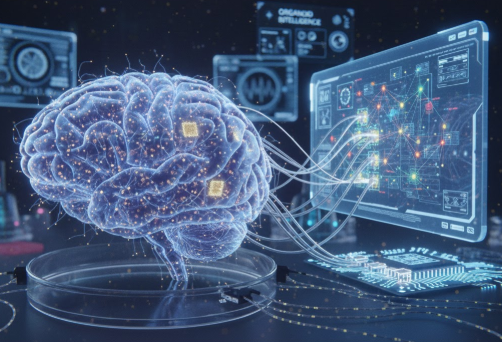
Emerging as a concept inspired by biological principles, OI aims to support systems that are not only computationally powerful but also flexible, resilient, and capable of understanding the world like natural nervous systems.
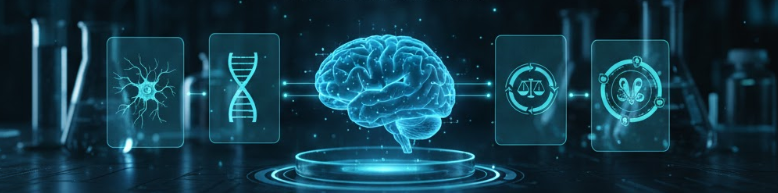
Rather than boosting raw power by adding more parameters or resources, OI focuses on the core traits of living intelligence: energy efficiency, learning from very limited data, continuous adaptability, robustness against noise, and an internal model of the world.
Biological principles underlying OI
Energy Efficiency

The human brain achieves remarkable information-processing efficiency using only about 20 watts of power, thanks to distributed computing, parallel processing, and self-regulating heat mechanisms. OI implements this principle by designing distributed, event-driven architectures that minimize redundant computations and optimize information flow. For example, spiking neural networks (SNNs), inspired by biological electrical signals, only fire when necessary, much like real neurons, saving energy compared to traditional neural networks.
Few-Shot / One-Shot Learning

In nature, living organisms learn from very limited experience but can generalize effectively. Children, for instance, can recognize objects or understand meanings after seeing just a few examples. OI simulates this ability through structured knowledge storage, context-based pattern recognition, and continual learning, instead of relying on millions of training examples. Meta-learning algorithms in OI aim to “learn how to learn,” similar to how children grasp new concepts.
Neural Plasticity & Self-Adaptation
The biological brain continuously restructures neural connections based on experience and environmental feedback. OI models this plasticity through self-adjusting weights, knowledge updates over time, and environment-driven feedback. This allows OI systems to adapt flexibly and process information in changing environments without needing full retraining.
World Modeling & Causal Reasoning
Living organisms do more than just react to their environment – they build internal models to predict the consequences of their actions. OI incorporates this principle through causal models, event mapping, and logic-based prediction. For example, an OI-powered robot navigating an unknown space can anticipate that an object might fall, similar to how humans predict that a tilted glass of water will spill.
Parallel & Hierarchical Processing

The brain processes information hierarchically, from basic sensory neurons to high-level abstract networks. OI embodies this principle with hierarchical processing layers, where small modules handle local tasks that combine to form general understanding. This approach both optimizes energy use and enhances the ability to handle complex information.
Continual Adaptation
Unlike traditional AI, which can “forget” previous knowledge (catastrophic forgetting) when updated, living organisms manage memory efficiently, integrating new knowledge without catastrophic loss of prior information. OI replicates this through synaptic plasticity, enabling incremental knowledge updates, and environmental feedback integration, achieving ongoing adaptive learning.
Knowledge-Behavior Integration
In nature, knowledge and behavior are inseparable—perception and action constantly interact. OI embodies this principle by integrating abstract knowledge, world models, and decision-making behavior, creating an intelligent system that can understand, act, and learn – much like living organisms.
Vision for AI Enhancements with OI
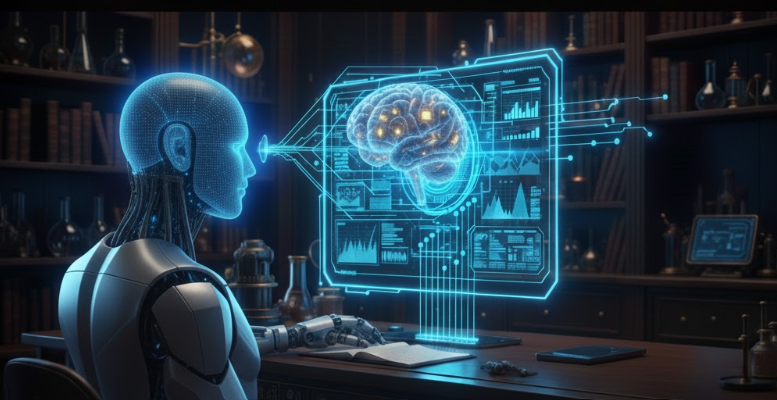
We are on the threshold of the convergence of digital and biological intelligence. Artificial intelligence (AI) has asserted its dominance in high-speed data processing and massive scalability, representing raw computational power and comprehensive retrieval. However, AI is still limited by poor energy efficiency and shallow conceptual depth, severe forgetfulness, and lack of true generalization.
This is where OI provides a crucial strategic complement:

Unleashing the vision to create an Intelligent Resonance, where OI modules handle the core tasks that require efficiency, conceptual creativity, and cumulative learning, while AI provides the raw computational throughput, acting as the control interface and scalable network backbone.
This integration goes beyond a simple computational upgrade. It frees AI from its current physical and logical constraints, creating a hybrid intelligence that is more resilient, flexible, and profound – equipped to tackle the most complex challenges. By combining the best of digital and biological systems, we are gradually redefining the boundaries of what machines can learn and understand.
Conclusion
Augmenting existing AI (with its speed and large-scale data processing capabilities) with OI (with its generalizable learning, energy efficiency, and biological foundations) is more than just an upgrade; it represents a genuine leap forward in technology. Together, they pave the way for future generations of systems that are more energy and training efficient, with the ability to “think” in ways that mirror biological cognition, transforming how we study the brain, advance medicine, drive innovation in technology, and tackle the world’s complex problems.
References
https://www.sinobiological.com/resource/organoid-review/organoid-intelligence
https://www.sciencedirect.com/science/article/pii/S2950489925000521