


In the evolving landscape of data management, Data Mesh has emerged as a transformative approach. At its core lies Domain-Oriented Data Architecture (DODA), a crucial concept that reshapes how organization structure and utilize their data.
Introduction to Data Mesh
Data Mesh is a fundamental concept that represents a paradigm shift in how organizations approach data infrastructure and governance. Data mesh architecture advocates a decentralised model which states that each domain should own and govern its own data. This is in complete contrast to a centralised architecture where a central team consumes and processes data for all the domains.
The core idea is to treat data as a product, managed by domain-specific teams rather than a central IT department therefore the core idea is to treat data as a product, managed by domain-specific teams rather than a central IT department.
Data Mesh is built on four key principles: domain-oriented decentralized data ownership and architecture, data as a product, self-serve data infrastructure, and federated computational governance. This approach enables organizations to scale their data operations more effectively, improve data quality, and foster a culture of data-driven decision-making across all levels.
What is Domain-Oriented Data Architecture?
Domain-Oriented Data Architecture (DODA) is about organizing data around specific business domains or functions.
DODA is an architectural approach that structures data around business domains, rather than traditional functional or technical silos and it recognizes that each business domain has unique data needs, requirements, and characteristics. By organizing data around domains, DODA enables domain teams to own and manage their data, making them more agile and responsive to changing business needs. This approach aligns data management more closely with the specific needs and functions of different parts of the organization.
Key Aspects of DODA in Data Mesh:
- Decentralized Data Ownership DODA empowers domain teams to take full responsibility for their data and this includes data collection, storage, processing, and sharing and by doing so, it brings data management closer to domain expertise.
- Data as a Product In DODA, each domain treats its data as a product. This mindset shift encourages teams to focus on data quality, usability, and value for consumers across the organization.
Self-Serve Data Infrastructure DODA promotes the creation of tools and platforms that allow domain teams to manage their data independently. This reduces bottlenecks and accelerates data-driven decision-making.
The challenges with centralized data ownership
The central data team, tasked with managing and interpreting data from various departments, often lacks the deep contextual understanding that data producers possess. This knowledge gap results in misinterpretations, oversights, and a diminished ability to extract meaningful insights.
Furthermore, the centralized model creates a bottleneck in data processing and delivery and as all data funnel through a single team, delays become inevitable, causing delays and outdated analyses across the organization.
Highlighting what above sentence, when a single team handles all data requests for an organization, it creates a significant slowdown. This centralized approach leads to delays in processing and delivering data, as the team becomes overwhelmed with requests from various departments. Consequently, analysts often find their data-based analyses outdated before they can use them and the time lag between requesting data and receiving insights means that by the time information is available, it may no longer be relevant or actionable. This delay significantly reduces the value of data-driven decision-making and hinders an organization’s ability to respond quickly to changing conditions or opportunities.
The disconnect between data producers and consumers also stifles innovation, as valuable feedback loops are broken, and the potential for real-time, domain-specific insights are lost. Ultimately, the centralized model’s inefficiency hampers organizations from being data-driven and agile.
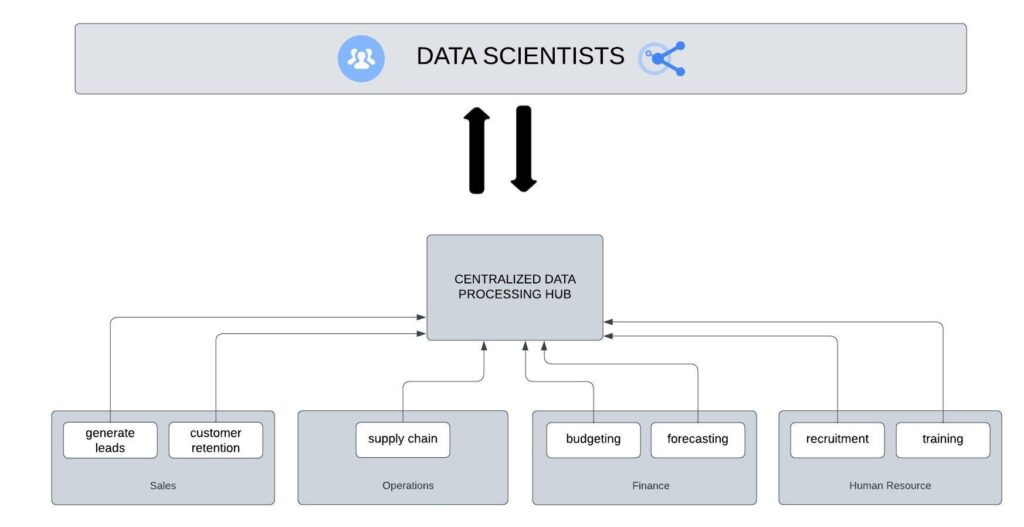
Centralized Data Management Architecture
Key implications of a centralized architecture
- The centralized team acts as a bottleneck between data producers (business units) and consumers (data scientists).
- It requires the central team to have broad expertise across all business domains.
- There’s a potential disconnect between those who produce the data and those who analyse it, as the central team mediates all interactions.
- This model may lead to delays and inefficiencies as all data requests must go through a single team.
Here’s how domain-driven model addresses the challenges of a centralized data management approach in a complex, multi-faceted business environment.
Domain-Oriented Data Architecture: Foundation for Agile, Scalable Data Management
- Decentralized Ownership: In domain-driven architecture, each business domain (like Merchants, Marketing, Best Sellers, Users) owns and manages its own data. This eliminates the bottleneck created by the central team and allows for more agile data management.
- Domain Expertise: Unlike the centralized model where the data team must be experts in all areas, domain-driven architecture leverages the existing expertise within each business unit. This leads to better data quality and more relevant insights.
- Scalability: As organizations grow, centralized models struggle to keep up. Domain-driven architecture scales more easily because each domain can evolve independently without affecting the entire system.
- Data as a Product: This approach treats data as a product, with each domain responsible for making their data usable and valuable to others in the organization. This shifts the mindset from data as a byproduct to data as a key asset.
- Self-serve Data Infrastructure: Domain-driven architecture promotes the development of self-serve platforms, allowing other teams to access and use data without going through a central bottleneck.
- Improved Data Governance: While it might seem counterintuitive, domain-driven architecture can lead to better governance through federated models that balance local control with global standards.
That is how Domain-Oriented Data Architecture provides a structural basis for modern, efficient data practices that can adapt to changing business needs and scale with organizational growth.

Implementing Domain-Oriented Data Architecture
Domain Identification and Structuring
The first step in implementing a domain-driven architecture is to identify and define the distinct domains within the organization. This process involves analysing the business structure, operations, and capabilities to determine logical boundaries. Each domain should represent a specific business function or area of expertise. For example, in an e-commerce company, domains might include Customer Management, Inventory, Orders, and Marketing. The goal is to create autonomous units that can manage their own data independently.
Data Ownership and Responsibility:
Once domains are identified, the next crucial step is assigning data ownership to each domain. This means that the teams within each domain become responsible for the entire lifecycle of their data – from collection and storage to processing and serving. This shift in responsibility is fundamental to the Data Mesh approach. It ensures that those with the most relevant knowledge and context are in charge of managing and evolving the data within their domain.
Data as a Product:
A key principle in domain-driven Data Mesh is treating data as a product. Each domain is tasked with creating data products that are usable, valuable, and accessible to other parts of the organization. This involves defining clear interfaces, providing comprehensive documentation, and ensuring data quality and reliability. Domain teams must think like product managers, considering the needs of their data consumers and continuously improving their data offerings.
Federated Governance:
While domains operate autonomously, there’s still a need for organization-wide consistency and interoperability. This is achieved through a federated governance model. It involves establishing global standards and policies for data management, security, and compliance, while allowing domains flexibility in how they implement these standards. This balance ensures that data can be shared and used across domains while maintaining the benefits of domain-specific management.
Interoperability and Data Sharing:
Implementing domain-driven architecture requires mechanisms for seamless data sharing and interoperability between domains. This often involves creating standardized data formats, APIs, and protocols for data exchange. A data catalogue or discovery service is typically implemented to help users across the organization find and access data products from different domains.
By methodically addressing these aspects, organizations can effectively implement a domain-driven architecture within the Data Mesh paradigm, leading to more agile, scalable, and value-driven data management.
Conclusion
The shift from centralized to decentralized data architectures, exemplified by Data Mesh, represents a fundamental change in enterprise data management. This transition addresses the scalability and agility limitations of traditional centralized approaches, enabling organizations to better handle the increasing volume and complexity of data in today’s business landscape.
Domain-driven architecture is key to this change, matching data management to business areas and giving teams control over their data. By spreading out responsibilities and encouraging data ownership, this approach improves data quality, usefulness, and ease of access. Setting up Data Mesh and domain-focused structures isn’t easy, but the rewards are worth it. Organizations can expect better data control, quicker progress, and smarter use of information. For companies that want to stay ahead in today’s data-driven world, this strategy offers a powerful way forward.