



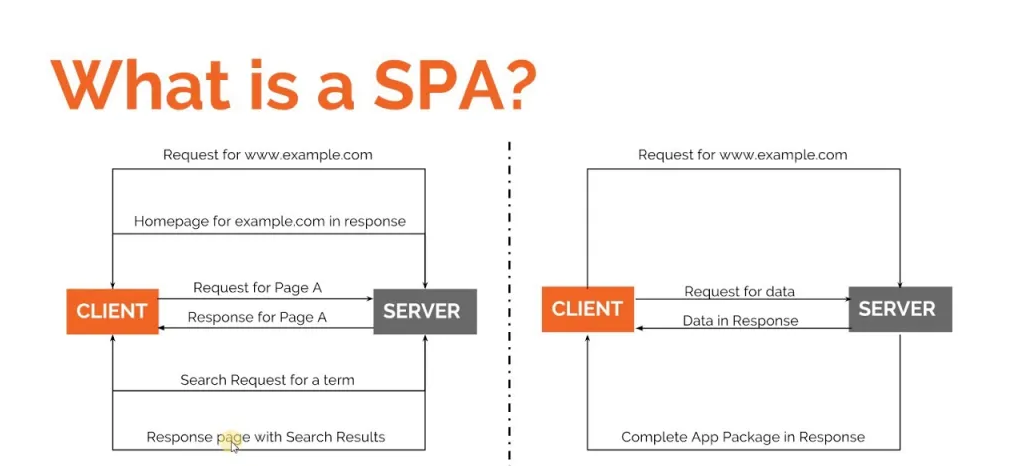
- In the constantly evolving landscape of web development. The emergence of Single Page Applications (SPAs) marks a pivotal shift in user interaction paradigms.
- Unlike traditional multi-page websites that trigger full reloads upon each user action. SPAs load initially and subsequently update content dynamically without reloading the entire page. This transformative approach results in a seamless, uninterrupted browsing experience, characterized by fluid transitions and instantaneous responses to user inputs.
- Among the array of frameworks available for building SPAs, Angular, developed and maintained by GoogleIts robust architecture.
- Coupled with a myriad of tools and features, has propelled it to the forefront of web development. Angular’s versatility, scalability, and extensive ecosystem make it a preferred framework for crafting sophisticated, feature-rich, and high-performance single-page applications.
Throughout this comprehensive guide, we embark on an explorative journey into the realm of Single Page Angular applications. Our aim is to dissect and comprehend their underlying architecture, unravel the inherent advantages they offer over conventional web applications.
Dissect their key components, and elucidate the best practices that pave the way for creating efficient, maintainable, and user-centric applications.
The Basics of Angular
- In the traditional landscape of web applications, each user interaction triggers a complete page reload.
- Causing interruptions and delays in the browsing experience. Whether navigating between sections or executing actions.
- The conventional model requires the server to reload the entire web page each time, resulting in slower and less fluid user experiences.
- This frequent reloading of content disrupts the user flow, leading to perceptible delays and hindering the overall responsiveness of the application.
However, the paradigm shift introduced by Single Page Applications (SPAs) has revolutionized this norm.
- SPAs load the core resources and content of the application just once, usually at the initial visit
- The implementation of technologies like Asynchronous JavaScript and XML (AJAX) enables SPAs to communicate with the server in the background
- This innovative approach eliminates the need for constant full-page reloads
- Allowing users to seamlessly navigate and access new information within the application
- Without experiencing the interruptions inherent in traditional web applications.
- As a result, SPAs offer a significantly enhanced browsing experience characterized by speed, fluidity, and responsiveness
- Setting a new standard for web application usability.
Key Features of Single Page Angular Applications
Component-Based Architecture:
- Angular’s foundation lies in its component-based architecture, a fundamental principle
- That promotes a modular and reusable approach to building web applications.
- At its essence, this architecture revolves around breaking down the application into smaller, self-contained units called components.
- Each component encapsulates a specific set of functionalities, comprising its own HTML template.
- TypeScript code defining the component’s behavior, and CSS for styling.
- These components are designed to be reusable entities, enabling developers
- To compose complex applications by assembling these smaller, well-defined building blocks.
- This modular approach not only simplifies the development process by allowing developers to focus on distinct functionalities
- By compartmentalizing different aspects of the application into separate components, Angular facilitates easier debugging, testing, and scalability.
- Additionally, the reusability of components across different parts of the application ensures consistency in design and functionality
Two-Way Data Binding:
- Angular’s powerful data binding capabilities form the backbone of its reactive and dynamic nature.
- At the heart of this capability lies two-way data binding, a mechanism that establishes a seamless synchronization between the application’s data model (the ‘source of truth’) and the user interface (UI).
- When data in the model changes, the corresponding UI elements are automatically updated, and vice versa,
- Ensuring that any modifications made by the user in the UI reflect immediately in the underlying data model.
- This bidirectional data flow eliminates the need for manual manipulation or tracking of changes in both directions
- Significantly reducing the boilerplate code and enhancing developer productivity.
- It enables the creation of highly responsive and interactive applications, UI are instantly reflected in the data and vice versa.
Dependency Injection:
- Angular’s dependency injection (DI) mechanism is a key aspect that promotes flexibility, maintainability, and testability within applications.
- Dependency injection involves the external provision of dependencies required by a component or service
- This approach decouples components from their dependencies, allowing for easier management, testing, and swapping of dependencies
- Without modifying the component’s code.
- By injecting dependencies, Angular encourages a modular and loosely coupled architecture, where components can be easily interchanged or tested in isolation. This practice enhances code reusability, as well as facilitating the maintenance and scalability of the application. Moreover, it simplifies the testing process by enabling the mocking or substitution of dependencies during unit testing, ensuring robust and reliable code.
Routing:
- Angular’s robust routing system is instrumental in enabling developers to create single-page applications with multiple views and navigation capabilities.
- The Angular Router facilitates the mapping of different views to distinct URLs within the application.
- Allowing users to navigate seamlessly between these views without triggering full-page reloads.
- Developers can define various routes, each corresponding to a specific view or component
- And specify how these routes should be activated based on URL changes or user actions.
- This enables the creation of a rich and multi-view application experience
- Where users can move between different sections or pages of the application while maintaining a consistent UI and state.
- Additionally, Angular’s routing capabilities support features like nested routes, route guards for authentication, lazy loading of modules, and parameterized routes, offering a comprehensive solution for managing navigation and state within the application.
Building Blocks of Single Page Angular Applications
Components:
Components are the fundamental building blocks that compose an Angular application. Each component encapsulates a specific part of the user interface and its associated functionality. At the core of a component lies its template, usually written in HTML, which defines the structure of the view that the component represents. Alongside the template, a component consists of TypeScript code that defines the component’s behavior, including logic, data manipulation, event handling, and interaction with other components or services. Additionally, components can have their own stylesheets to define their unique visual presentation and layout.
The encapsulation of HTML, TypeScript, and styling within a component fosters a modular and reusable approach to web development. Components promote code reusability by allowing developers to create self-contained and cohesive units of functionality that can be easily composed and reused across different parts of the application. They encourage a separation of concerns, making it easier to manage and maintain complex user interfaces by breaking them down into smaller, manageable units.
Modules:
- Angular applications are structured using modules, which serve as containers for organizing the application’s code into cohesive units.
- A module is a logical grouping of components, directives, pipes, services, and other code-related entities
- That collectively define a specific feature, workflow, or functionality within the application.
- Modules in Angular help in organizing and compartmentalizing the codebase, thereby enhancing maintainability and scalability.
- They define clear boundaries between different functionalities or features of the application
- Making it easier to manage dependencies and encapsulate related code.
- Angular applications typically have a root module (AppModule) and may include additional feature modules
- Allowing developers to modularize the application and promote code reusability.
Services:
- Services in Angular are reusable, injectable classes that encapsulate business logic, data manipulation
- They act as singletons within an application, providing a centralized
- Reusable way to share data or functionality among different parts of the application.
- Services play a crucial role in facilitating code reuse, as they enable components to delegate common tasks or functionalities to a centralized service
- Rather than duplicating code across multiple components.
- They abstract away complex logic or data manipulation, promoting a more maintainable and testable codebase.
- Services are often used for tasks such as making HTTP requests, managing application state
- Handling authentication, or any other functionality that needs to be shared or reused across components.
Directives:
There are different types of directives in Angular:
- Component Directives: Components themselves are a type of directive in Angular.
- Structural Directives: These directives alter the structure of the DOM by adding, removing, or manipulating elements based on conditions or loops (e.g., *ngIf, *ngFor).
- Attribute Directives: These directives change the appearance or behavior of an element (e.g., ngStyle, ngClass).
Directives allow developers to extend HTML’s capabilities, enabling the creation of dynamic and interactive user interfaces. They encapsulate commonly used functionalities and enable the reusability of behavior or styling across different parts of the application.
By using directives, developers can create more expressive and maintainable templates
Advantages of Single Page Angular Applications
Enhanced Performance:
SPAs revolutionize web performance by fundamentally altering the way web applications load and operate. Unlike traditional multi-page applications, SPAs load once, retrieving essential resources like HTML, CSS, and scripts during the initial visit. Subsequent interactions or navigation within the application trigger asynchronous data retrieval, usually through AJAX or APIs, to fetch only the required data or content without reloading the entire page.
This approach significantly reduces server load and minimizes the amount of data transmitted between the client and server. As a result, SPAs typically offer faster initial load times and subsequent interactions, as they don’t need to retrieve the entire page from the server each time a user performs an action. Additionally, by leveraging client-side caching mechanisms effectively, SPAs can optimize resource usage and deliver a snappier, more responsive user experience.
Rich User Experience:
The seamless, fluid navigation inherent in SPAs contributes to a highly engaging user experience. SPAs eliminate the jarring experience of full-page reloads, allowing users to navigate between different sections or perform actions within the application without experiencing interruptions or delays. As content updates dynamically within the same page, users enjoy a smoother interaction, akin to using a native application.
This enhanced user experience goes beyond just navigation. SPAs enable real-time updates of content, interactive elements, and state changes without requiring users to wait for the entire page to reload. This approach fosters a more immersive and enjoyable browsing experience, leading to increased user satisfaction and prolonged engagement with the application.
Improved Development Efficiency:
Let’s expand on the benefits of Single Page Applications (SPAs) and the advantages brought by Angular in terms of performance, user experience, and development efficiency:
Enhanced Performance:
SPAs revolutionize web performance by fundamentally altering the way web applications load and operate. Unlike traditional multi-page applications, SPAs load once, retrieving essential resources like HTML, CSS, and scripts during the initial visit. Subsequent interactions or navigation within the application trigger asynchronous data retrieval, usually through AJAX or APIs, to fetch only the required data or content without reloading the entire page.
This approach significantly reduces server load and minimizes the amount of data transmitted between the client and server. As a result, SPAs typically offer faster initial load times and subsequent interactions, as they don’t need to retrieve the entire page from the server each time a user performs an action. Additionally, by leveraging client-side caching mechanisms effectively, SPAs can optimize resource usage and deliver a snappier, more responsive user experience.
Rich User Experience:
The seamless, fluid navigation inherent in SPAs contributes to a highly engaging user experience. SPAs eliminate the jarring experience of full-page reloads, allowing users to navigate between different sections or perform actions within the application without experiencing interruptions or delays. As content updates dynamically within the same page, users enjoy a smoother interaction, akin to using a native application.
This enhanced user experience goes beyond just navigation. SPAs enable real-time updates of content, interactive elements, and state changes without requiring users to wait for the entire page to reload. This approach fosters a more immersive and enjoyable browsing experience, leading to increased user satisfaction and prolonged engagement with the application.
Improved Development Efficiency:
Angular, as a robust framework for building SPAs, contributes significantly to improving the efficiency of the development process. Angular’s structured architecture, combined with its Command Line Interface (CLI) tools and extensive documentation, empowers developers to build complex applications more efficiently.
The component-based architecture of Angular promotes modularity and code reusability, allowing developers to create and manage independent and reusable components. This modular approach streamlines development, making it easier to maintain and scale applications as they grow in complexity.
Moreover, Angular’s CLI tools automate repetitive tasks such as project setup, scaffolding components, services, and modules, and optimizing builds. This automation accelerates the development workflow, reduces manual effort, and ensures consistency across the codebase.
The comprehensive documentation provided by Angular serves as a valuable resource for developers, offering detailed guidance, best practices, and examples. This accessibility to documentation aids developers in quickly learning and leveraging Angular’s features, thereby reducing the learning curve and expediting the development cycle. Consequently, Angular significantly reduces time-to-market for applications by providing a structured, efficient, and well-documented development environment.
Best Practices for Single Page Angular Applications
Optimize Performance:
- Minimize HTTP Requests: Reducing the number of HTTP requests enhances SPA performance. Techniques like bundling and minification of scripts and stylesheets help consolidate resources, minimizing the number of requests required to load the application.
- Leverage Lazy Loading: Employing lazy loading for modules and components allows loading only the necessary resources when they’re needed, optimizing initial load times and reducing the overall page load size.
- Efficient Caching Strategies: Utilizing browser caching mechanisms, implementing content delivery networks (CDNs), and employing caching for API responses or frequently accessed data enhance performance by reducing network latency and resource retrieval times.
Follow Angular Style Guide:
Adhering to Angular’s style guide and best practices ensures consistency, readability, and maintainability across the codebase. Angular provides a comprehensive style guide detailing conventions for coding standards, naming conventions, folder structure, component architecture, and more. Following these guidelines helps teams maintain a uniform coding style, making the codebase easier to understand, navigate, and maintain.
Handle State Management Efficiently:
Effective state management is critical in maintaining a robust and scalable application. Angular provides various mechanisms for managing application state. Utilizing Angular services for state management can centralize and manage shared data or business logic across components. Alternatively, employing state management libraries like NgRx (using the Redux pattern) facilitates a more structured and predictable way to handle application state, especially in larger or complex applications.
Implement SEO Best Practices:
Search Engine Optimization (SEO) is crucial for ensuring that web applications are discoverable and indexed effectively by search engines. Implementing server-side rendering (SSR) or pre-rendering techniques helps search engine crawlers index the content by presenting a fully rendered HTML version of the application, making it accessible to crawlers. SSR generates HTML content on the server and sends it to the client, while pre-rendering generates static HTML files for specific routes or pages during the build process. This enables search engines to index the content accurately, improving visibility and search rankings.
By implementing these best practices, developers can significantly enhance the performance, maintainability, discoverability, and overall user experience of Single Page Angular applications.
Conclusion
Single Page Angular applications represent a paradigm shift in web development, reshaping the way users engage with digital experiences. They stand as a testament to the evolution of modern web applications, offering users a highly immersive, dynamic, and responsive interface. Angular, with its comprehensive toolkit and robust set of features, serves as a catalyst in this transformation, empowering developers to architect sophisticated SPAs that align with contemporary web standards while ensuring consistent performance and usability across a spectrum of devices and browsers.
At the core of Single Page Angular applications lies a synergy between Angular’s capabilities and the dynamic nature of SPAs. Angular’s feature-rich framework facilitates the creation of powerful SPAs by leveraging a component-based architecture, two-way data binding, dependency injection, routing, and other integral features. These elements work in unison, enabling developers to build applications that deliver seamless and intuitive user experiences.
By adopting Angular’s structured architecture and embracing its best practices, developers can harness the framework’s potential to create applications that excel in performance, scalability, and maintainability. The modular nature of Angular components fosters code reusability, making it easier to manage and extend applications as they evolve. The framework’s CLI tools, extensive documentation, and community support further contribute to streamlining the development process, reducing complexities, and expediting time-to-market.
Moreover, adherence to established principles such as optimized performance, adherence to Angular’s style guide, efficient state management, and SEO best practices elevates the quality and effectiveness of Single Page Angular applications. Minimizing HTTP requests, following coding conventions, handling application state effectively, and implementing SEO strategies not only enhance the user experience but also contribute to the application’s visibility and accessibility on the web.
In embracing these principles and leveraging Angular’s robust features, developers can unlock the potential to create innovative, sophisticated, and efficient Single Page Angular applications. This proactive approach not only meets the demands of modern web development but also sets the stage for a new era of excellence, where applications are not just functional but offer unparalleled experiences that captivate and engage users in new and impactful ways.
For Angular Directives please refer to my: Directives Blog!