



Image created by Copilot
Why is Test Case Review Important?
As we know, testing is one of the phases in the Software Development Life Cycle performed by a Tester. In this phase, effective testing and high standards of quality in the application require a well-structured testing process that includes various stages, one of which is the test case review. Test case reviews to ensure that they comply with the writing test cases standards and that any functionality mentioned in the acceptance criteria is covered. Test case reviews will surely make them better as:
- During the test case review, having two viewpoints helps cover all things better. If anything is missed by one, the other can provide it. This teamwork makes sure we do not overlook any important details and helps us understand the system better.
- Test case reviews to ensure that all team members are on the same page about the features and requirements
- During test case reviews, any differences in understanding the requirements can be sorted out sooner and we can avoid large costs for future remediation
Test Case Review Process
There are various types of test case review processes. However, the appropriate test case review process can be determined by factors such as project scale, project structure, software development methodology, and project-specific requirements.
The test case review process typically involves multiple activities, including the review and analysis of test cases, review meetings, and feedback sessions, and concludes with the approval and final documentation.
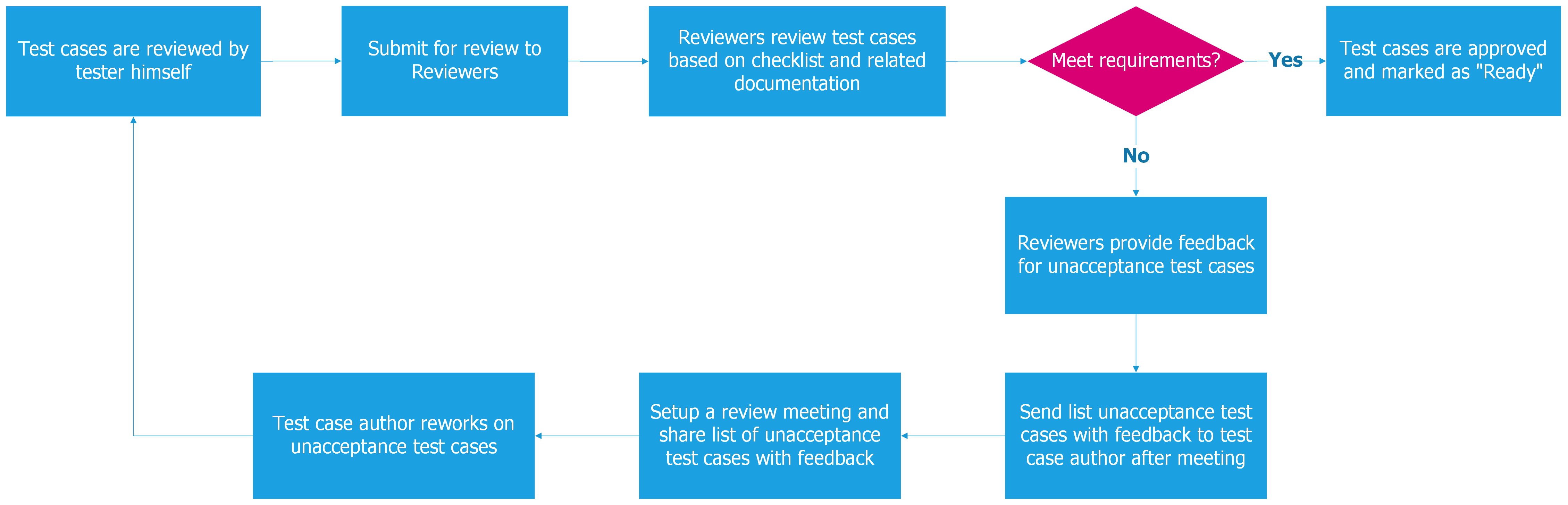
Techniques for Test Case Review
There are three techniques for conducting test case reviews, and each technique has advantages and disadvantages. By integrating these approaches, test cases will become more perfect.
Self-review
It is done by the tester himself who has written the test cases. He can verify whether all the requirements are covered or not by looking into acceptance criteria.
- Advantages: It does not take too much time because the writer understands their test case, making it easier to review and minimizing many basic errors, thus saving the reviewer’s time afterward.
- Disadvantages: Not achieving high efficiency due to viewing the problem from only one perspective.
Peer review
It is done by other testers who are not very familiar with the application under test and have not created the test cases. It is also called the Maker and Checker review.
- Advantages: Assisting in achieving higher efficiency in test case reviews by incorporating perspectives and viewpoints from multiple sources, thereby enhancing accuracy and test case coverage. Everyone gains a deeper understanding of various parts and functionalities of the system, enabling them to conduct testing on those parts post-test case review, or support/back each other when necessary. This facilitates a comprehensive understanding of the system, avoiding situations where QA/testers are only knowledgeable about their assigned main functionalities.
- Disadvantages: It takes a lot of time to understand the features well enough to do cross-reviews.
Review by a supervisor
It is done by a team lead or manager or Business Analysts who is superior to the tester who has written the test cases and has great knowledge about the requirements and system under test.
- Advantages: The supervisor is usually more experienced and has a broader perspective, so their review of test cases is often very effective. Additionally, QA/testers who write the test cases can learn a lot from the supervisor’s reviews, gaining valuable experience.
- Disadvantages: Sometimes, the person being reviewed might make changes even if they’re not fully convinced, either because they trust the supervisor too much or feel pressured to do so.
Test Case Review Checklist
Some of the common mistakes
During checking the test case review process, some of the common mistakes as:
- Spelling mistakes: Sometimes, spelling mistake can create a lot of confusions or make a sentence difficult to understand.
- Grammar: If grammar is not proper then test case can be interpreted in a wrong way, resulting in wrong results.
- Template format:If proper template is followed then it becomes easy to add/modify test cases in future and test case plan looks organized.
- Standard/Guidelines: While review process, it is very important to check whether all the standards and guideline are properly followed.
- Language used: Test cases should have a very simple language which is easy to understand.
- Functionality coverage: It is highly recommended that all the functionality associated with the system under test should be covered so that major defects are not missed.
- Replication: It refers to the duplicate test cases removal. It is possible that two or more test cases test the same thing and can be merged into one, this would save time and space.
- Redundancy: It refers to uselessness of a test case due to change in requirements or some modifications. Such test cases must be removed.
- Consistency: Check whether the writing style of the test case is consistent from top to bottom, across different test case files, and among different testers as appropriate (if necessary).
- Rationality: The steps within test cases as well as the test cases themselves should be arranged in a logical order based on business requirements to facilitate easy tracking for reviewers and testers who will execute them.
Test Case Review Checklist

Drawing from common fundamental mistakes identified during test case reviews, we can formulate a checklist to assess the completeness and accuracy of test cases. At NashTech, we have a standard test case review checklist which can be tailored to specific project requirements. Here are some of the key points for test case review checklist:
- Test Case ID should be unique, and easy to identify.
- Test cases should be easily readable.
- Check the traceability of test cases with the relevant requirements.
- Test cases should be prioritized according to requirements.
- Test cases should be classified according to the types functional and nonfunctional.
- Test Case steps should be clearly defined & easy to understand.
- Test cases should be in the logical functional flow.
- Test cases should not be duplicated or redundant.
- Test data should be given with the source of the test data. Maintain the privacy of the data and have the test data like passwords masked.
- Test cases should cover both positive and negative scenarios.
- Test cases should have the prerequisites for execution.
- Test cases should be checked for language, spelling, and grammatical mistakes.
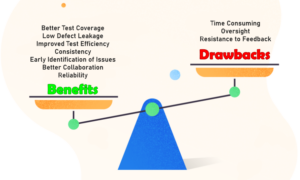
Benefits and Drawbacks Of The Test Case Review Process
Some Tips for Test Case Review
- While reviewing, always cross-reference with the requirement specification documents.
- Based on the checklist for reviewing test cases.
- Review all the test cases for a ticket before providing feedback.
- A face-to-face meeting with the tester should make him understand all the review feedback properly. Share the feedback in a constructive way and with no personal offense. Respect the response from the author.
- Should let members with lower positions review test cases of testers in higher positions to improve how to write better test cases. From there, they can add and propose new ideas to improve the process.
- If you are unsure about any test case or expected outcome, you should discuss it with the test case writer and stakeholders before making a decision.
- Always use the latest version of the test case when reviewing to avoid wasting time and unnecessary confusion.
- Keep doing the same steps and make things better. Get feedback from users, stakeholders, and project team members to improve the project’s final products
Conclusion
Testers sometimes write test cases the same old way, based on their experiences, which may lead to mistakes. Test case reviews help catch errors and prevent software problems. It is important to review test cases, not just for testing, but for developing software too. Reviews help us be more careful and gather useful experience.
I hope this blog helps you see why reviewing test cases is important. If you have any good tips, please kindly share them with me so I can learn and get better at my job too.
Thank you for your reading 🙂