



Rust is a systems programming language that has gained a tremendous reputation for its unique approaches to memory management, predominantly through its ownership and borrowing system. Unlike other languages that rely on garbage collection to handle memory and its related bugs, Rust offers a compile-time solution that guarantees memory safety and efficiency. This article unpacks Rust’s core concepts related to ownership and borrowing, exploring how they serve as a basis for preventing memory-related bugs.
The Ownership System
Rust’s ownership model revolves around three fundamental rules:
- Each value in Rust has a single owner: There’s always a variable (or structure) that owns a certain piece of memory, and when it goes out of scope, the memory is automatically freed.
- Values can be transferred: Ownership can be transferred from one variable to another using the concept of ownership transfer or “moving.” Once a value is moved, the previous owner can no longer access that value, ensuring that pairs of access to memory references don’t exist.
- Borrowing: If you need to access a piece of data without taking ownership, Rust allows borrowing through two distinct modes—immutable and mutable. You can have multiple immutable references to a value (thus reading it) or one mutable reference (allowing you to modify it), but never both at the same time. This binary helps avoid race conditions at compile time.
Let’s look at a practical example to highlight the concepts of ownership and borrowing:
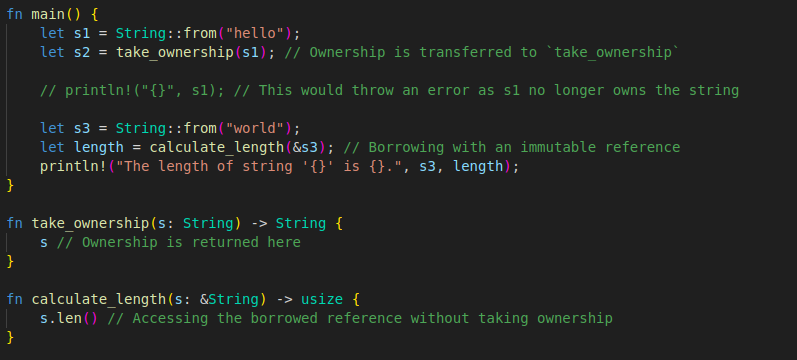
In the above code, attempting to print s1 after passing it to take_ownership(s1) will lead to a compile-time error, ensuring that ownership practices help prevent dangling references. This check reflects Rust’s robustness in eliminating memory-related issues that arise in languages that rely solely on dynamic memory.
Comparisons With Garbage Collected Languages
Languages such as Java or Python manage memory through a garbage collection (GC) system that evaluates—at runtime—when to free memory that is no longer necessary. While this eliminates many manual memory management errors, GC introduces latency and potential unpredictable performance, particularly in real-time applications.
In contrast, Rust compiles down to machine code with no runtime overhead for memory management. By using its ownership rules, Rust eliminates memory issues before program execution while enhancing performance predictability, making it an attractive option for system-level programming.
How Ownership Prevents Data Races
Concurrency introduces complexities, especially with data sharing between threads. Traditional techniques such as locks or atomic operations can safeguard data integrity but often incur performance overhead and avoidance of most concurrent benefits. Rust’s ownership system provides a unique approach to ensure thread-safe concurrency through its guarantees at compile-time, significantly preventing data races.
Ownership Model and Concurrency
The same borrowing principles that govern Rust’s memory safety paradigm apply seamlessly to concurrency. Here’s how:
- No shared mutable state: Rust prevents data races by isolating mutable states. When you declare a variable mutable, only one mutable reference can exist to modify it, forbidding other threads from simultaneously accessing it in a non-safe context.
- Ownership transfers between threads: Rust’s ownership ensures that only one thread owns data at a time, which eliminates many classical threading issues.
Example of Concurrent Programming
Let’s see a brief example that illustrates how ownership and borrowing can serve in concurrent contexts:

In this simple example with the spawn function, we transfer the ownership of data to the spawned thread using the move keyword. The parent thread can’t access data afterwards, ensuring that no two threads can access the unique piece of data in conflicting states, thereby preventing possible data races.
Conclusion
Rust’s ownership and borrowing system offer developers a novel approach to manage memory and concurrency without compromising safety and performance. By enforcing rules at compile-time regarding data ownership, Rust effectively reduces the likelihood of memory-related bugs and data races traditionally associated with parallel programming in other languages. This enables robust, efficient, and concurrent applications safe from the pitfalls inherent in more conventional approaches, making Rust a fantastic choice for systems programming today.
For more tech related blogs refer to Nashtech blogs