


Introduction
When teams start building backend systems, the first big architectural question often is:
“Should we build a monolith or go for microservices?”
In reality, jumping straight to microservices creates more problems than it solves—especially for small or growing teams. This is where the Modular Monolith approach becomes extremely practical.
A modular monolith allows us to keep the simplicity of a single deployable application while still enforcing clear structure, boundaries, and ownership inside the codebase. It is not a temporary shortcut—it is a deliberate design choice.
This blog explains modular monoliths from a beginner-to-intermediate perspective and answers the most common real-world questions around:
- When to use it
- How it differs from microservices
- Whether it can safely evolve into microservices later
What Is a Modular Monolith?
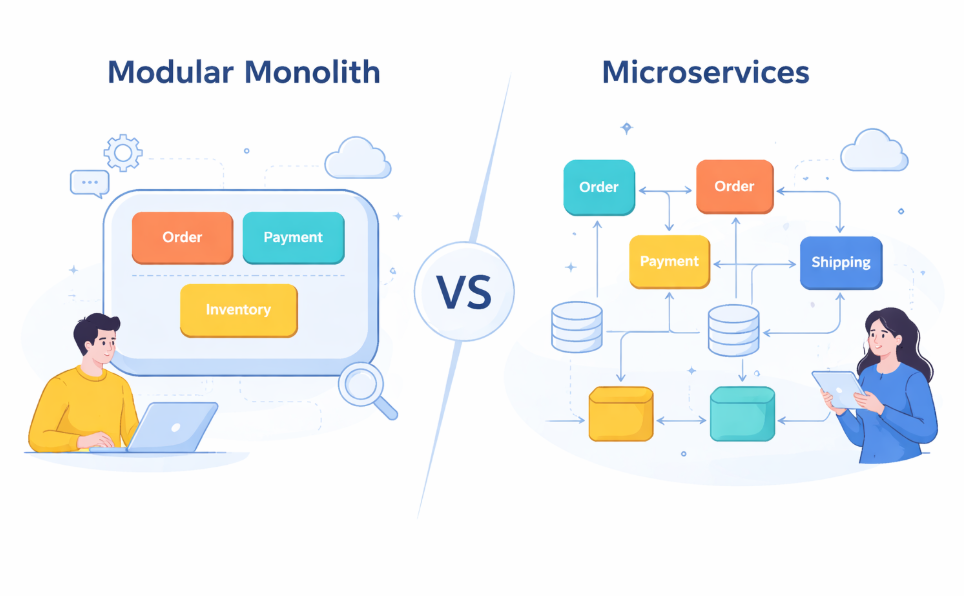
A modular monolith is a single application (single codebase, single deployment) that is internally divided into well-defined, independent modules.
Each module:
- Owns its business logic
- Has clear boundaries
- Controls its data
- Exposes functionality only through defined interfaces
The key idea is simple:
The application is monolithic in deployment, but modular in design.
This makes the system easier to understand, maintain, and evolve.
Why Not Start Directly with Microservices?
Microservices are powerful—but they come with cost.
Starting with microservices means:
- Distributed systems complexity
- Network failures
- Data consistency challenges
- CI/CD overhead
- Monitoring and debugging complexity
For many teams, these problems appear before the system actually needs microservices.
A modular monolith allows teams to:
- Focus on business logic first
- Avoid premature distribution
- Still design the system in a future-ready way
Monolith vs Modular Monolith
A traditional monolith usually looks like this:
- Shared database
- Tight coupling
- Business logic scattered across layers
- Any change risks breaking unrelated features
A modular monolith, on the other hand:
- Has explicit module boundaries
- Prevents direct access across modules
- Encourages ownership and isolation
- Makes reasoning about changes easier
So, this is not “monolith done neatly”— its monolith done intentionally.
What Does “Module” Actually Mean?
A module is not just a package.
A real module:
- Represents a business capability (e.g., Orders, Payments, Inventory)
- Has its own internal model and rules
- Does not expose internal classes directly
- Communicates with other modules via well-defined APIs
If another module can freely access your internal classes or database tables, then it is not a real module.
How Modular Monolith Prepares You for Microservices
A common concern is:
- What if later we need to move to microservices?
This concern is valid—but only if modularity is weak. A modular monolith is microservices-ready when:
- Modules are loosely coupled
- Each module owns its data
- Cross-module communication happens through interfaces
- Business rules do not leak across boundaries
In that case, converting a module into a microservice becomes:
- An architectural decision
- Not a rewriting exercise
You are extracting a well-defined unit, not untangling a mess.
How Hard Is It to Move from Modular Monolith to Microservices?
It is not easy, but it is manageable. Challenges include:
- Splitting databases safely
- Introducing network communication
- Handling eventual consistency
- Operational overhead
However, if the monolith was properly modular, these challenges are expected and controlled, not chaotic. The real danger is not choosing a modular monolith—it is choosing a non-modular one and assuming it can scale forever.
What If My Modular Monolith Is NOT Convertible Later?
This is an honest and important question. If your modular monolith cannot be converted later, it usually means:
- Module boundaries were unclear
- Data ownership was shared
- Shortcuts were taken under pressure
But even then, the system is still more maintainable than a traditional monolith. Also, not every system needs microservices. A well-designed modular monolith can scale surprisingly far.
When Should You Choose a Modular Monolith?
Choose a modular monolith when:
- Team size is small to medium
- Business requirements are evolving
- Deployment simplicity matters
- You want clarity over complexity
Avoid it only when:
- You already have independent teams
- You truly need independent scaling
- You can afford distributed-system overhead
Conclusion
Choosing an architecture is not about trends—it’s about timing, context, and team maturity.
A modular monolith gives teams the ability to build systems that are simple to deploy, easy to reason about, and structured for growth. It avoids the operational overhead of microservices while still enforcing clear boundaries inside the codebase. More importantly, it encourages good design practices early—explicit ownership, controlled dependencies, and meaningful separation of concerns. When these principles are followed, the system remains maintainable even as complexity grows.
Microservices may still be the right choice later, but they should be a response to real needs, not an assumption made on day one.
In practice, a well-designed modular monolith often turns out to be not just a starting point—but a long-term, sustainable architecture.