


Introduction
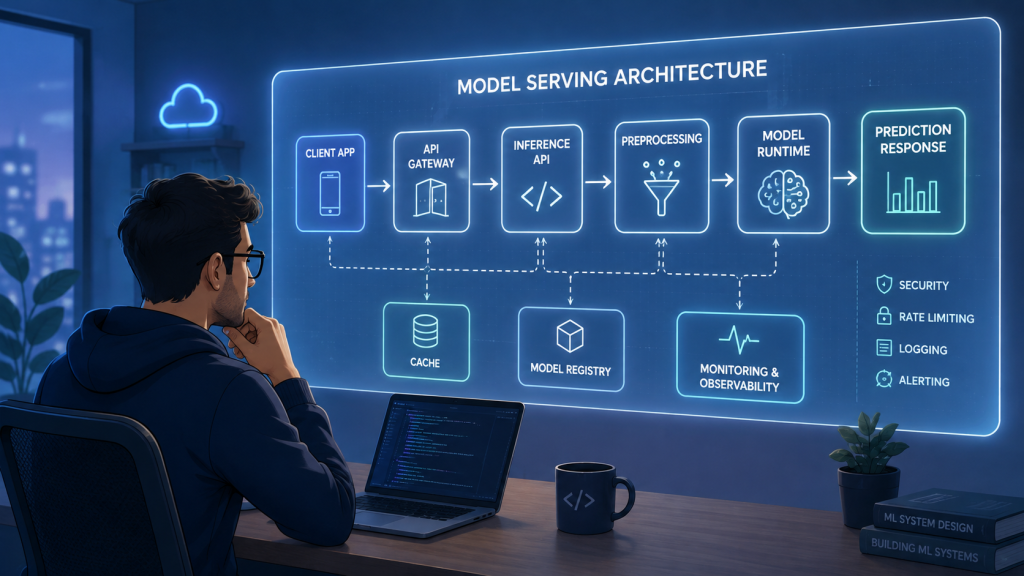
The Model Serving Architecture Pattern provides a structured approach for exposing trained AI and machine learning models as reliable services for real-world applications. While a model can be tested easily in a notebook or Python script, deploying it into production requires much more than wrapping a prediction function inside an API.
A production AI service must handle concurrent requests, predictable latency, model versioning, scalability, security, failure recovery, and continuous monitoring. Without a well-designed serving architecture, even an accurate model may become difficult to operate, integrate, and maintain.
The Model Serving Architecture Pattern addresses these challenges by placing a stable service interface between the model and its consumers. Applications can submit input data and receive predictions without needing to understand how the model is loaded, executed, scaled, or updated.
This pattern is commonly used for real-time and near-real-time workloads such as fraud detection, recommendation, customer support routing, risk scoring, personalisation, image classification, and sentiment analysis.
In this article, we explore how the Model Serving Architecture Pattern works, when to use it, how to design it for production, and how to implement a scalable real-time AI API through a practical demonstration.
What Is the Model Serving Architecture Pattern?
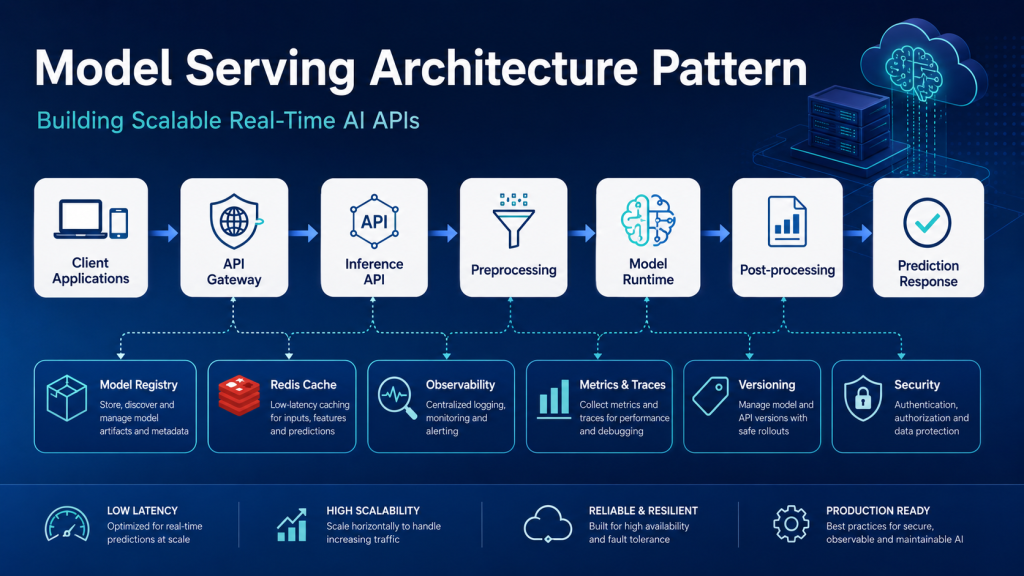
The Model Serving Architecture Pattern makes a trained model available to other applications through a defined interface, typically an HTTP or gRPC endpoint.
A client sends a request containing input data. The serving layer validates and transforms the input, invokes the model runtime, processes the prediction, and returns a structured response.
A simplified flow looks like this:
Client Application
        |
        v
API Gateway or Load Balancer
        |
        v
Inference API
        |
        v
Input Preprocessing
        |
        v
Model Runtime
        |
        v
Output Post-processing
        |
        v
Prediction Response
The model is therefore treated as an independently deployable capability instead of being embedded directly into every consuming application.
This separation provides several benefits:
- The application and model can be deployed independently.
- Multiple applications can reuse the same model.
- Model versions can be changed without modifying client applications.
- Inference capacity can scale separately from the rest of the system.
- Model-specific telemetry and security controls can be managed centrally.
- Teams can introduce routing, caching, fallback, or experimentation without changing the consumer contract.
The essential idea is simple:
The consumer depends on a stable inference contract, not on the model implementation.
Example Use Case: Real-Time Support Ticket Classification
Consider a customer support platform that receives thousands of support tickets each day.
When a ticket is submitted, the platform needs to determine:
- The ticket category
- Its priority
- The appropriate support team
- The confidence of the prediction
The classification must happen quickly because the result is used immediately to route the ticket.
A request may look like this:
POST /api/v1/predictions/ticket-classification
Content-Type: application/json
{
  "ticketId": "TICKET-10245",
  "subject": "Payment was deducted twice",
  "description": "My card was charged twice for the same order."
}
The inference service responds with:
{
  "ticketId": "TICKET-10245",
  "category": "billing",
  "priority": "high",
  "assignedTeam": "payments-support",
  "confidence": 0.964,
  "modelName": "ticket-classifier",
  "modelVersion": "1.2.0",
  "requestId": "req-38af5c31"
}
The support platform does not need to know whether the prediction was produced by a scikit-learn model, a transformer, a hosted model endpoint, or a custom runtime.
It only relies on the API contract.
Reference Architecture
A production-oriented implementation of the Model Serving Architecture Pattern usually contains more than the model endpoint itself.
flowchart LR
    Client[Client Application]
    Gateway[API Gateway]
    Auth[Authentication and Authorization]
    API[Inference API]
    Validator[Request Validation]
    Cache[(Prediction Cache)]
    Runtime[Model Runtime]
    Registry[(Model Registry)]
    Response[Response Handler]
    Telemetry[Logs, Metrics and Traces]

    Client --> Gateway
    Gateway --> Auth
    Auth --> API
    API --> Validator
    Validator --> Cache
    Cache -->|Cache miss| Runtime
    Registry --> Runtime
    Runtime --> Response
    Cache -->|Cache hit| Response
    Response --> Client

    API --> Telemetry
    Runtime --> Telemetry
    Response --> Telemetry
Client Application
The client may be a web backend, mobile application, workflow service, event processor, or another internal system.
It sends inference requests and uses the returned prediction in a business process.
API Gateway or Load Balancer
The gateway provides a controlled entry point for the inference service.
Typical responsibilities include:
- TLS termination
- Authentication
- Rate limiting
- Request routing
- Request-size limits
- Correlation ID propagation
- Traffic management
The gateway should manage transport concerns. It should not contain model-specific business logic.
Inference API
The inference API exposes the model through a stable contract.
Its responsibilities normally include:
- Request validation
- Input normalization
- Model invocation
- Timeout handling
- Error mapping
- Response construction
- Model metadata inclusion
For the accompanying demonstration, the API is implemented with FastAPI.
Input Preprocessing
Most models cannot consume raw application input directly.
The preprocessing layer may perform:
- Text normalization
- Tokenization
- Image resizing
- Feature extraction
- Missing-value handling
- Categorical encoding
- Schema conversion
Preprocessing must be versioned together with the model. Using a new model with incompatible preprocessing logic can silently reduce prediction quality even when the API remains available.
Model Runtime
The model runtime loads the model and executes inference.
Depending on the workload, it could be:
- A Python runtime
- ONNX Runtime
- TensorFlow Serving
- TorchServe
- NVIDIA Triton
- MLflow Model Serving
- KServe
- A managed cloud inference endpoint
The demo intentionally uses a lightweight Python runtime so that readers can run it locally without requiring cloud infrastructure.
Model Registry
A model registry stores and manages approved model versions and their metadata.
It may contain:
- Model artifacts
- Version numbers
- Evaluation results
- Tags and aliases
- Deployment status
- Training metadata
- Approval information
MLflow Model Registry, for example, supports registered models with versions, aliases, tags, and associated metadata. An alias can be reassigned to a different version when production traffic should move to a newly approved model.
Prediction Cache
A cache can reduce inference latency and cost when requests are deterministic and repeated frequently.
However, caching is not appropriate for every workload.
A prediction cache should only be introduced when:
- The same input can reasonably occur more than once.
- The prediction remains valid during the cache period.
- The model behaves deterministically enough for reuse.
- The input does not contain data that must not be retained.
- The cache key includes the model version.
A suitable cache key could be:
SHA256(normalized_input + model_name + model_version)
Including the model version prevents predictions generated by an older model from being returned after a deployment.
Observability Layer
Model serving requires conventional service monitoring and AI-specific monitoring.
The service should capture:
- Request count
- Error rate
- End-to-end latency
- Model inference latency
- Queue time
- Cache hit ratio
- Request and response size
- Resource utilization
- Prediction distribution
- Confidence distribution
- Model version
- Input or feature drift
- Business acceptance rate
OpenTelemetry provides APIs and SDKs for producing telemetry signals such as traces, metrics, and logs, and Python applications can use either code-based or automatic instrumentation.
End-to-End Request Flow
The complete request flow can be broken into the following stages.
1. Receive the Request
The client sends a prediction request through the API gateway.
The gateway authenticates the caller, applies rate limits, and assigns or propagates a correlation ID.
2. Validate the Input
The inference API validates:
- Required fields
- Data types
- Supported input length
- Allowed values
- Payload size
- Content safety rules where applicable
Invalid requests should be rejected before they reach the model runtime.
3. Resolve the Model
The service determines which model and model version should handle the request.
The simplest implementation uses one active model. More advanced systems may select a model using:
- Customer segment
- Request type
- Accuracy requirement
- Latency requirement
- Cost constraint
- Experiment assignment
- Regional availability
4. Check the Cache
When caching is enabled, the service checks whether a valid prediction already exists for the normalized input and active model version.
A cache hit avoids model execution.
5. Preprocess the Input
The preprocessing component converts the business input into the representation expected by the model.
For the support ticket example, it may combine the subject and description, normalize whitespace, and transform the text into model features.
6. Execute Inference
The model runtime generates the prediction.
The service should enforce a timeout so that slow inference does not consume resources indefinitely.
7. Post-process the Output
Raw model output is converted into a business-friendly response.
This may include:
- Mapping class indexes to labels
- Applying decision thresholds
- Calculating confidence
- Selecting the recommended team
- Removing unsupported outputs
- Applying business rules
The model should not become responsible for every business decision. Deterministic rules and authorization decisions should remain in application code.
8. Record Telemetry
The service records technical and model-related information such as:
- Request ID
- Model version
- Inference duration
- Prediction category
- Confidence range
- Error status
- Cache result
Sensitive request data should not be written into logs by default.
9. Return the Response
The final response contains the prediction, relevant model metadata, and the request ID required for troubleshooting and auditing.
Designing a Stable Inference Contract
The inference API is the boundary between the AI capability and its consumers. A poorly designed contract creates tight coupling between applications and model internals.
A good prediction contract should:
- Use business-oriented field names.
- Avoid exposing framework-specific data structures.
- Include a schema version.
- Include the model name and model version.
- Return a request or trace identifier.
- Define timeout and error behaviour.
- Support backward compatibility.
- Distinguish model confidence from business certainty.
For example, the model may return a high classification confidence, but the business may still require manual review for certain categories.
These are two separate concepts:
Model confidence: How strongly the model prefers its prediction.

Business decision: Whether the organisation permits an automated action.
The API should preserve this distinction.
Synchronous and Asynchronous Model Serving
Model serving does not always require a synchronous HTTP request.
Synchronous Inference
The client waits for the prediction before continuing.
Request → Inference → Response
This approach is appropriate when:
- The user or business workflow requires an immediate answer.
- Inference latency is predictable.
- The request can be completed within the service timeout.
- The output is relatively small.
Examples include ticket classification, fraud scoring, product ranking, and text moderation.
Asynchronous Inference
The client submits a request and receives a job identifier. The result is delivered later or retrieved from a result endpoint.
Submit Request
      |
      v
Inference Queue
      |
      v
Model Worker
      |
      v
Result Store
      |
      v
Webhook, Event or Result API
This approach is more suitable when:
- Inference can take many seconds or minutes.
- Inputs are large.
- The workload is compute-intensive.
- Requests need queue-based load control.
- Clients do not need to keep a connection open.
Examples include video analysis, large document processing, and complex generative tasks.
The accompanying demo focuses on synchronous inference because it provides the clearest illustration of the core pattern.
Scalability Considerations
A model serving workload may be constrained by CPU, memory, GPU capacity, model loading time, or request concurrency.
Horizontal Scaling
Stateless inference services can be replicated behind a load balancer.
                    ┌─ Inference Instance 1
Client → Gateway ───┼─ Inference Instance 2
                    └─ Inference Instance 3
On Kubernetes, Horizontal Pod Autoscaler can adjust the replica count based on resource or custom metrics. The autoscaling/v2 API supports custom metrics, which can be useful when CPU utilization does not accurately represent inference pressure.
Useful scaling signals may include:
- Concurrent requests
- Pending requests
- Queue depth
- Requests per second
- Inference latency
- GPU utilization
- Tokens processed per second
Cold Starts
Model instances may take time to become ready because they must:
- Schedule a container
- Pull an image
- Download model artifacts
- Allocate memory
- Initialize the runtime
- Warm up the model
KServe documentation notes that cold starts may take longer when the serving image is not already cached on the target node.
For latency-sensitive workloads, teams may maintain a minimum number of warm instances instead of scaling completely to zero.
Request Batching
Some runtimes can combine multiple requests into one model execution.
Batching can improve throughput, especially for GPU workloads, but it may increase individual request latency while the system waits to form a batch.
The design must therefore balance:
Larger batch
    → Better throughput
    → Potentially higher waiting time

Smaller batch
    → Lower waiting time
    → Potentially lower hardware efficiency
Model Optimization
Depending on the workload, teams may reduce latency and infrastructure cost through:
- Quantization
- Model pruning
- Distillation
- ONNX conversion
- Hardware-specific compilation
- Smaller fallback models
- Reduced input size
The fastest model is not automatically the best model. The appropriate choice depends on the required balance between accuracy, latency, throughput, and cost.
Reliability and Failure Handling
An inference service should assume that dependencies and model executions can fail.
Timeouts
Every model call should have a defined timeout.
Without one, slow requests can accumulate and exhaust workers, connections, or memory.
Retries
Retries should be used carefully.
Retrying a request can help when a failure is transient, but immediate retries against an overloaded inference service can make the incident worse.
A retry policy should use:
- A limited number of attempts
- Exponential backoff
- Jitter
- A total retry deadline
- Clear rules for retryable errors
Validation errors and deterministic model failures should not be retried.
Circuit Breaker
A circuit breaker temporarily stops calls to an unhealthy model runtime.
The application may then:
- Return a controlled error
- Use a fallback model
- Use a cached result
- Route the case to manual review
- Continue with reduced functionality
Bulkhead Isolation
Different models or customer workloads should not always share the same resource pool.
A slow or resource-intensive model should not consume all available capacity and prevent other predictions from being processed.
Health and Readiness Checks
The service should distinguish between:
- Liveness: The process is running.
- Readiness: The service can accept inference traffic.
- Model readiness: The expected model version has been loaded successfully.
An API process may be alive while its model is unavailable. Routing traffic to it would still cause failures.
Model Versioning and Deployment Strategies
A production service must make the deployed model version visible and controllable.
Each prediction should be traceable to:
- Model name
- Model version
- Preprocessing version
- Deployment version
- Request ID
- Timestamp
Common deployment strategies include the following.
Rolling Deployment
Instances using the old model are gradually replaced by instances using the new model.
This is straightforward, but old and new predictions may temporarily coexist.
Blue-Green Deployment
Two complete serving environments are maintained.
Blue  → Current production model
Green → Candidate model
Traffic is switched after the green environment passes validation.
Rollback is fast because the blue environment remains available.
Canary Deployment
A small portion of traffic is sent to the candidate model.
Teams compare:
- Error rate
- Latency
- Prediction distribution
- User acceptance
- Business results
Traffic is increased only when the new version performs acceptably.
Shadow Deployment
The candidate model receives a copy of production requests, but its output does not affect users.
This allows the team to compare the current and candidate models using realistic traffic before promoting the new version.
Security Considerations
A model endpoint is an application interface and should be secured like any other production API.
Key controls include:
Authentication and Authorization
Only approved applications or users should be allowed to invoke the model.
Authorization can also restrict:
- Available models
- Maximum request volume
- Allowed input types
- Access to sensitive predictions
Input Limits
The service should enforce limits on:
- Payload size
- Text length
- Image dimensions
- Supported file types
- Batch size
These limits protect the service from accidental and intentional resource exhaustion.
Sensitive Data Protection
Requests may contain personal, financial, health, or confidential business information.
The architecture should define:
- Whether request bodies may be logged
- How data is encrypted
- How long data is retained
- Which operators can view traces
- Whether input can be used for retraining
- How regional data requirements are enforced
Model Artifact Integrity
Model artifacts should be downloaded only from trusted storage and verified before loading.
Controls may include:
- Artifact checksums
- Signed images
- Restricted registry access
- Immutable versions
- Vulnerability scanning
- Deployment approval policies
Output Validation
The service should validate model output before returning it to downstream systems.
This is particularly important when predictions trigger automated actions.
When to Use This Pattern
The Model Serving Architecture Pattern is a strong fit when:
- Applications require real-time or near-real-time predictions.
- Multiple consumers need access to the same model.
- The model needs to scale independently.
- Model versions will change over time.
- The organisation requires central security and monitoring.
- Prediction latency can be bounded.
- The output is used immediately in a workflow.
Typical use cases include:
- Fraud scoring
- Recommendation ranking
- Ticket classification
- Sentiment analysis
- Image classification
- Product categorisation
- Dynamic pricing support
- Personalisation
- Risk assessment
When Not to Use This Pattern
A real-time inference endpoint may be unnecessary when:
- Results are only needed daily, weekly, or monthly.
- Millions of records can be processed more efficiently together.
- The workflow does not require an immediate response.
- The same prediction can be calculated in advance.
- The cost of continuously available serving infrastructure is unjustified.
- Inference duration is too long for a synchronous request.
In those cases, the Batch AI Pipeline Pattern may be a better option.
A model serving API also should not be introduced merely because it is technically possible. If a deterministic rule can solve the problem reliably, adding a model may create unnecessary operational and governance complexity.
Demo Repository
The accompanying repository demonstrates a real-time support ticket classification service.
ai-pattern-model-serving
The initial implementation includes:
- FastAPI inference endpoint
- Pydantic request and response validation
- A lightweight text classification model
- Model metadata and versioning
- Prediction caching with Redis
- Structured error responses
- Health, readiness, and model-readiness endpoints
- Prometheus-compatible metrics
- OpenTelemetry tracing
- Docker and Docker Compose
- Unit and integration tests
- Load testing with k6
- GitHub Actions
- Production deployment examples
Proposed Repository Structure
ai-pattern-model-serving/
├── README.md
├── LICENSE
├── Makefile
├── .env.example
├── docker-compose.yml
├── pyproject.toml
├── docs/
│   ├── architecture.md
│   ├── api-contract.md
│   ├── design-decisions.md
│   ├── security.md
│   └── production-readiness.md
├── diagrams/
│   ├── system-context.drawio
│   ├── container-diagram.drawio
│   └── prediction-sequence.drawio
├── src/
│   ├── main.py
│   ├── api/
│   │   ├── dependencies.py
│   │   ├── error_handlers.py
│   │   └── routes/
│   │       ├── health.py
│   │       └── predictions.py
│   ├── application/
│   │   └── prediction_service.py
│   ├── domain/
│   │   ├── models.py
│   │   └── interfaces.py
│   ├── infrastructure/
│   │   ├── cache/
│   │   ├── model_runtime/
│   │   └── telemetry/
│   └── settings.py
├── models/
│   ├── metadata.json
│   └── ticket-classifier/
├── tests/
│   ├── unit/
│   ├── integration/
│   └── performance/
├── infrastructure/
│   ├── kubernetes/
│   └── terraform/
└── scripts/
    ├── train_model.py
    ├── run_demo.sh
    └── seed_data.py
Running the Demo
The target developer experience is intentionally simple:
git clone https://github.com/VuiLenDi/ai-pattern-model-serving.git
cd ai-pattern-model-serving

cp .env.example .env
docker compose up --build
The API will then be available at:
http://localhost:8000
API documentation:
http://localhost:8000/docs
Example request:
curl -X POST http://localhost:8000/api/v1/predictions/ticket-classification \
  -H "Content-Type: application/json" \
  -d '{
    "ticketId": "TICKET-10245",
    "subject": "Payment was deducted twice",
    "description": "My card was charged twice for the same order."
  }'
Production Readiness Checklist
Before deploying a model serving system, verify the following areas.
API and Model Contract
- The input and output schemas are versioned.
- Invalid input is rejected before inference.
- The model and preprocessing versions are traceable.
- Client applications do not depend on framework-specific output.
Reliability
- Timeouts are defined.
- Retries are bounded.
- Readiness checks verify that the model is loaded.
- Fallback behaviour is documented.
- Overload behaviour has been tested.
Scalability
- Expected throughput has been measured.
- Autoscaling uses an appropriate signal.
- Cold-start behaviour is understood.
- Concurrency and batch settings have been tested.
- Resource limits are configured.
Security
- Authentication and authorization are enforced.
- Request limits are configured.
- Sensitive inputs are not logged unnecessarily.
- Model artifacts are stored securely.
- Access to operational telemetry is restricted.
Observability
- End-to-end and inference latency are measured.
- Requests can be traced using a correlation ID.
- Model versions appear in telemetry.
- Prediction and confidence distributions are monitored.
- Alerts are connected to an operational response.
Model Operations
- A deployment and rollback strategy exists.
- Candidate models are evaluated before promotion.
- Production feedback can be linked to model versions.
- Drift and quality degradation can be detected.
- Ownership for model incidents is clearly assigned.
Key Takeaways
The Model Serving Architecture Pattern creates a stable boundary between AI models and the applications that consume them.
A production model endpoint is not merely a Python function wrapped in HTTP. It is an operational service that requires:
- A stable inference contract
- Versioned preprocessing and models
- Capacity management
- Failure handling
- Security controls
- Deployment strategies
- Technical and model-level observability
The architecture should begin with the business workflow and service requirements, not with a serving framework.
Once latency, throughput, risk, cost, availability, and model lifecycle requirements are understood, teams can decide whether to use a lightweight custom service, a specialised serving platform, or a managed cloud endpoint.
The next article in this series will examine the AI Observability and Evaluation Pattern, showing how to measure not only whether an inference service is available, but whether its predictions remain useful after deployment.
References
- NashTech Blog, AI System Architecture Patterns: A Practical Guide.
- AI Observability and Evaluation Pattern for Production AI
- Kubernetes Documentation, Horizontal Pod Autoscaling.
- KServe Documentation, Autoscaling with Knative Pod Autoscaler.
- MLflow Documentation, ML Model Registry.
- OpenTelemetry Documentation, Python Instrumentation.