


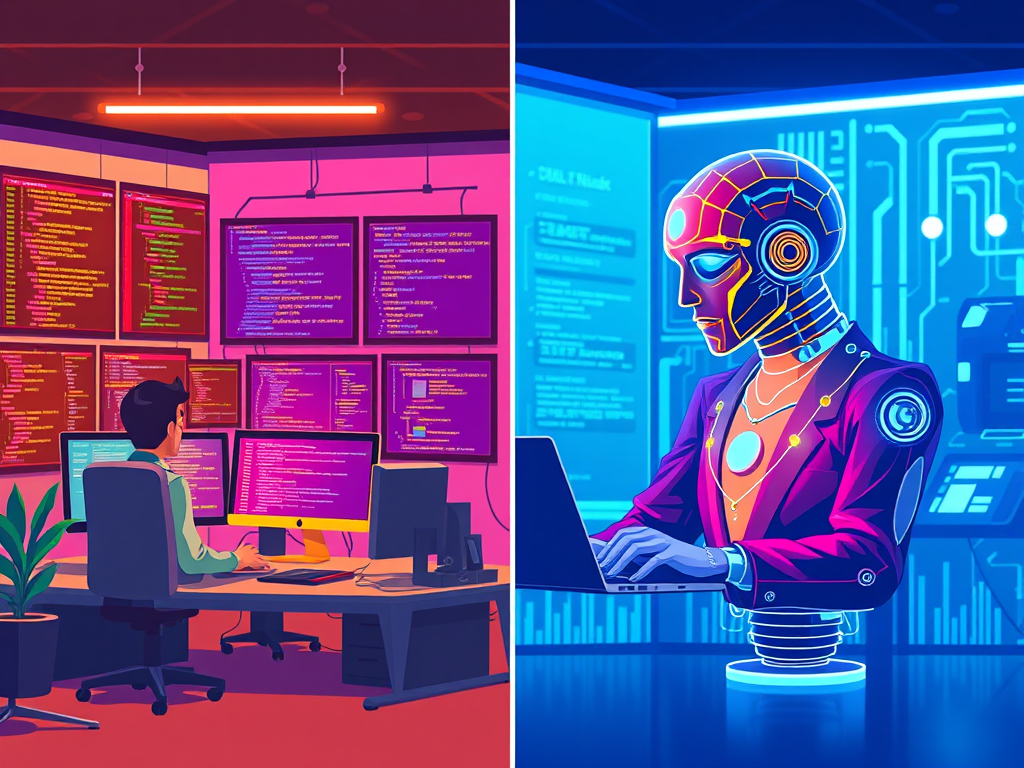
FullStack vs AI Developer – Why This Comparison Matters?
If you’ve been searching for the difference between a FullStack Developer vs an AI Engineer, you’re not alone. In today’s AI-driven tech landscape, companies often hire both roles without understanding where they overlap or diverge.
This guide explores the differences between Full Stack Developers and AI Engineers, providing clear examples, and explains when your business needs one, the other, or both.
What is a FullStack Developer?
A FullStack Developer is a generalist who can work across the software stack:
- Build user interfaces (React, Angular, Vue)
- Develop backend APIs (Node.js, Python, Go)
- Manage databases (SQL, NoSQL)
- Deploy and monitor systems (Docker, CI/CD, AWS, GCP)
Their strength lies in building end-to-end systems — from UI to backend to deployment.
✅ Key mindset: “How do I ship a full product fast, reliably, and securely?”
What is an AI Engineer?
An AI Engineer focuses on developing and integrating AI/ML models:
- Train or fine-tune models (TensorFlow, PyTorch, scikit-learn)
- Deploy models into production (MLOps, REST/gRPC APIs)
- Work with data pipelines (ETL, feature engineering)
- Understand vector search, embeddings, and LLMs
They are data-driven specialists who bring intelligence and automation to software systems.
✅ Key mindset: “How can this product learn from data and get smarter over time?”
FullStack vs AI Developer — Skill Comparison
| Category | FullStack Developer | AI Engineer |
|---|---|---|
| Core Focus | Frontend, Backend, DevOps | Data, Models, Machine Learning |
| Key Tools | React, Node.js, PostgreSQL, Docker | Python, TensorFlow, PyTorch, LangChain |
| Typical Output | Web apps, APIs, Admin Panels | AI services, models, intelligent APIs |
| Deployment | Vercel, ECS, CI/CD | SageMaker, Vertex AI, MLOps tools |
| Business Impact | Build usable products quickly | Add automation, prediction, personalization |
They complement each other — one builds the app, the other makes it smart.
When Do You Need Both FullStack and AI Engineer Roles?
You need both when:
- Your product needs a custom AI workflow, like:
- Chatbot using proprietary documents
- Image/video recognition specific to your business
- AI-assisted content generation with tone/style control
- You’re building a scalable product where both UX and intelligence matter:
- A job-matching platform
- A recommendation engine for e-commerce
- A productivity tool enhanced with AI suggestions
- Your AI Engineer is not full-stack, and your FullStack Developer is not AI-savvy.
🎯 Rule of thumb: If AI is core to the product, you likely need both.
How They Work Together in Real Projects
Example: Internal AI Chatbot
- AI Engineer: Fine-tunes embedding models, manages RAG, builds vector store
- FullStack Dev: Builds frontend UI, connects API, handles access control & deployment
Example: Smart Analytics Dashboard
- AI Engineer: Builds anomaly detection, forecasts, clustering
- FullStack Dev: Renders data, charts, filters, and role-based views
They collaborate via clear interfaces — APIs, events, or microservices.
Want to Transition Between FullStack and AI Developer Roles?
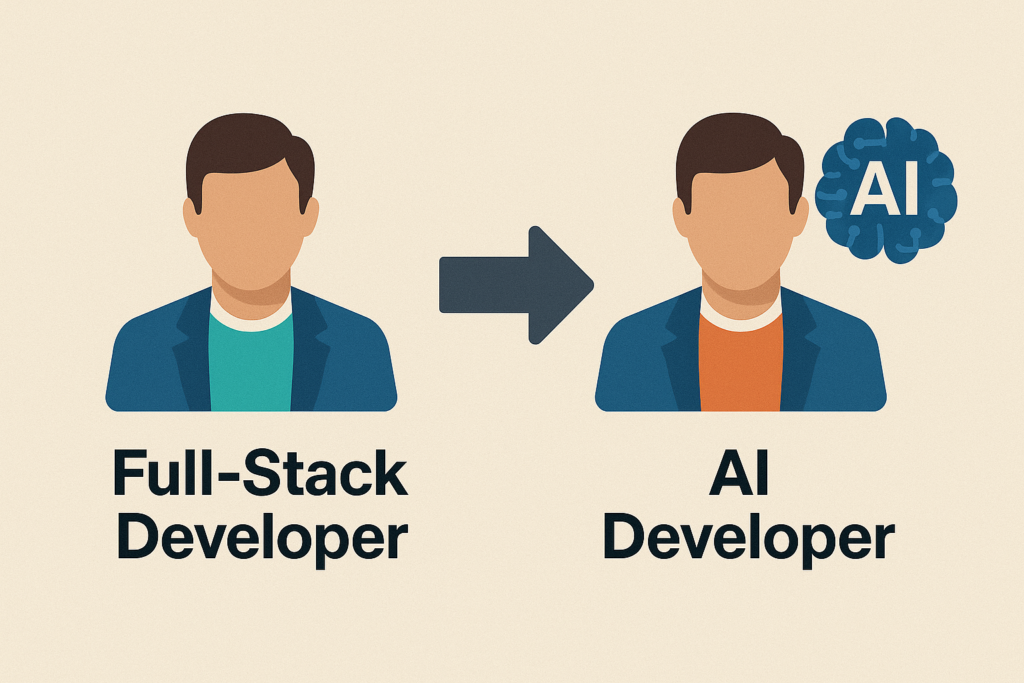
- If you’re a FullStack Developer looking to become an AI Developer:
- Learn Python, NumPy, Pandas, HuggingFace, OpenAI API
- Build side projects: AI summarizer, classifier, chatbot
- If you’re an AI Developer aiming to become a FullStack Developer:
- Learn how to deploy with Docker, CI/CD, build UIs with React
- Learn REST APIs, authentication, and frontend integration
🌱 Bonus: Becoming a hybrid is a huge career advantage in 2025 and beyond.
Summary: Different Goals, Shared Mission
| FullStack Developer | AI Engineer |
| Build complete products | Build smart systems |
| Focus on usability, deployment | Focus on learning, prediction |
| Ship fast and iterate | Experiment and optimize with data |
Together, they bring speed, usability, and intelligence to modern products.
Choose wisely. Or become both.